
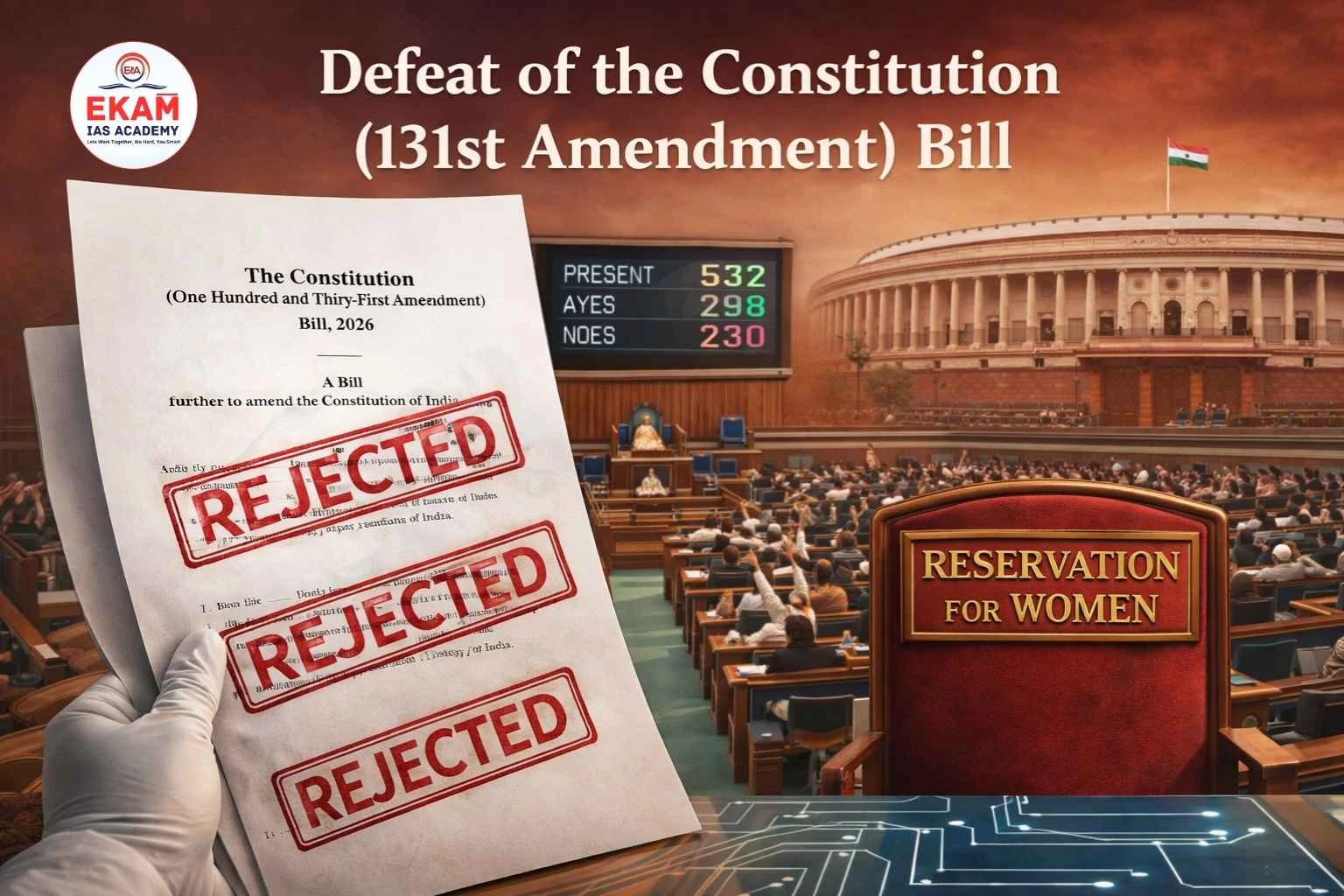
The Constitution (131st Amendment) Bill, 2026 aimed at linking women’s reservation in Parliament with delimitation based on the 2011 Census was defeated in Lok Sabha after failing to secure the required two-thirds majority. This topic is important for aspirants preparing through IAS coaching in Hyderabad, UPSC coaching in Hyderabad, and UPSC online coaching.
Background
• The Bill sought to redistribute Lok Sabha seats using the 2011 Census.
• Objective: ensure time-bound implementation of women’s reservation for the 2029 general election.
• Required two-thirds majority (352 votes) but received only 298 in favour, 230 against.
Such constitutional developments are frequently discussed in Hyderabad IAS coaching and civils coaching in Hyderabad for GS2 polity.
Developments Around the 131st Amendment Bill
Government’s Legislative Package
• The Centre introduced a set of three interconnected legislations:
• The Constitution (131st Amendment) Bill.
• The Union Territories Laws (Amendment) Bill.
• The Delimitation Bill.
• These were designed to work together, linking women’s reservation in Parliament with seat redistribution based on the 2011 Census.
Withdrawal After Defeat
• The Constitution Amendment Bill failed to secure the required two-thirds majority in Lok Sabha.
• Following this defeat, the government withdrew the allied Bills, halting the entire reform package.
Extension of Budget Session
• To allow further deliberation on these contentious legislations, the government extended the Budget Session of Parliament.
• This move reflected the seriousness of the proposals and the need for wider political discussion.
These parliamentary developments are crucial for aspirants attending IAS coaching and UPSC online coaching.
Issues Highlighted
• Population disparity: Freeze since 1971 Census has created unequal constituency sizes.
• Regional concerns: Southern States fear reduced representation.
• Reservation link: Debate over whether SC/ST seat increase should be tied to delimitation.
• Caste count: Allegations that government is sidestepping ongoing caste census.
These analytical dimensions are often covered in UPSC coaching in Hyderabad.
Significance
• Marks the fifth time women’s reservation legislation has been stalled.
• Highlights tension between political consensus and structural reforms in electoral representation.
• Raises debate on balancing demographic realities with federal equity.
Majorities in indian parliament
Simple Majority
- Means more than 50% of members present and voting.
- Used for passing ordinary bills, motions, and confidence votes.
- Example: Passing a Money Bill in Lok Sabha.
Absolute Majority
- Refers to more than 50% of the total membership of the House, regardless of how many are present.
- Rarely used in practice but important in theory.
- Example: Needed for forming a government (majority of total Lok Sabha seats).
Effective Majority
- Means more than 50% of the effective strength of the House (total membership minus vacancies).
- Example: Required for removing the Vice‑President under Article 67(b).
Special Majority (Article 368)
- Required for Constitutional Amendments.
- Different forms exist:
- Special Majority of 2/3rd present and voting + majority of total membership (used for most constitutional amendments).
Special Majority with ratification by half of the States (used for amendments affecting federal provisions like representation of states in Parliament).
Conclusion
The rejection of the Bill shows the difficulty of building consensus on linking women’s reservation with delimitation. It reflects the larger challenge of balancing gender justice, demographic realities, and federal equity in India’s electoral reforms. For aspirants preparing through IAS coaching in Hyderabad, UPSC coaching in Hyderabad, and UPSC online coaching, this topic is highly relevant for GS2 polity.
This topic is available in detail on our main website.