
The Government of India has released the draft Corporate Average Fuel Efficiency (CAFE 3) norms, scheduled for implementation from April 2027. This topic is highly important for aspirants preparing through IAS coaching in Hyderabad, UPSC coaching in Hyderabad, and UPSC online coaching.
CAFE Norms
• Corporate Average Fuel Efficiency (CAFE) norms are regulatory standards that require automobile manufacturers to maintain a prescribed average fuel efficiency and CO₂ emission level across their entire fleet.
• First introduced in 2017 (CAFE 1), tightened under CAFE 2 (2022 onwards), and now moving towards CAFE 3 (2027–2032).
• Purpose: To reduce vehicular fuel consumption, cut greenhouse gas emissions, and promote cleaner mobility technologies.
• Global Context: Similar fleet-wide efficiency standards exist in the US, EU, and Japan, forming part of international climate action strategies.
These environmental policies are frequently discussed in Hyderabad IAS coaching and civils coaching in Hyderabad for GS3 Environment.
Objectives of CAFE Norms
• Reduce fuel consumption by improving vehicle efficiency.
• Lower greenhouse gas emissions, especially CO₂, from the transport sector.
• Decrease dependence on crude oil imports, enhancing energy security.
• Promote innovation in cleaner technologies such as EVs, hybrids, and flex-fuel vehicles.
• Support India’s climate commitments, including the net zero target by 2070.
Such objectives are important topics in IAS coaching and UPSC online coaching.
Features of Draft CAFE 3 Norms
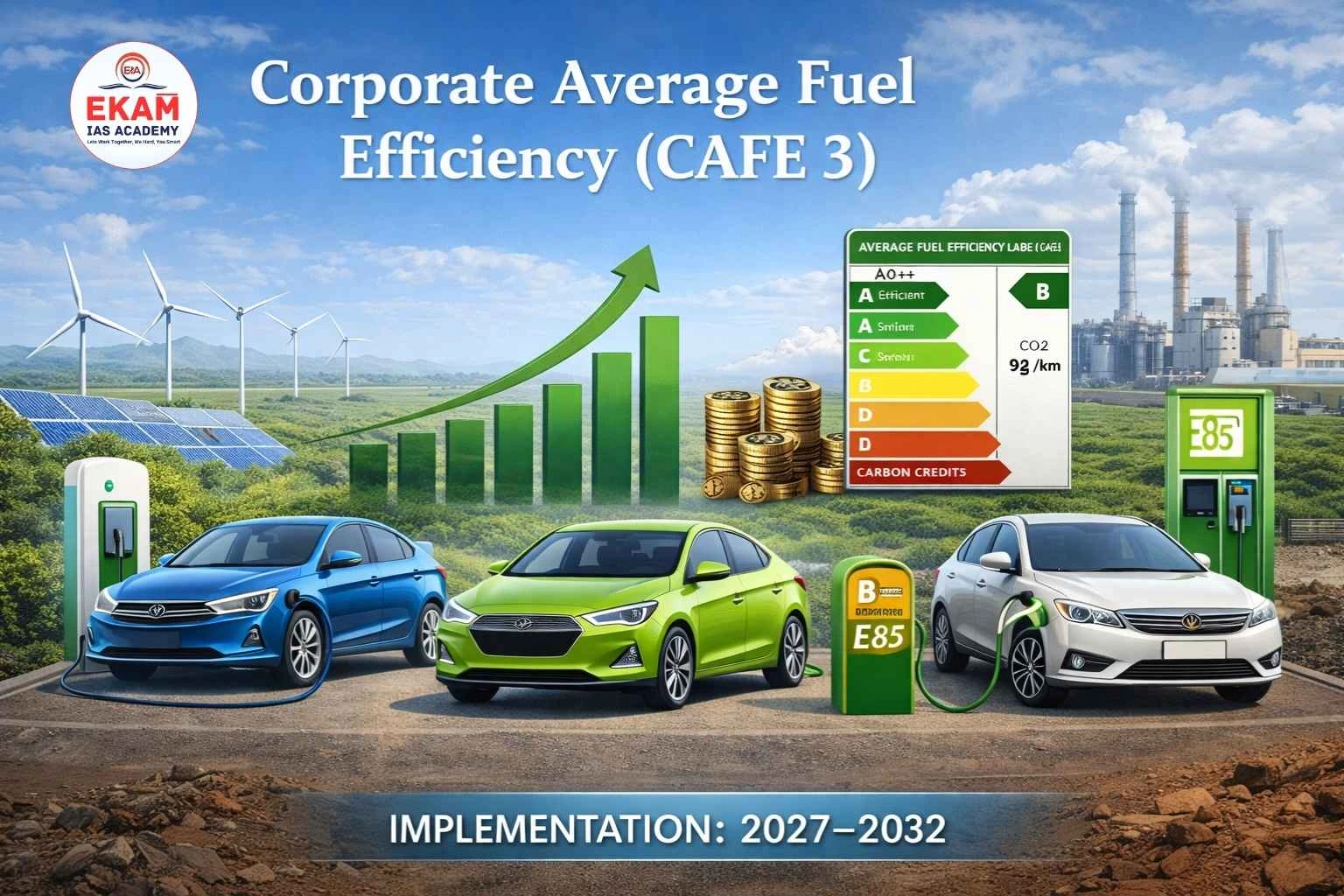
• Flexible Compliance: Shift from a penalty-driven approach to an incentive-based model. Automakers given flexibility in meeting targets, reducing compliance burden.
• Carbon Credit Trading: Companies exceeding emission targets can generate surplus credits. These credits can be sold to manufacturers falling short of targets.
• Offset Mechanism via BEE: Deficits can be offset by purchasing credits from the Bureau of Energy Efficiency (BEE). Ensures lagging manufacturers can still comply.
• Promotion of Clean Technologies: Higher weightage for electric vehicles, hybrids, and flex-fuel vehicles.
• Support for Alternative Fuels: Push for biofuels and ethanol blending. Flex-fuel vehicles promoted to reduce fossil fuel reliance.
These policy mechanisms are often analysed in UPSC coaching in Hyderabad.
Implementation Timeline
• Applicable from FY 2027–28 to FY 2031–32.
• Provides industry a five-year transition window to adapt to new standards.
Significance of Draft CAFE 3 Norms
• Encourages innovation in clean mobility technologies.
• Supports India’s net zero pathway (2070).
• Reduces compliance burden through flexibility and trading mechanisms.
• Promotes market-based environmental regulation instead of rigid penalties.
• Aligns industrial growth with sustainability goals, balancing environment and economy.
These aspects are crucial for GS3 preparation in IAS coaching in Hyderabad and civils coaching in Hyderabad.
Conclusion
The draft CAFE 3 norms combine flexible compliance and carbon trading with progressive emission targets, ensuring that the automobile industry can grow while moving towards cleaner mobility and net zero goals by 2070. For aspirants preparing through IAS coaching in Hyderabad, UPSC coaching in Hyderabad, and UPSC online coaching, this topic is highly relevant for GS3 environment and economy.
This topic is available in detail on our main website.