
NASA’s MAVEN spacecraft recently detected the Zwan Wolf Effect in the Martian ionosphere, marking the first time this phenomenon has been observed in a planetary atmosphere. This topic is important for aspirants preparing through IAS coaching in Hyderabad, UPSC coaching in Hyderabad, and UPSC online coaching.
Zwan Wolf Effect
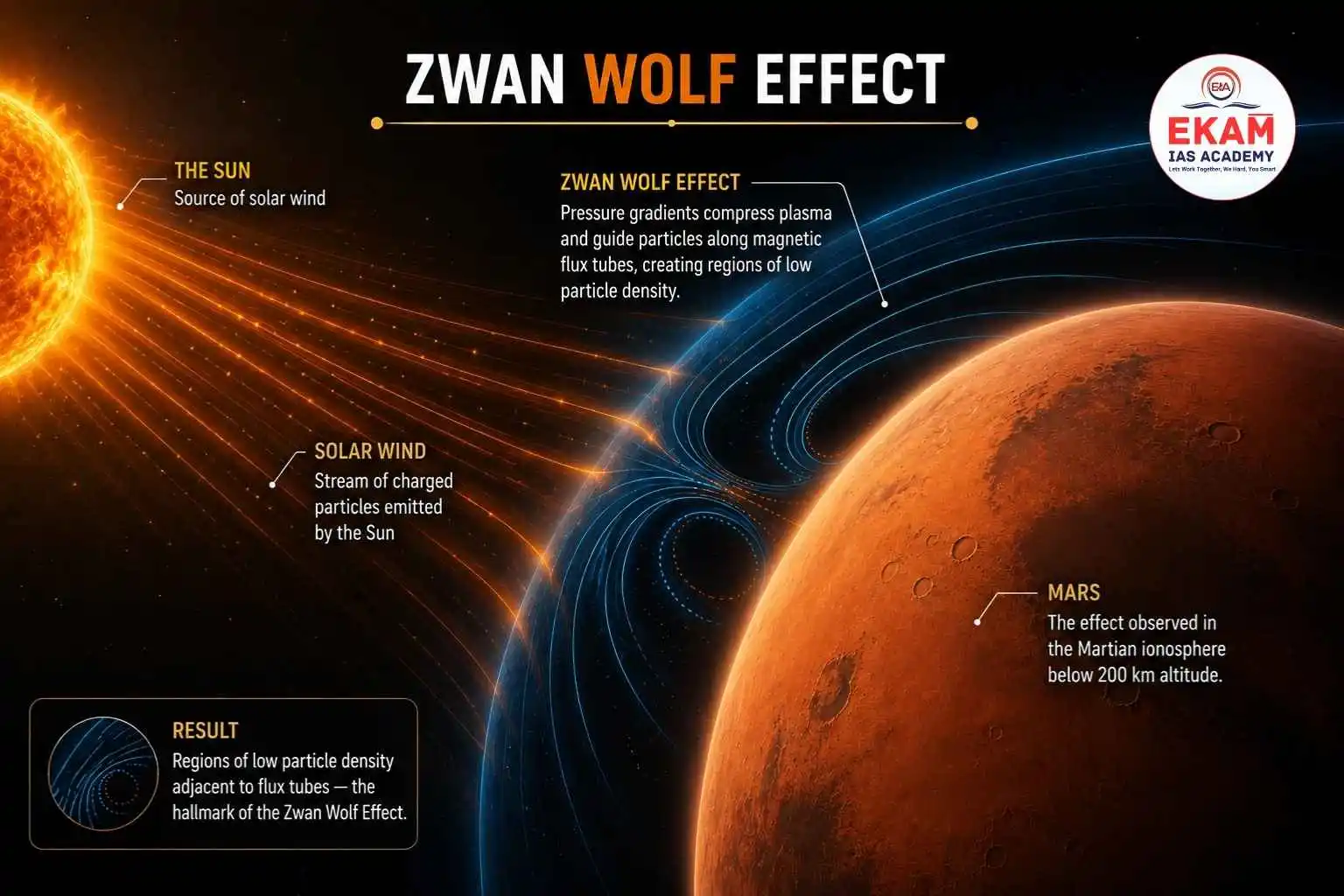
• The Zwan Wolf Effect, discovered in 1976, explains how charged particles are compressed and guided along magnetic flux tubes due to pressure gradients created by solar wind.
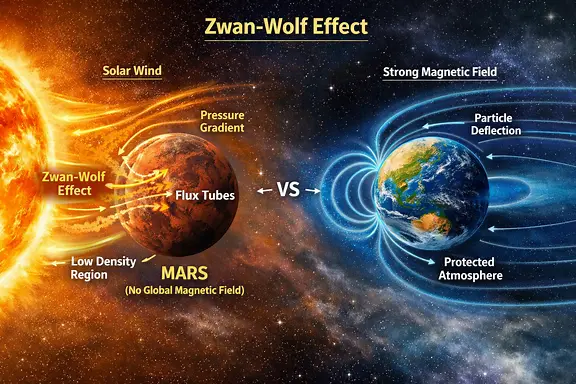
• On Earth, this phenomenon plays a crucial role in deflecting solar wind, thereby shielding the planet’s atmosphere from continuous solar radiation.
• The recent detection of this effect on Mars is remarkable because, despite lacking a global magnetic field, the planet exhibits similar plasma interactions, offering new insights into space weather and atmospheric evolution.
How the Effect Works
• Solar Wind: Stream of charged particles emitted by the Sun.
• As solar wind approaches a planet’s magnetic boundary, it compresses plasma.
• This creates a pressure gradient, forcing particles along magnetic structures.
• The result: regions of low particle density adjacent to flux tubes — the hallmark of the Zwan Wolf Effect.
Significance of the New Findings
• Mars’ Atmosphere: Observed below 200 km altitude in the ionosphere, showing charged particles being redistributed.
• Atmospheric Loss: Supports MAVEN’s earlier finding that Mars lost nearly two-thirds of its early atmosphere to space.
• Comparative Planetology: Demonstrates that even without a global magnetic field, Mars experiences solar wind interactions similar to Earth.
• Space Weather Impact: Helps predict how solar storms affect planetary atmospheres, which is crucial for future human missions to Mars.
MAVEN Mission Highlights
• Launched: 2013; arrived at Mars in 2014.
• First mission dedicated to studying Mars’ upper atmosphere and ionosphere.
• Instruments include:
• Solar wind analyser.
• Ultraviolet spectrometer.
• Mass spectrometer.
• Key finding: Mars’ atmosphere thinned drastically due to solar wind stripping.
Way Forward
• Deeper Research: Study how localised magnetic anomalies on Mars interact with solar wind.
• Comparative Models: Apply findings to exoplanets lacking magnetic fields.
• Human Exploration: Understanding plasma dynamics is vital for shielding astronauts and equipment.
• Global Collaboration: Encourage joint missions by NASA, ESA, ISRO and other space agencies to expand knowledge of planetary atmospheres.
Conclusion
The Zwan Wolf Effect on Mars reveals how solar wind shapes planetary atmospheres. It strengthens our understanding of space weather, atmospheric loss, and planetary habitability. For aspirants preparing through IAS coaching and civils coaching in Hyderabad, this topic is highly relevant for GS3 Science and Technology, space missions, and planetary science.
This topic is available in detail on our main website.