
A recent plea seeking the Attorney General’s consent to initiate criminal contempt proceedings against the Chief Election Commissioner has highlighted the statutory role of the Attorney General of India in contempt matters.
Constitutional Position
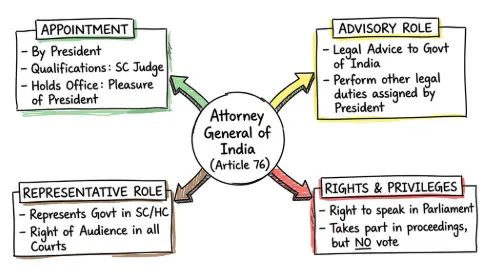
- Article 76 establishes the office of the Attorney General of India (AGI), the Union Government’s highest law officer. This forms the Attorney General of India Constitutional Position under the Constitution.
- The President appoints a person qualified to be a Supreme Court judge as the Attorney General of India.
- The AGI must be an Indian citizen and should have been a High Court judge for 5 years, an advocate for 10 years, or be a distinguished jurist in the President’s opinion. These constitute the Attorney General Qualifications India.
- The AGI holds office during the pleasure of the President; the Constitution provides no fixed tenure or specific removal procedure. This explains the Attorney General Term of Office.
Functions and Duties
- Provides legal advice to the Government of India as part of the Attorney General Powers and Functions.
- Performs legal duties assigned by the President.
- Represents the Union Government before courts, particularly the Supreme Court.
- Has the right to appear in all courts in India.
- These responsibilities form the core of the Attorney General Duties India and distinguish the office within the Law Officers of India.
Parliamentary Rights
- The AGI can speak and participate in proceedings of both Houses of Parliament, joint sittings and parliamentary committees of which they are a member.
- However, the AGI cannot vote in Parliament.
- They enjoy parliamentary privileges and immunities applicable to Members of Parliament.
- The Attorney General Right to Speak in Parliament is therefore accompanied by participation rights without voting rights.
Contempt-Related Role
- Under Section 15 of the Contempt of Courts Act, 1971, the Attorney General’s consent is required when a private person seeks to initiate criminal contempt proceedings in the Supreme Court.
- This acts as a procedural safeguard against frivolous contempt litigation.
Conclusion
The Attorney General of India combines constitutional, advisory, courtroom and parliamentary functions, making the office central to the Union Government’s legal affairs. Understanding Attorney General of India Article 76, Attorney General of India UPSC, and the distinction between the Attorney General vs Solicitor General is important for Indian Polity UPSC preparation.