
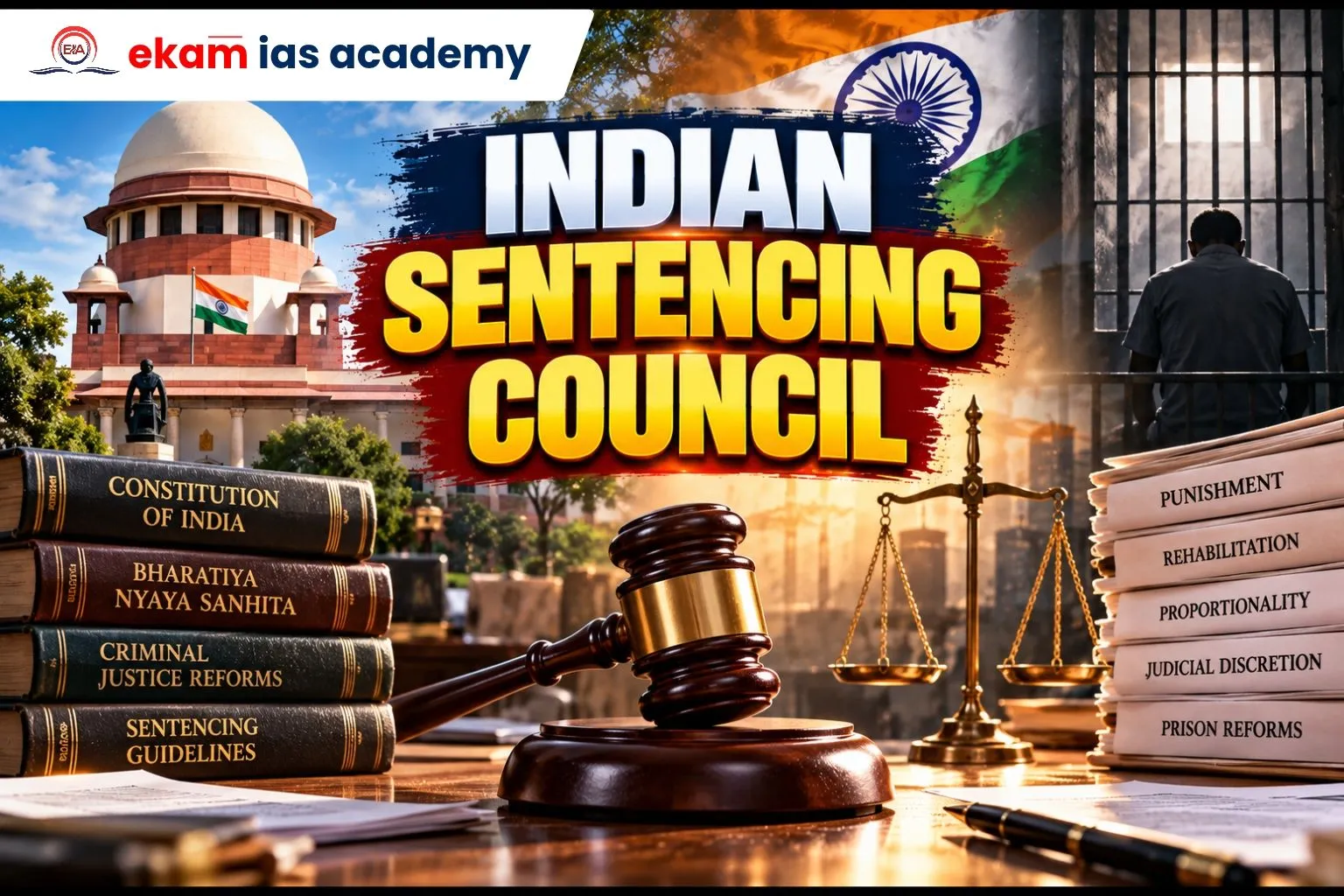
Growing concerns over unequal punishments for similar offences have renewed demands for a National Sentencing Policy and an Indian Sentencing Council, making sentencing reform an important issue in Indian Judiciary Reforms and the Criminal Justice System in India.
What is Sentencing Reform?
- Sentencing is the judicial process of deciding punishment after a person is convicted.
- Indian criminal laws generally prescribe minimum or maximum punishments, leaving considerable Judicial Discretion in Sentencing.
- A Sentencing Council would develop Sentencing Guidelines in India to promote consistency while allowing courts to consider individual circumstances.
- India currently has no statutory national Sentencing Council. The proposal for an Indian Sentencing Council UPSC framework seeks to strengthen consistency and fairness in sentencing.
Why Does India Need Sentencing Reform?
- Unequal punishment: Similar offences may attract significantly different sentences.
- Unstructured discretion: No uniform framework exists for weighing aggravating and mitigating circumstances, highlighting the need for a Uniform Sentencing Policy India.
- Irrelevant considerations: Social stereotypes may sometimes influence punishment decisions.
- Judicial burden: Higher courts frequently review sentencing inconsistencies.
- Prison overcrowding: Excessive imprisonment can increase pressure on correctional institutions, linking sentencing reform with Prison Reforms in India.
- These concerns form an important part of Sentencing Reforms in India and broader Criminal Justice Reforms UPSC discussions.
Constitutional and Legal Framework
- Article 14: Guarantees equality before the law and protection against arbitrariness.
- Article 21: Protects personal liberty through fair, just and reasonable legal procedures.
- BNSS, 2023 — Section 258(2): Requires a Sessions Judge to hear the convicted person on the question of sentence.
- BNSS Sections 401–402: Provide for probation-related relief and recording reasons in specified situations.
- Probation of Offenders Act, 1958: Permits eligible offenders to receive supervised opportunities for reform instead of imprisonment.
- The framework is relevant to Bharatiya Nyaya Sanhita Sentencing, Proportionality in Criminal Punishment and broader Law and Justice in India reforms.
Important Judicial Principles
- Soman v. State of Kerala (2012): Highlighted the need to balance deterrence, proportionality and rehabilitation.
- Bachan Singh v. State of Punjab (1980): Established the “rarest of rare” doctrine for awarding the death penalty.
- Sentencing must consider both the seriousness of the offence and the individual circumstances of the offender, reinforcing the principle of proportionality.
International Example: England and Wales
- The Sentencing Council, established under the Coroners and Justice Act, 2009, issues structured guidelines.
- Judges examine harm caused, offender culpability and aggravating or mitigating factors.
- Indicative sentencing ranges improve consistency without completely removing judicial discretion.
Proposed Indian Sentencing Council
- Standardised guidelines: Establish offence-specific sentencing ranges within existing laws.
- Evidence-based decisions: Consider violence, planning, victim vulnerability and actual harm.
- National database: Use anonymised sentencing information to identify disparities.
- Reasoned departures: Require judges to explain significant deviations from guidelines.
- Institutional independence: Include judicial, legal, criminological and correctional expertise.
Challenges and Way Forward
- Avoid mechanical sentencing, excessive punishment and political pressure.
- Respect India’s federal structure and differences in prison capacity.
- Promote judicial training, restorative justice and rehabilitation.
- Ensure guidelines remain transparent, regularly reviewed and open to public consultation.
- Such reforms should strengthen Judicial Reforms in India without undermining judicial independence.
Conclusion
India needs a fair and evidence-based sentencing framework that makes punishment consistent, proportionate and humane without weakening judicial independence. The Indian Sentencing Council, Indian Sentencing Council UPSC, Uniform Sentencing Policy India, Criminal Justice System in India, Indian Judiciary Reforms, Criminal Justice Reforms UPSC and Indian Polity and Governance UPSC perspectives highlight the need for a balanced and accountable sentencing framework.