
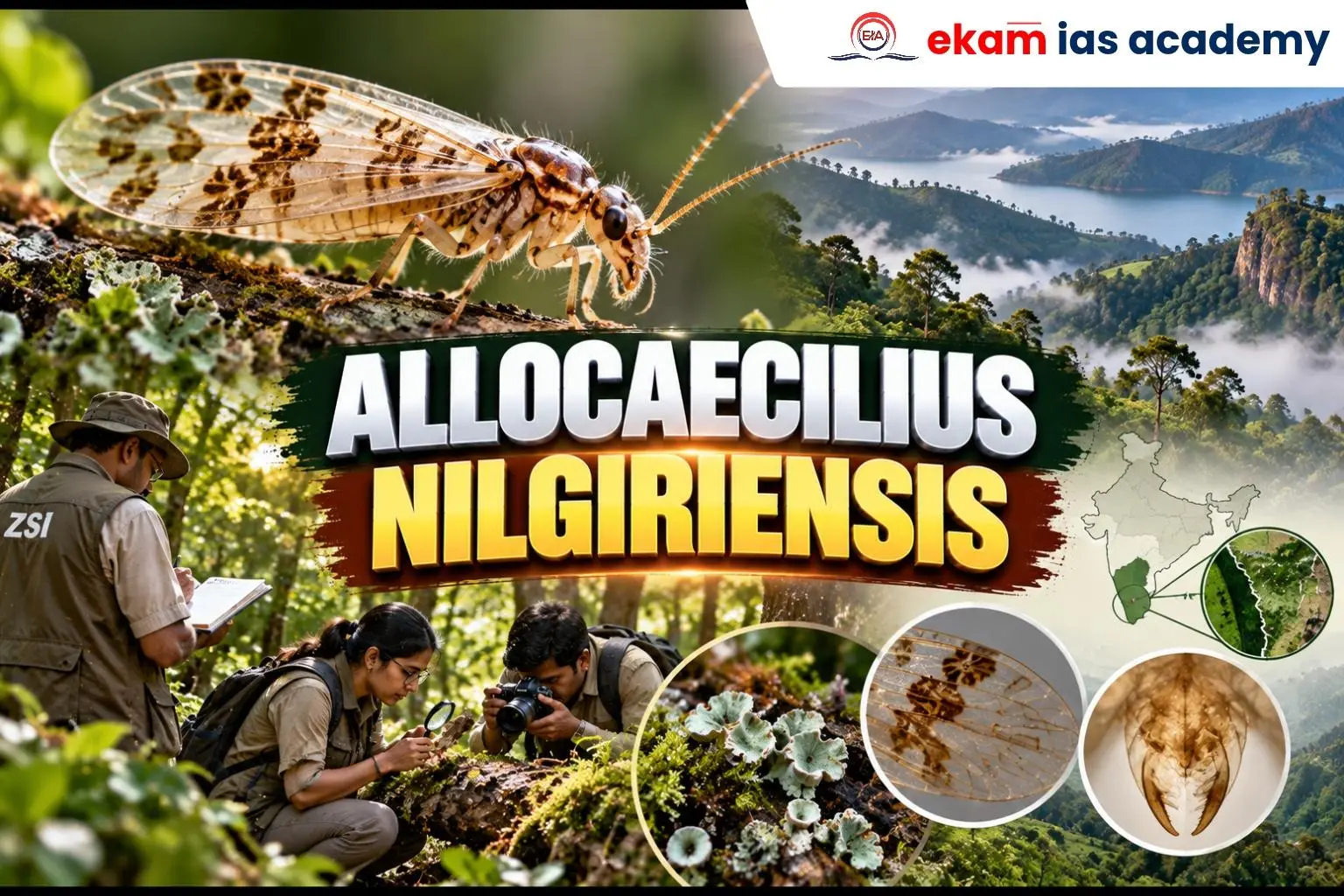
Scientists from the Zoological Survey of India (ZSI) have discovered a new insect species in India, Allocaecilius nilgiriensis, in the Nilgiri Hills, highlighting the rich Nilgiri Hills Biodiversity and ongoing Insect Species Discovery in the Western Ghats.
About Allocaecilius nilgiriensis
- Classification: A newly identified species of barklouse, a small insect, representing an important finding in Taxonomy and Species Discovery.
- Discovery location: Nilgiri Hills, Southern Western Ghats, an important region of Western Ghats Biodiversity.
- Distribution: Moist forest habitats of Tamil Nadu and Kerala.
- Habitat: Shaded shola forests and tropical evergreen forests.
- It represents only the second recorded species of the genus Allocaecilius in India.
- Its discovery brings the reported global total of this genus to 13 species and adds to knowledge of Insect Diversity in India and Biodiversity Conservation in India.
- The species is relevant to Allocaecilius nilgiriensis UPSC preparation and India’s broader biodiversity studies.

Important Characteristics
- Appearance: Distinctive brown markings near the tips of the forewings.
- Male anatomy: Specialised thumb-like structures on the hypandrium.
- Female anatomy: A deeply indented subgenital plate.
- These characteristics help scientists distinguish the species from related insects and contribute to Taxonomy and Species Discovery.
Ecological Importance
- Natural decomposers: Barklice feed on fungi, algae, lichens and dead organic material.
- Nutrient cycling: Their feeding activities support forest ecosystem processes.
- Biodiversity indicators: Their presence reflects specialised forest microhabitats and contributes to understanding Endemic Species of Western Ghats and Nilgiri Biosphere Reserve ecosystems.
- Scientific value: New discoveries improve understanding of insect diversity and evolution, strengthening knowledge of Indian Biodiversity Current Affairs, Biodiversity UPSC and Environment and Ecology UPSC.