


Government is now considering two key legislative amendments to the Civil Liability for Nuclear Damage Act (CLNDA), 2010, and the Atomic Energy Act, 1962 to attract private investment, foreign technology, and expand nuclear power capacity.
Why in the News
- The government is preparing to Modify CLNDA, 2010 to ease strict supplier liability norms.
- Amend the Atomic Energy Act, 1962 to allow private sector participation, particularly in Small Modular Reactors (SMRs).
- This would mark the first-ever structured private entry into India’s nuclear power generation sector.
Civil Liability for Nuclear Damage Act, 2010 (CLNDA)
- Issue: Supplier liability under Section 17(b) has deterred global nuclear firms.
- Likely Change: Redefining or limiting supplier liability to encourage foreign and private investments.
- Expected Outcome: Partnerships with companies like Westinghouse (US), GE-Hitachi, and Framatome (France), enabling faster and cost-effective nuclear expansion.
Atomic Energy Act, 1962
- Current Provision: Only the government can build and run nuclear plants.
- Likely Amendment: Allowing private firms to co-invest and develop SMRs.
- Impact: Creates a hybrid public-private nuclear ecosystem to accelerate capacity addition.
Small Modular Reactors (SMRs)
- Compact, factory-built reactors that are transportable and quicker to deploy.
- Advantages:
- Scalable and suitable for decentralized grids
- Safer, smaller footprint, faster installation
- Compatible with renewable energy systems
- Current Interest: NPCIL developing an indigenous SMR design, with private interest from Reliance, Adani, and Tata Power.
Challenges in India’s Nuclear Sector
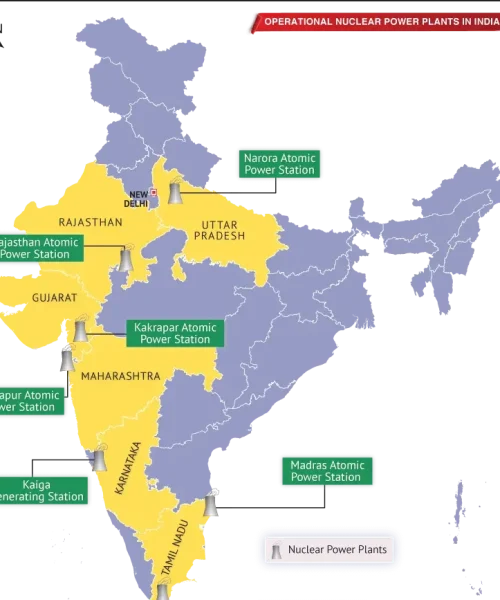
- State Monopoly: NPCIL is currently the sole operator.
- Liability Concerns: Section 17(b) of CLNDA discourages foreign suppliers.
- Base-load Requirement: Renewable energy intermittency requires reliable nuclear backup.
- Need for New Technology: Modern reactors and SMRs offer scalability and lower environmental impact.
Why Private and Foreign Entry Matters
- Capital infusion reduces financial burden on the government.
- Access to advanced reactor designs and global expertise.
- Supports India’s Net Zero 2070 targets through low-carbon power.
- Enhances energy security and grid reliability.
Conclusion
These proposed reforms represent a historic shift in India’s nuclear policy. By combining public oversight with private innovation and global partnerships, India can expand nuclear power capacity, reduce carbon emissions, and strengthen its long-term energy security while supporting the transition to a sustainable and reliable power system.
This topic is available in detail on our main website.