
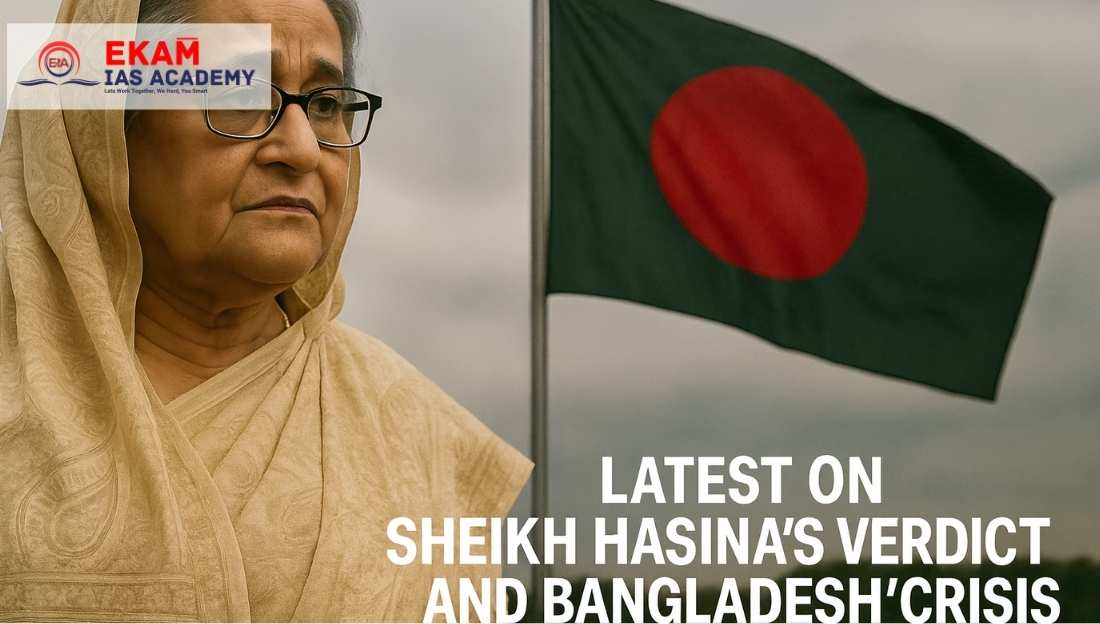
Former Prime Minister Sheikh Hasina was sentenced to death in absentia by Bangladesh’s International Crimes Tribunal (ICT) for crimes against humanity tied to a violent crackdown on student-led protests in 2024.
Background & Legal Framework
- The ICT in Bangladesh was originally established in 2009 to try war-crimes from the 1971 Liberation War.
- After mass student protests in July-August 2024 against quota issues in public service recruitment, a crackdown reportedly caused up to 1,400 deaths.
- Hasina fled to India in August 2024 as her government collapsed and later faced charges of ordering killings, authorising use of drones/helicopters and failing to prevent violence.

The Verdict & Immediate Outcomes
- On 17 November 2025, the ICT found Sheikh Hasina guilty of crimes against humanity and sentenced her to death.
- Bangladesh’s interim government issued an extradition request to India following the verdict.
- Hasina and her party (the Awami League) claim the trial was politically motivated and biased.
India’s Role & Regional Dimensions
- India’s Ministry of External Affairs (MEA) stated it “noted” the verdict and emphasised support for Bangladesh’s people (not explicitly the government) — a calibrated approach.
- India continues to provide refuge to Hasina and has not yielded to extradition requests, citing concerns about fairness and political nature of charges.
- The situation affects India-Bangladesh relations, stability in Bengal region, and democratic norms in South Asia.
Challenges & Risks Ahead
- The trial’s legitimacy is questioned by international rights groups over fairness, due process and use of death penalty in absentia.
- The ban on Awami League and exclusion of major parties may affect the credibility of the 2026 elections and Bangladesh’s democratic fabric.
- A leadership vacuum in major parties could lead to political instability, social unrest and governance void.
Challenges & Risks Ahead
- The trial’s legitimacy is questioned by international rights groups over fairness, due process and use of death penalty in absentia.
- The ban on Awami League and exclusion of major parties may affect the credibility of the 2026 elections and Bangladesh’s democratic fabric.
- A leadership vacuum in major parties could lead to political instability, social unrest and governance void.
Conclusion
The sentencing of Sheikh Hasina marks a turning point in Bangladesh’s politics, signalling accountability but also triggering serious questions about rule-of-law, separation of powers and democratic legitimacy. For India and the region, the outcome underscores the importance of inclusive politics, transparent institutions and safeguarding democratic norms.
This topic is available in detail on our main website.