

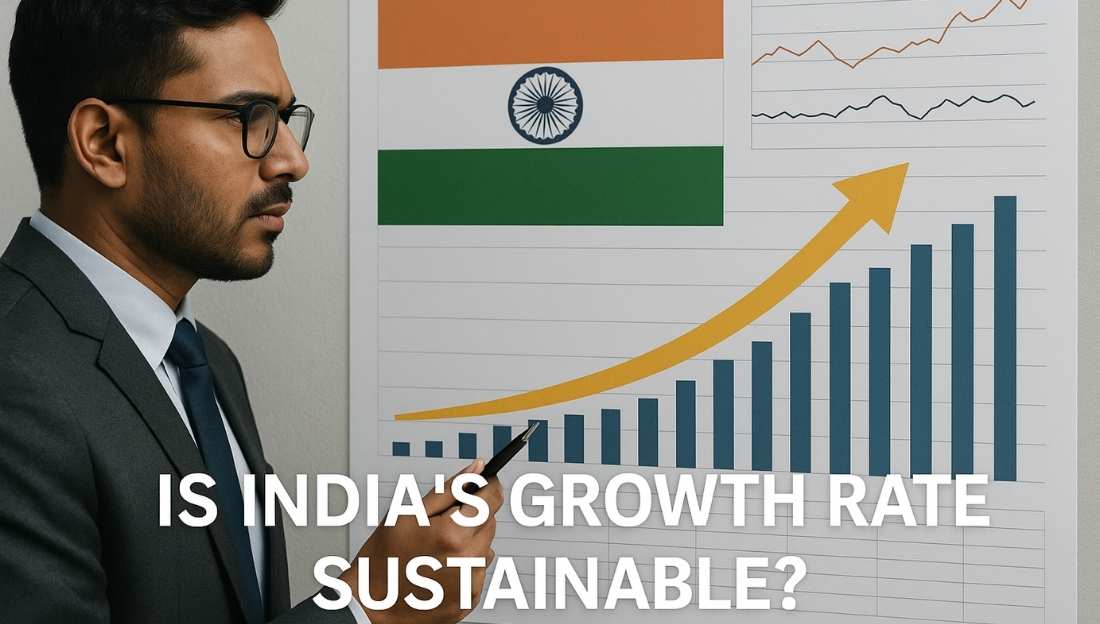
India recorded 8.2% GDP growth in 2024–25, reflecting strong economic momentum, but the IMF assigned a ‘Grade C’, citing structural weaknesses in data and institutional capacity. This raises questions about the long-term sustainability of growth.
Current Growth Scenario
- Overall GDP & Sectoral Growth: GDP expanded 8.2%, with manufacturing 9.1% and services 9.2% (financial services 10.2%). GVA rose from ₹82.88 to ₹89.41 lakh crore, showing real value addition.
- Consumption & Agriculture: PFCE up 7.9%, households spending more; agriculture grew 3.5%, aided by better irrigation and horticulture output.
- Price Stability & Banking: Inflation remained moderate (nominal GDP +8.8%). Banks maintained strong balance sheets and capital buffers.
- Fiscal & External Position: Government continued fiscal consolidation via GST/direct taxes; external sector stable, CAD low, forex reserves adequate.

IMF’s Assessment (‘Grade C’)
- Data Gaps: Outdated base year (2011–12), lack of Producer Price Indices, single deflation issues, and informal sector coverage weak.
- Statistical Limitations: Gaps between production- and expenditure-based GDP, no consolidated state/local data since 2019, and absence of seasonal adjustments.
- Key Message: High growth numbers exist, but the institutional and data framework supporting them is weak.
Structural Vulnerabilities
- Uneven Sectoral Growth: Mining (0.04%) and utilities (4.4%) remain sluggish, showing backbone sectors are weak, while services dominate output but create fewer high-productivity jobs.
- Employment & Productivity Mismatch: Too many workers in low-productivity agriculture and informal services.
- External Risks: Exports vulnerable to global protectionism, tariffs, and geopolitical tensions; services and remittances cannot fully offset weak goods exports.
- State-Level Weaknesses: Poor institutional capacity at state and local levels affects policy delivery and economic governance.
Contradictions in the Growth Story
- High GDP growth masks structural weaknesses: uneven sectoral recovery, low industrial productivity, and job creation challenges.
- Economic momentum is strong, but underlying institutions and governance frameworks are yet to fully support sustained high-quality growth.
WHAT IS GDP GROWTH RATE?
GDP growth rate measures how fast a country’s economy is growing over a period, usually a year or a quarter. It shows the percentage increase in the value of all goods and services produced (GDP) compared to the previous period.
Importance of GDP Growth Rate
- Economic Health: Shows whether the economy is expanding or contracting, helping policymakers make decisions.
- Investment & Jobs: Higher growth attracts investments, creates employment, and improves income levels.
- Policy Planning: Helps governments and central banks plan budgets, taxes, and interest rates for stable economic growth.
Conclusion
With missions like Astrosat and XPoSat, India is steadily building capacity in space-based astronomy. Understanding nebulas and telescopes is crucial for UPSC aspirants, linking current affairs with science and technology.
This topic is available in detail on our main website.