
Nearly 10 million Sudanese have been forced to flee due to the ongoing civil war. Fresh clashes in Kordofan and Darfur have intensified civilian killings, famine, and economic collapse.
Root Cause of the Conflict
- Power Struggle: A clash for authority between SAF (Gen. al-Burhan) and RSF (Hemedti) after years of uneasy cooperation.
- Post-Revolution Fallout: Both factions helped remove Omar al-Bashir (2019) and jointly executed the 2021 coup, but diverged over military integration plans.
- Control of Resources: Each group seeks to retain control over wealth networks, armed power, and political influence.
- Failed Security Reform: Disagreement over merging RSF into the national army triggered the full-scale conflict in April 2023.
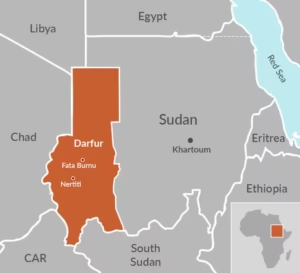
Territorial Division in Sudan
- SAF-Dominated Areas: Holds central and eastern Sudan, including Port Sudan and parts of Khartoum.
- RSF-Controlled Zones: Dominates Darfur and significant parts of Kordofan.
- Parallel Governance: RSF’s expanding territory enables it to run a de facto administration in western regions.
- Fragmented State: The country is now effectively split into rival military zones, weakening national governance.
Recent Escalation of Violence
- Kordofan Attacks: RSF air-drone strikes in Kalogi destroyed a kindergarten, hospital, and hit rescue groups, killing many children.
- Fall of El Fasher: After an 18-month siege, the last major SAF stronghold in North Darfur collapsed, shifting the war’s momentum.
- Rising Civilian Targeting: ACLED data shows ~400 attacks on civilians, with 55% recorded in 2025 alone.
- High Casualties: Over 1,400 people killed in Darfur-Kordofan region during these intensified clashes.
Deepening Humanitarian Crisis
- Large-Scale Deaths: More than 50,000 civilians have died since the conflict began.
- Mass Displacement: About 9.8 million people displaced (Sept 2025), now the fastest-growing displacement crisis globally.
- Collapsed Public Services: Conflict has destroyed healthcare, schooling, and basic administrative functions.
- Civilian Trapped Zones: Siege tactics have blocked food, medicine, and safe movement in several cities.
Conclusion
The Sudan conflict has evolved into a severe humanitarian catastrophe marked by mass displacement, famine, and economic collapse. Without urgent international mediation and sustained humanitarian access, Sudan risks long-term fragmentation and a deepening regional crisis.
This topic is available in detail on our main website.