
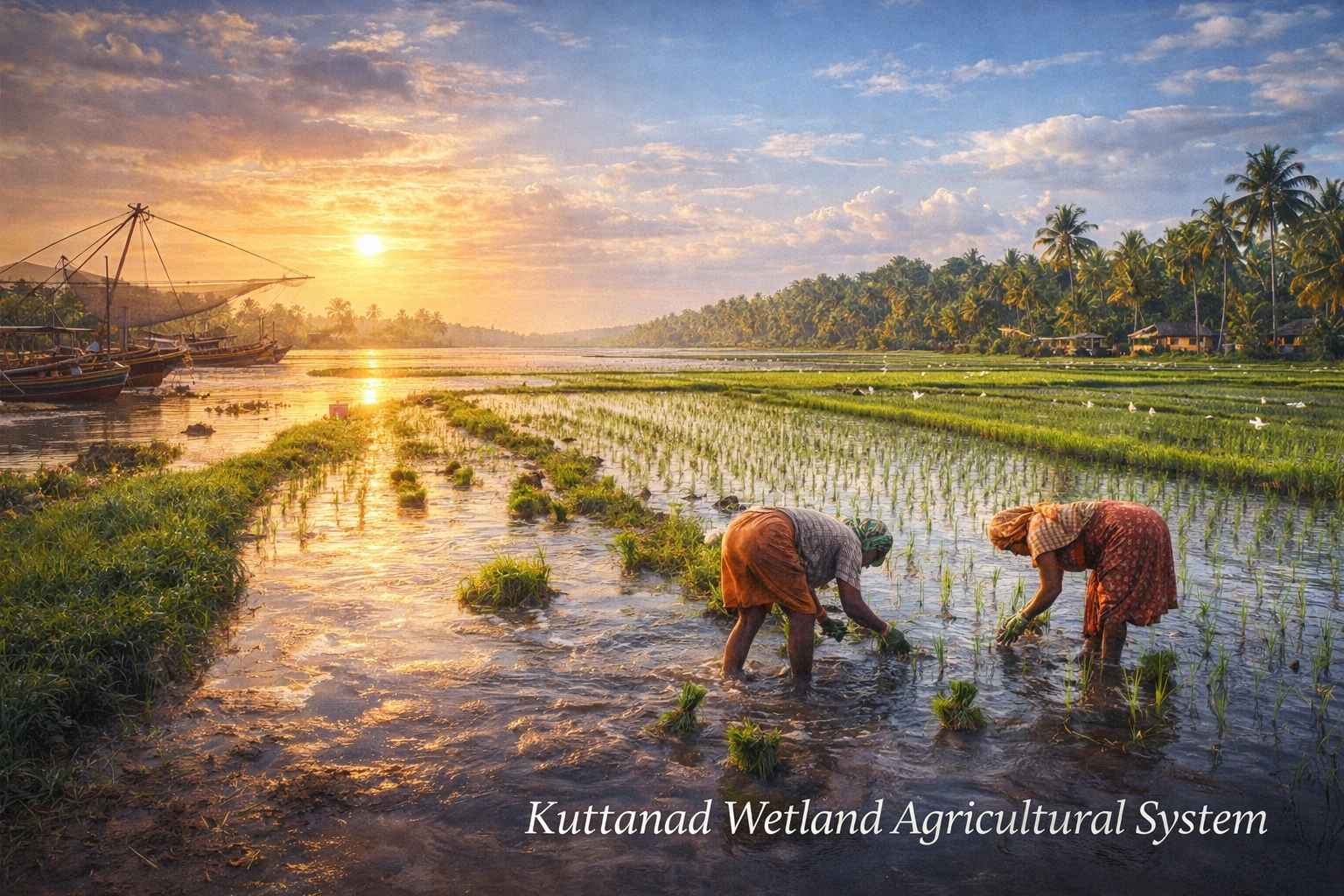
Recent soil testing in the Kuttanad paddy fields of Kerala has revealed rising aluminium levels, raising serious concerns about soil health and crop productivity in this globally recognised agricultural heritage system. Such environment–agriculture linkages are frequently analysed in GS Paper III by aspirants preparing through UPSC coaching in Hyderabad.
About Kuttanad Wetland Agricultural System
- Kuttanad is the only region in India where rice is cultivated below sea level.
- The system is a mosaic of three distinct landscapes:
- Wetlands used for paddy cultivation and fishing.
- Garden lands for coconut, tubers, and food crops.
- Water bodies for inland fishing and shell collection.
- It represents a traditional, community-managed farming practice adapted to wetland ecology.
Recognition
- The Kuttanad Below Sea-level Farming System is recognised as part of the Globally Important Agricultural Heritage Systems (GIAHS) by the Food and Agriculture Organization (FAO).
- This recognition highlights its cultural, ecological, and economic significance, making it a standard case study in agriculture and geography modules at Hyderabad IAS coaching.

Impact of Aluminium on Soil and Crops
- Aluminium becomes toxic when soil pH falls below 5.
- Excess aluminium damages plant roots, reducing their ability to absorb essential nutrients like phosphorus, calcium, potassium, and magnesium.
- This leads to poor crop growth and declining yields, threatening food security in the region.
About Globally Important Agricultural Heritage Systems (GIAHS)
- Launched by FAO in 2002 at the World Summit for Sustainable Development.
- Aims to balance conservation, sustainable adaptation, and socio-economic development.
- India’s recognised GIAHS sites include:
- Koraput region (Odisha): Known for subsistence paddy farming on highland slopes.
- Kuttanad system (Kerala): Unique below-sea-level rice cultivation.
- Saffron Park (Kashmir): Traditional saffron-based agro-pastoral system.
Conclusion
The rising aluminium concentration in Kuttanad soils presents a serious challenge to one of the world’s most distinctive agricultural heritage systems. Protecting soil health through scientific management and sustainable practices is essential to preserve this landscape, safeguard livelihoods, and ensure long-term food security. This issue exemplifies the intersection of environment, agriculture, and sustainability—core themes for aspirants preparing through UPSC online coaching.
This topic is available in detail on our main website.