
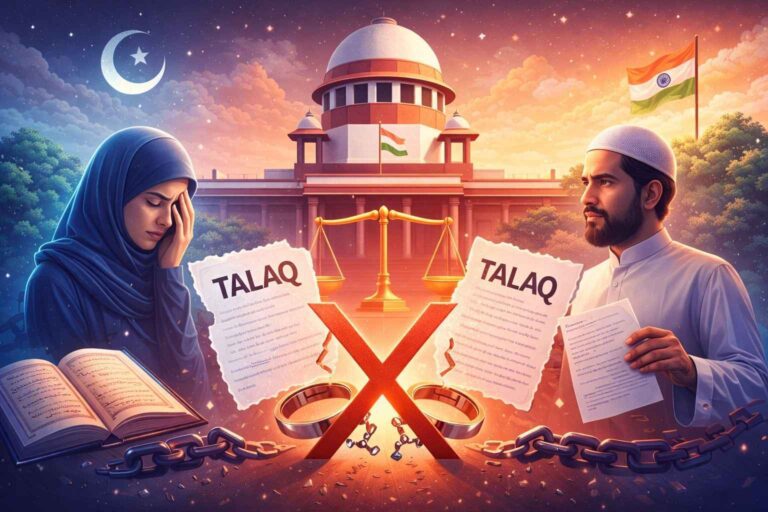
On November 19, 2025, the Supreme Court of India, in Benazeer Heena vs Union of India, questioned the practice of advocates issuing divorce notices on behalf of husbands, observing that such conduct is inconsistent with a civilised society and constitutional values. The judgment has reopened the debate on the validity of unilateral talaq practices, a key issue in GS Paper II (Polity & Governance) often discussed by aspirants preparing through UPSC coaching in Hyderabad.
Marriage as a Contract of Equals
- In Islam, marriage is seen as a solemn contract (uqdatannikah, meesaaqan ghaleean) between two consenting adults.
- The Quran does not give men superior authority to dissolve marriage unilaterally.
- A unilateral divorce violates the principle of natural justice (no one can be judge in their own case).
- Equality between spouses is central, making unilateral talaq practices unjust and discriminatory.
Quranic Procedure for Divorce
- The Quran prescribes a stepbystep conciliatory process before divorce:
- Private resolution of disputes.
- Temporary separation to reduce conflict.
- Clear communication to highlight seriousness of the issue.
- Family arbitration with representatives from both sides.
- Only after these steps fail can talaq be pronounced.
- Iddah period: Three menstrual cycles (or three months for postmenopausal women, until childbirth for pregnant women).
- During iddah, reconciliation is encouraged; divorce becomes final only after the third talaq, declared before two witnesses.
- The Quran allows reunion after iddah if both spouses agree on equitable terms.
Unilateral Talaq Practices and Their Issues
- Practices like talaqebid‘a, talaqehasan, talaqeahsan, talaqetafweed are not supported by the Quran or hadith.
- These originated from juristic traditions influenced by patriarchy, undermining women’s autonomy.
- Allowing divorce through agents (vakeel) under tawkeel (agency) has no Quranic basis and demeans women’s dignity.
Constitutional and Ethical Concerns
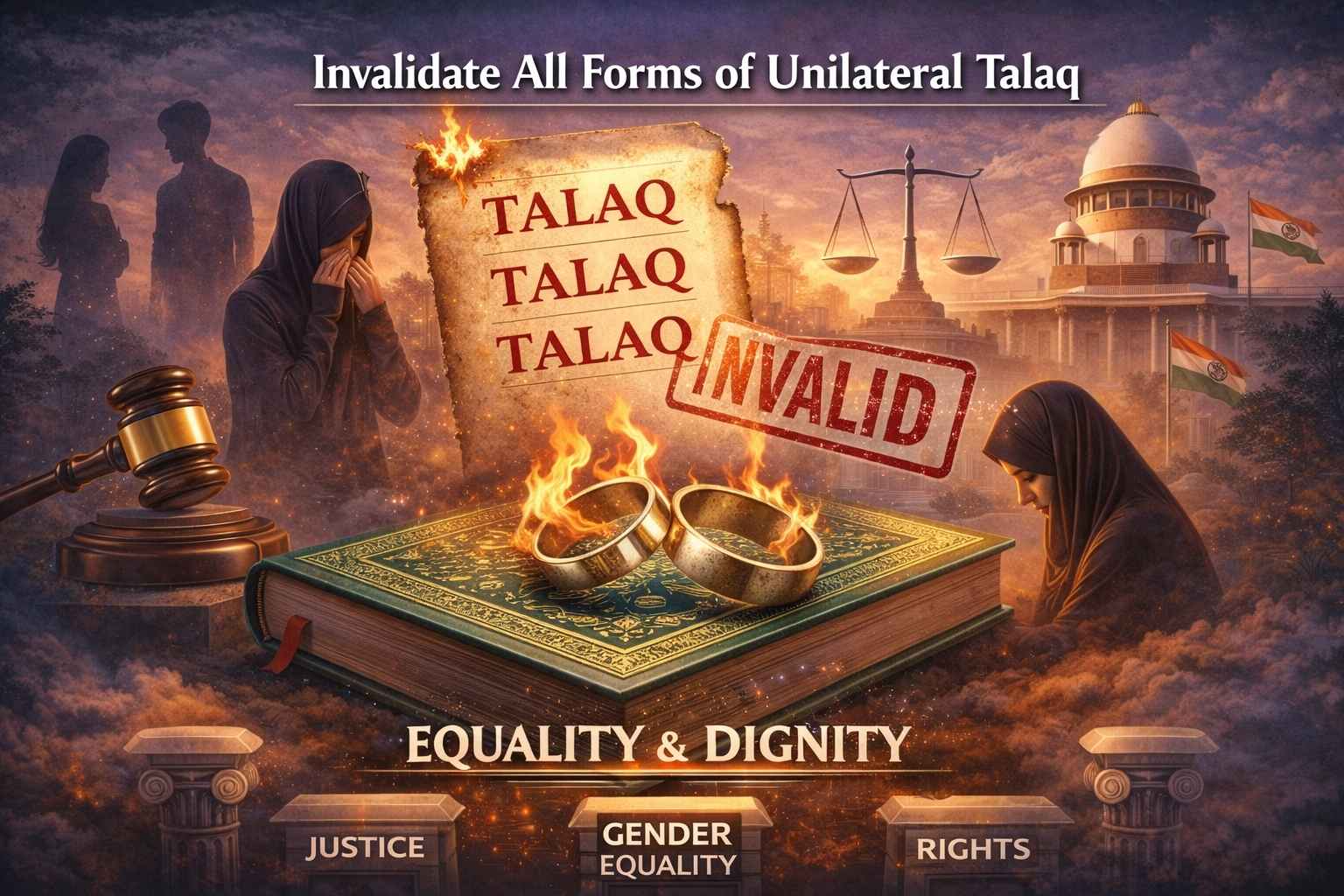
- Unilateral talaq violates gender equality and the right to dignity under Article 21.
- It conflicts with the constitutional vision of justice, equality, and non-discrimination.
- In Shayara Bano vs Union of India (2017), the Supreme Court invalidated instant triple talaq (talaq-e-bid‘a).
- Extending this reasoning, all forms of unilateral talaq merit constitutional invalidation—an argument frequently analysed in polity discussions at Hyderabad IAS coaching.
Way Forward
- Recognise only the Quranic divorce procedure, which is reconciliation-oriented and gender-neutral.
- Provide robust legal safeguards to protect women from arbitrary and unilateral divorce.
- Promote community awareness about the egalitarian ethos of Islamic law.
- Align personal laws with constitutional morality and universal human rights standards, a recurring theme in civils coaching in Hyderabad.
Conclusion
The Supreme Court would be on firm ground in invalidating all unilateral talaq practices. Retaining only the Quranic process, applied equally to men and women, would uphold both constitutional values and Islamic principles of justice and equality.
This topic is available in detail on our main website.