
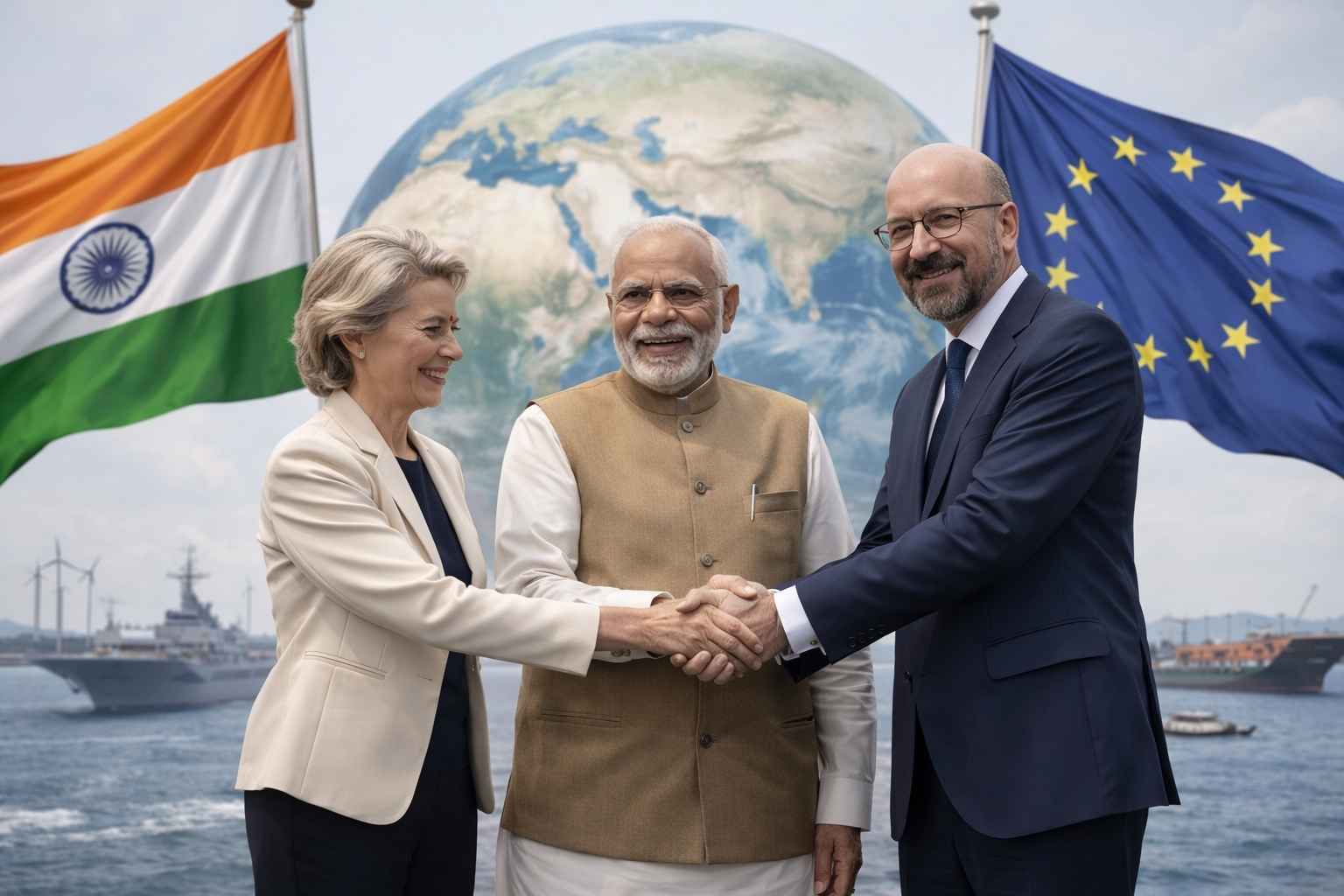
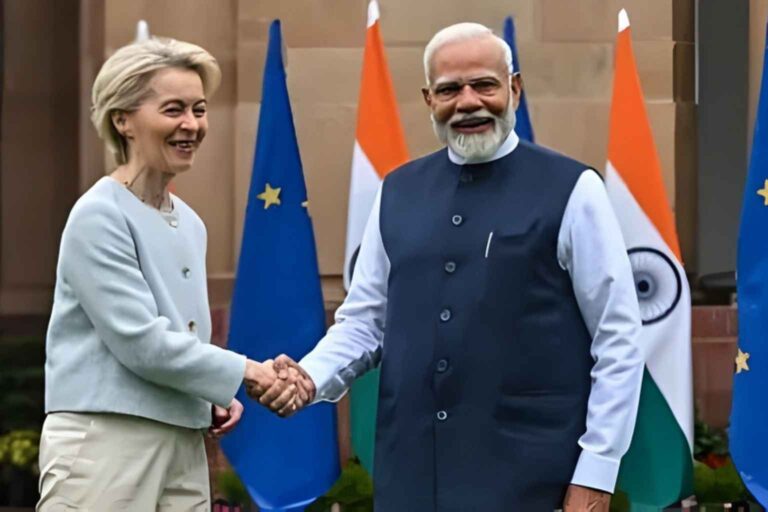
The President of the European Commission and the President of the European Council are visiting India as chief guests for Republic Day 2026 and co-chairing the 16th India–EU Summit. This marks a crucial moment in strengthening India–EU ties amid global geopolitical shifts and is a key contemporary international relations issue analysed by aspirants preparing through UPSC coaching in Hyderabad.
Background
- India–EU relations have long been described as having untapped potential.
- Progress has often been slow due to differing positions on Russia, China, and U.S. relations.
- Current global uncertainties have created urgency for a deeper and more structured partnership, a theme frequently discussed in GS Paper II at Hyderabad IAS coaching.
Free Trade Agreement (FTA)
- Negotiations ongoing since 2007, now in final stages.
- Potential benefits:
- India: Tariff cuts for textiles, apparel, pharmaceuticals, chemicals, IT services.
- EU: Greater access to India’s market for automobiles, machinery, and digital trade.
- Challenge: EU’s Carbon Border Adjustment Mechanism (CBAM) imposes 20–35% carbon charges on Indian exports (steel, aluminium, cement, fertilizers).
- India views CBAM as a non-tariff barrier; resolution is key for FTA success.
Defence and Security Partnership
- EU proposes a Security and Defence Partnership with India, similar to Japan and South Korea.
- Benefits for India:
- Access to European defence technology.
- Support for Make in India through co-production.
- Enhanced joint exercises and maritime cooperation in the Indian Ocean.
- Benefits for EU: Entry into India’s defence market and strategic collaboration.
Strategic Autonomy
- Both India and the EU emphasise independent decision-making free from the influence of the U.S., Russia, or China.
- Shared objective: Reduce over-dependence on single partners—whether Russian gas, Chinese markets, or U.S. security guarantees.
- The partnership is increasingly seen as a model for multipolar cooperation, balancing flexibility with pragmatism—an idea central to IR discussions in civils coaching in Hyderabad.
Significance
- Strengthens India’s global leadership role and EU’s outreach to the Global South.
- Offers a template for resilient multilateralism in a fragmented world.
- Enhances cooperation in trade, technology, defence, and climate equity.
- Positions India–EU as credible actors in shaping a multipolar, sovereign, and equitable global order.
Conclusion
The India–EU partnership is at a turning point. If both sides overcome bureaucratic hurdles and finalize the FTA alongside defence cooperation, they can co-create a new chapter in global governance that emphasizes resilience, fairness, and strategic autonomy.
This topic is available in detail on our main website.