
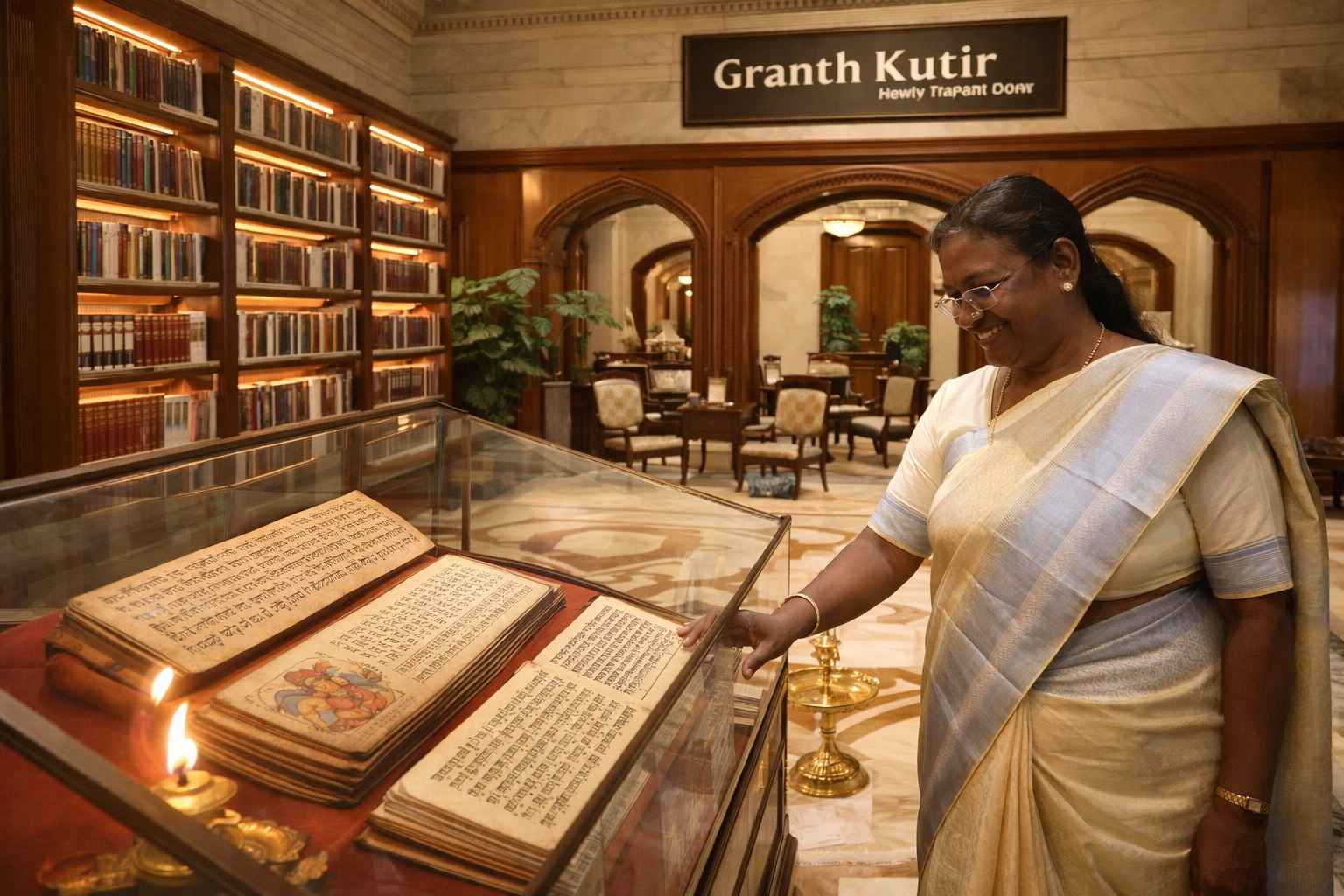
Droupadi Murmu, the President of India, inaugurated Granth Kutir, a new library and archival space at Rashtrapati Bhavan, showcasing India’s classical literary and cultural heritage. The initiative is relevant for GS Paper I (Culture) and is often highlighted in heritage-focused discussions by aspirants preparing through UPSC coaching in Hyderabad.
About Granth Kutir
- A dedicated library and archive within Rashtrapati Bhavan.
- Houses 2,300 books and around 50 manuscripts.
- Collection includes works in 11 classical languages: Tamil, Sanskrit, Kannada, Malayalam, Odia, Marathi, Pali, Prakrit, Assamese, Bengali, and others.
- Aim: To highlight India’s philosophical, literary, and intellectual tradition
- Serves as a repository of cultural knowledge for scholars and visitors.
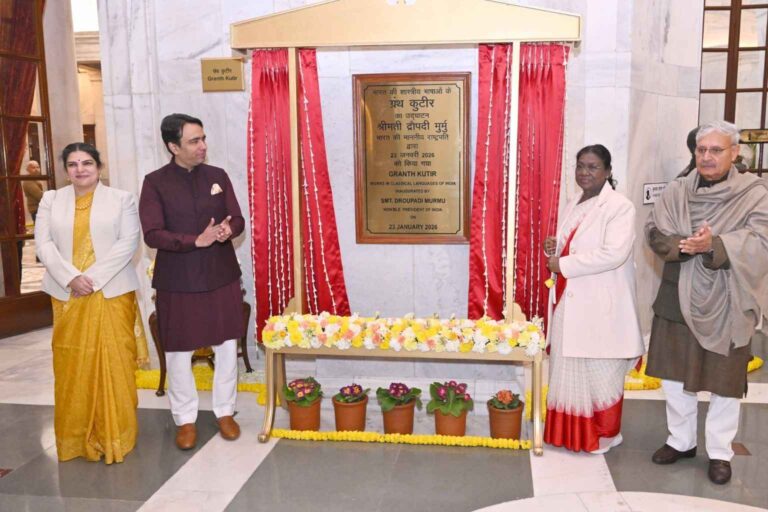
Significance
- Promotes awareness of India’s classical languages and manuscript traditions.
- Strengthens preservation of ancient texts and cultural heritage.
- Encourages research in literature, philosophy, and history.
- Symbolises Rashtrapati Bhavan not only as a political space but also as a cultural institution, a theme frequently discussed in GS preparation at Hyderabad IAS coaching.
What are Classical Languages?
- Classical languages are those which have a rich heritage of ancient literature, long history of use, and cultural significance.
- They are recognized by the Government of India based on specific criteria.
Criteria for Recognition (by Ministry of Culture)
- High antiquity of early texts/recorded history (at least 1500–2000 years).
- Rich and diverse ancient literature considered valuable heritage.
- Original literary tradition, not borrowed from another language.
- Distinct difference between ancient form and modern form.
- Classical status is given to languages that have contributed significantly to Indian culture and knowledge systems.
Official Languages in the Constitution
- Article 343: Hindi in Devanagari script is the official language of the Union. English continues as an associate official language for Union purposes.
- 22 languages are recognized under the Eighth Schedule of the Constitution (includes Assamese, Bengali, Gujarati, Hindi, Kannada, Kashmiri, Konkani, Malayalam, Manipuri, Marathi, Nepali, Odia, Punjabi, Sanskrit, Sindhi, Tamil, Telugu, Urdu, Bodo, Santhali, Maithili, Dogri).
- These languages are given importance in education, literature, and representation in commissions.
- Classical languages (like Tamil, Sanskrit, Kannada, Telugu, Malayalam, Odia) enjoy special recognition for their rich heritage.
Conclusion
The inauguration of Granth Kutir reflects India’s commitment to preserving its linguistic and cultural diversity. Alongside constitutional recognition of official and scheduled languages, such initiatives strengthen India’s identity as a nation rooted in pluralism and heritage.
This topic is available in detail on our main website.