
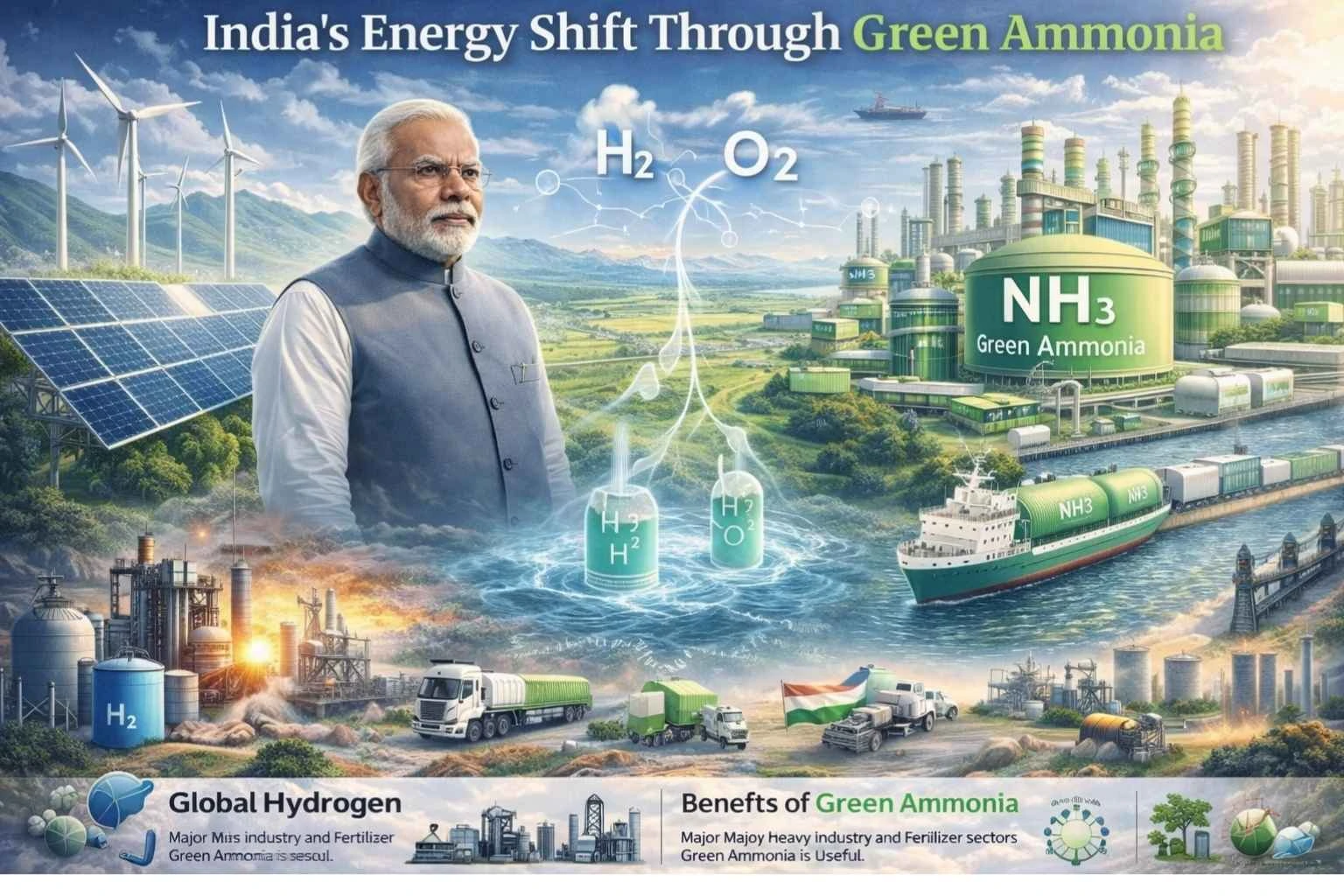
Recently, at India Energy Week 2026, Prime Minister Narendra Modi highlighted India’s push towards energy independence, with green hydrogen and its derivative green ammonia emerging as key drivers of the transition — an important development often discussed in UPSC coaching in Hyderabad.
What is Green Ammonia?
• Hydrogen produced by splitting water into hydrogen and oxygen through electrolysis powered by renewable energy (solar, wind, hydro).
• Clean Energy Source: Unlike grey hydrogen (from fossil fuels), green hydrogen has near-zero carbon emissions.
• Role in Energy Transition: Helps reduce dependence on fossil fuels and supports global climate goals.
Global Context
• EU’s H2Global auction for green ammonia under its hydrogen import strategy.
• South Korea’s CHPS tender for clean ammonia procurement.
• India’s SECI auction under the SIGHT programme has set new benchmarks in cost competitiveness.
India’s Green Ammonia Auction (SECI – SIGHT Programme)
• Tender Process: Initiated in June 2024 under SECI for supply to fertilizer plants.
• Market Certainty: Offered 10-year fixed-price offtake agreements, ensuring stability for producers and buyers.
• Price Discovery: Green ammonia prices discovered in the range of ₹49–65/kg.
• Support Mechanisms: Subsidies granted in the initial years to reduce production costs and support scale-up.
• Logistics Advantage: Delivery points identified near coastal fertilizer plants, facilitating transport through shipping.
• Reduced dependence on volatile global gas markets and enhanced supply chain resilience.
Significance
• Contracts cover nearly 30% of India’s ammonia imports, reducing dependence on volatile global gas markets.
• Provides price predictability and shields against currency risks and geopolitical pressures.
• Positions India as a global leader in clean ammonia markets due to low renewable energy costs, strong logistics, and robust contract design — a key topic in IAS coaching in Hyderabad.
Challenges
• Risk allocation, payment security, and pricing clarity required multiple revisions during tendering.
• Need for stable regulations on grid access, banking, and certification.
• Long-term viability depends on technical due diligence, hybrid renewable integration, and transparent monitoring frameworks.
Way Forward
• Strengthen Policy Support: Harmonised regulations, safety standards, and global certification alignment.
• Enhance Financing Models: Long-tenor blended finance, extended offtake agreements, and risk-mitigation instruments to attract private capital.
• Scale-Up Infrastructure: Invest in renewable energy, storage, and logistics to sustain large-scale green ammonia production and delivery.
Green Hydrogen

Sectors Where Green Hydrogen Helps
• Heavy Industry
• Fertilizers & Chemicals
• Transport
• Energy Storage & Grid Stability
• Power Generation
Benefits of Green Hydrogen
• Reduces greenhouse gas emissions.
• Provides energy security by lowering dependence on imported fossil fuels.
• Enables decarbonisation of hard-to-abate sectors.
• Creates new opportunities for investment, jobs, and technology leadership.
Countries Leading in Green Hydrogen
• China – Largest producer, accounting for nearly 80% of global electrolyzer capacity.
• Germany – Europe’s hydrogen powerhouse with ambitious national hydrogen strategy.
• Australia – Major projects leveraging abundant solar and wind resources.
• USA & UK – Significant investments in hydrogen infrastructure.
• South Africa & Estonia – Emerging players with growing capacity.
Conclusion
India’s green ammonia auction under SECI marks a breakthrough in cost-competitive clean energy adoption. With coordinated action by policymakers, developers, and financiers, India can move from energy security to energy independence, shaping the future of global clean ammonia markets — a transformative shift frequently examined in UPSC online coaching and civils coaching in Hyderabad.
This topic is available in detail on our main website.