
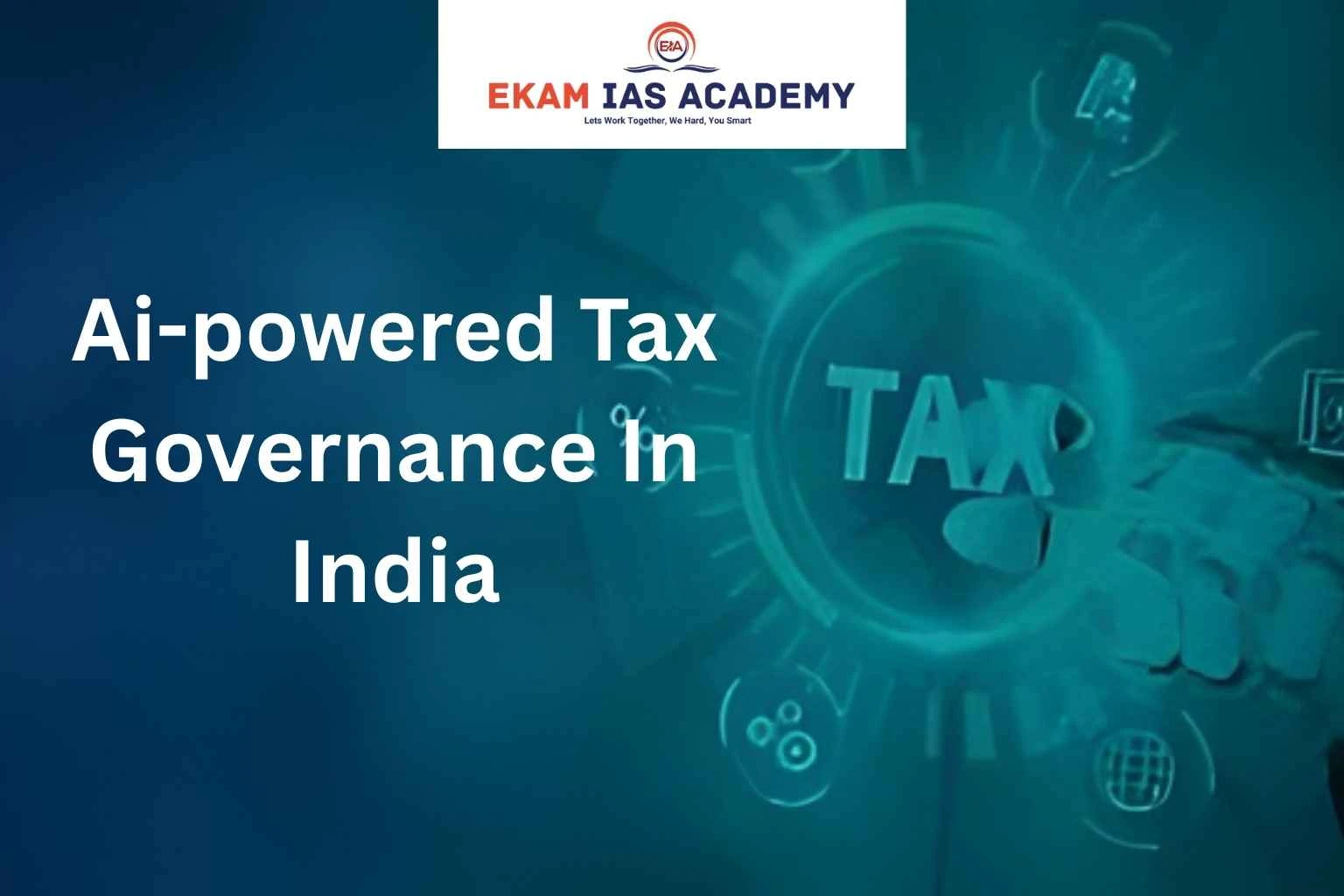
At the India AI Impact Summit (Feb 2026), experts highlighted India’s use of Artificial Intelligence (AI) in tax administration, particularly through the Income Tax Department’s Project Insight (PI). Such technological governance developments are important for aspirants preparing through IAS coaching in Hyderabad, UPSC online coaching, and other civil services preparation programs.
Background
• India’s tax-GDP ratio (2001–22 average: 16.36%) is among the lowest in emerging economies.
• Annual tax evasion costs India about 4.3% of revenues.
• To address this, the ITD launched Project Insight (2017, operational in 2019) using AI and data analytics.
Understanding such economic and technological reforms is essential for students preparing through UPSC coaching in Hyderabad and Hyderabad IAS coaching institutes, where governance and technology integration are key topics.
Benefits of Project
• Encourages voluntary compliance via behavioural nudges (SMS/email reminders).
• Builds 360° taxpayer profiles using data from banks, property, GST, credit cards, etc.
• Detects inconsistencies between declared income and actual financial activity.
• Automates routine tasks, freeing officials for complex cases.
• Improves taxpayer services (chatbots, faster refunds).
These governance innovations are frequently discussed in IAS coaching and civils coaching in Hyderabad, helping aspirants understand real-world applications of AI in public administration.
Outcomes So Far
• Since 2020–21: 1 crore revised returns filed, yielding ₹11,000 crore extra tax.
• Foreign Income NUDGE campaign: 62% taxpayers corrected returns; overseas assets worth ₹29,208 crore declared.
• Political donation claims corrected: ₹963 crore false deductions removed.
• Refund processing time reduced from 93 days to 17 days.
• AI detected ₹70,000 crore suppressed sales turnover by restaurants (2019–20 onwards).
• Similar AI-enabled systems used in Australia, UK, Italy, U.S. with success.
Such data-driven outcomes are important for aspirants enrolled in UPSC online coaching and structured UPSC coaching in Hyderabad programs.
Challenges
• Data Quality & Provenance: AI depends on reliable data; errors or complex family finances may trigger false positives.
• Algorithmic Bias: Models may replicate socio-economic/geographic biases (e.g., Dutch childcare scandal).
• Explainability & Due Process: Taxpayers must know why they are flagged and have a clear appeal mechanism. Human-in-the-loop review is essential.
• Privacy & Security: Sensitive financial data creates risks of misuse or cyberattacks.
• Lack of Ombudsman: No independent AI ombudsperson or external audits of risk-scoring models.
These challenges are widely analysed in Hyderabad IAS coaching programs to help aspirants develop balanced answers in GS Paper 3.
Conclusion
AI-driven tax governance has boosted compliance and revenue mobilisation in India, but without strong safeguards, it risks becoming a surveillance tool that undermines trust. For aspirants preparing through IAS coaching in Hyderabad, UPSC coaching in Hyderabad, and civils coaching in Hyderabad, such topics are essential for understanding the intersection of technology, governance, and ethics.
This topic is available in detail on our main website.