
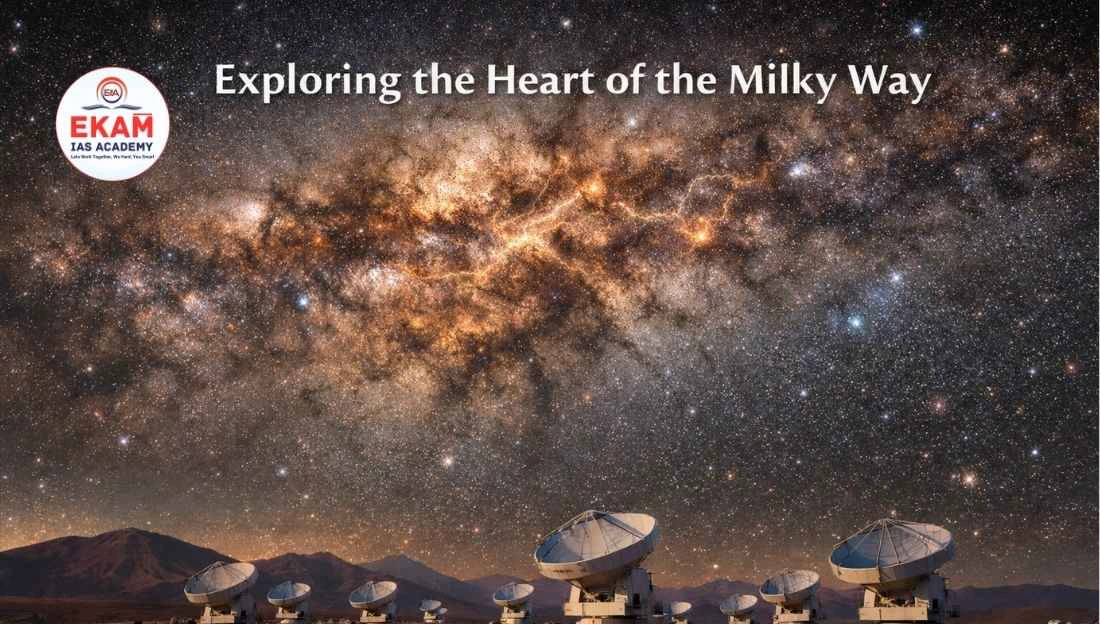
Astronomers recently used the ALMA telescope to capture the central region of the Milky Way, revealing a complex network of cosmic gas filaments in unprecedented detail — a development highly relevant for GS3 Science & Technology, frequently discussed in UPSC coaching in Hyderabad.
About ALMA
• Full name: Atacama Large Millimeter/submillimeter Array (ALMA).
• Location: Atacama Desert, Chile.
• Operational since 2013.
• Jointly developed by the US National Radio Astronomy Observatory (NRAO), National Astronomical Observatory of Japan (NAOJ), and the European Southern Observatory (ESO).
• Studies celestial objects at millimetre and submillimetre wavelengths.
Key Properties
• Extraordinary sensitivity to detect faint radio signals.
• Comprises 66 high-precision antennas, spread over up to 16 km.
• Antennas can be moved closer or farther apart, functioning like a zoom lens for different perspectives.
Major Discoveries
• 2013: Identified starburst galaxies earlier in cosmic history than previously known.
• Produced detailed images of the protoplanetary disc around HL Tauri, a young star about 450 light years away.
• Observed the Einstein ring phenomenon, where light bends around massive objects due to gravitational lensing.

Significance
• ALMA provides insights into galaxy formation, star birth, and cosmic structures.
• Helps astronomers study the early universe and understand the physics of interstellar matter.
• Its latest findings on the Milky Way’s centre deepen knowledge of gas dynamics and star-forming regions — topics commonly analysed in IAS coaching in Hyderabad and UPSC online coaching programs.
Conclusion
The ALMA telescope is one of the most advanced radio astronomy facilities in the world. By unveiling hidden structures of the universe, it strengthens our understanding of cosmic evolution and supports cutting-edge astrophysical research — a core area for aspirants preparing through civils coaching in Hyderabad.
This topic is available in detail on our main website.