
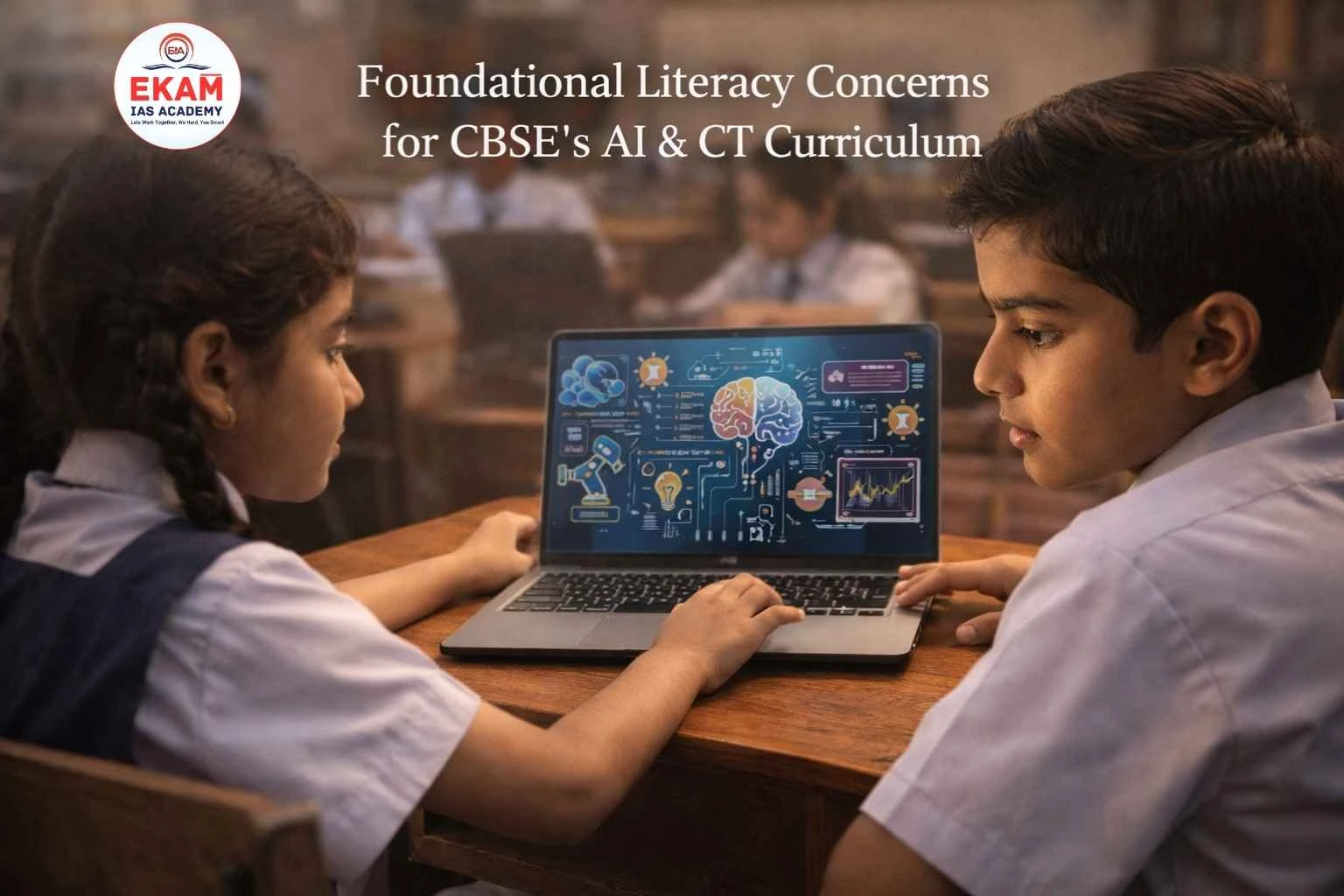
On 1 April 2026, the government introduced a CBSE curriculum on Computational Thinking (CT) and Artificial Intelligence (AI) for Classes 3–8, beginning in the 2026–27 academic session. Such education and governance reforms are important for aspirants preparing through IAS coaching in Hyderabad, UPSC online coaching, and other civil services preparation platforms.
Aim of the Curriculum
• Build skills in logical reasoning, problem-solving, and pattern recognition.
• Introduce students to AI applications in daily life.
• Designed as a step toward future-ready education.
Understanding such policy initiatives is essential for students preparing through UPSC coaching in Hyderabad and Hyderabad IAS coaching institutes, especially for GS Paper 2.
Foundational Challenge: LSRW Skills
• Listening, Speaking, Reading, Writing (LSRW) are essential for meaningful learning.
• CT curriculum is language-driven, requiring reading and comprehension.
• Activities like puzzles, problem-solving, and assessments depend on basic literacy skills.
• Students with weak reading ability may see CT tasks as reading challenges rather than thinking exercises.
These aspects are often analysed in IAS coaching and civils coaching in Hyderabad for better understanding of education reforms.
Evidence of Learning Deficit
• ASER 2024: Over half of Class 5 students in government schools cannot read a Class 2-level text.
• Literacy gap persists across government, private, rural, and urban schools.
• PARAKH 2024: Found urban private school students performed worse than rural peers at Grade 3 level.
• CBSE students are also affected by the national literacy crisis.
Such reports are frequently discussed in UPSC online coaching and structured UPSC coaching in Hyderabad programs.
Literacy Goals vs Reality
• NIPUN Bharat Mission (2021) aimed for foundational literacy by Grade 3 by 2026–27.
• ASER 2024 shows improvement but targets remain unmet.
• CT curriculum rollout coincides with the literacy deadline, creating a policy mismatch.
These issues are important for aspirants studying through IAS coaching in Hyderabad and Hyderabad IAS coaching programs.
Dependence on Foundational Skills
• CT curriculum focuses on higher-order skills like critical and analytical thinking.
• These require strong comprehension abilities.
• From Class 6 onwards, assessments include projects, journals, and written assignments.
• Students with weak literacy risk early breakdown in learning pipeline.
Such analytical points are commonly covered in IAS coaching and civils coaching in Hyderabad for GS2 answer writing.
Global Experience
• Countries like Finland, Singapore, South Korea introduced AI education only after achieving strong literacy.
• India’s rollout overlaps with unfinished literacy goals, raising concerns about sequencing.
These comparisons are often discussed in UPSC coaching in Hyderabad and UPSC online coaching programs.
Key Insights
• CT curriculum is ambitious and well-designed but assumes literacy readiness.
• Without strong LSRW skills, assessments may measure literacy gaps instead of computational thinking.
• Policy sequencing must ensure literacy first, AI next for true transformation.
Conclusion
The CBSE AI curriculum is a progressive step, but its success depends on bridging foundational literacy gaps. Without strong reading and comprehension skills, the promise of computational thinking and AI education cannot be fully realised. For aspirants preparing through IAS coaching in Hyderabad, UPSC coaching in Hyderabad, and UPSC online coaching, such topics are crucial for understanding education policy and governance in UPSC.
This topic is available in detail on our main website.