
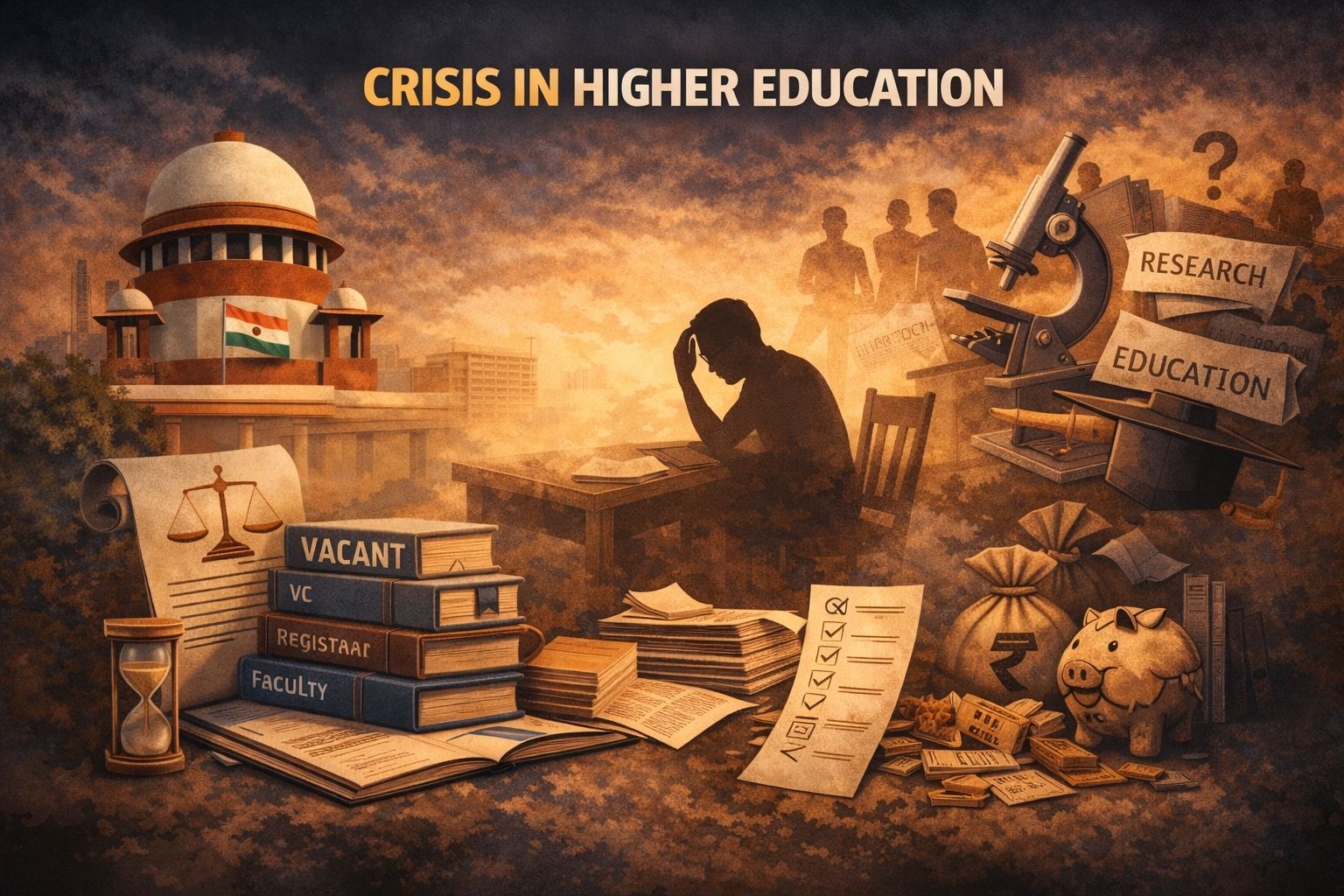
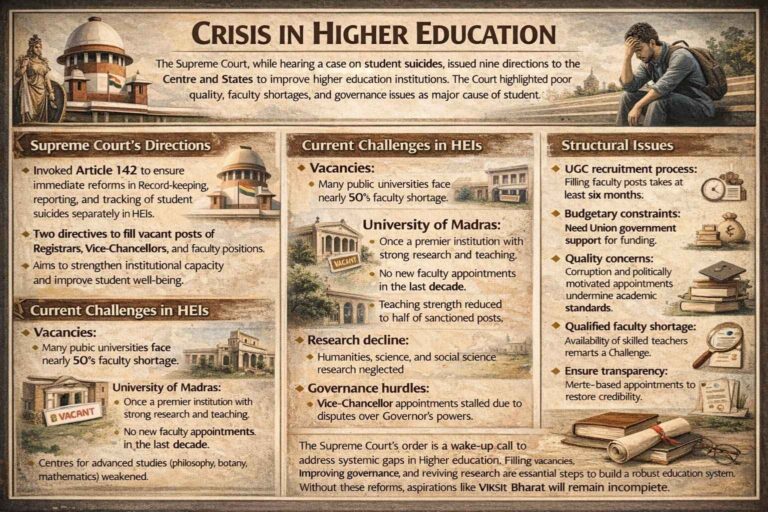
The Supreme Court, while hearing a case on student suicides, issued nine directions to the Centre and States to improve higher education institutions. The Court highlighted poor quality, faculty shortages, and governance issues as major causes of student distress—an issue frequently discussed in GS-II and GS-IV classes at leading IAS coaching in Hyderabad institutes.
Supreme Court’s Directions
- Invoked Article 142 to ensure immediate reforms in record-keeping, reporting, and tracking of student suicides separately in HEIs.
- Issued directives to fill vacant posts of Registrars, Vice-Chancellors, and faculty positions.
- Aimed to strengthen institutional capacity and improve student well-being.
These constitutional interventions are important for governance answers prepared through UPSC online coaching.
Current Challenges in HEIs
- Vacancies: Many public universities face nearly 50% faculty shortage.
- Case Study – University of Madras:
- Once a premier institution with strong research and teaching.
- No new faculty appointments in the last decade.
- Teaching strength reduced to half of sanctioned posts.
- Centres for advanced studies (philosophy, botany, mathematics) weakened.
- Research decline: Humanities, science, and social science research neglected.
- Governance hurdles: Vice-Chancellor appointments stalled due to disputes over Governor’s powers.
Structural Issues
- UGC recruitment process: Filling faculty posts takes at least six months.
- Budgetary constraints: State universities require stronger Union government support.
- Quality concerns: Corruption and politically motivated appointments undermine academic standards.
- Qualified faculty shortage: Availability of skilled teachers remains a persistent challenge.
These structural gaps are key discussion points in education governance modules of IAS coaching.
Way Forward
- Resolve governance ambiguity: Clarify Governor’s role in VC appointments.
- Speed up recruitment: Streamline UGC procedures and ensure timely appointments.
- Union-State cooperation: Financial and administrative support from the Centre to strengthen State universities.
- Focus on research revival: Invest in humanities, sciences, and social sciences for balanced growth.
- Ensure transparency: Merit-based appointments to restore credibility.
Conclusion
The Supreme Court’s order is a wake-up call to address systemic gaps in higher education. Filling vacancies, improving governance, and reviving research are essential steps to build a robust education system. Without these reforms, aspirations like Viksit Bharat will remain incomplete.
This topic is available in detail on our main website.