
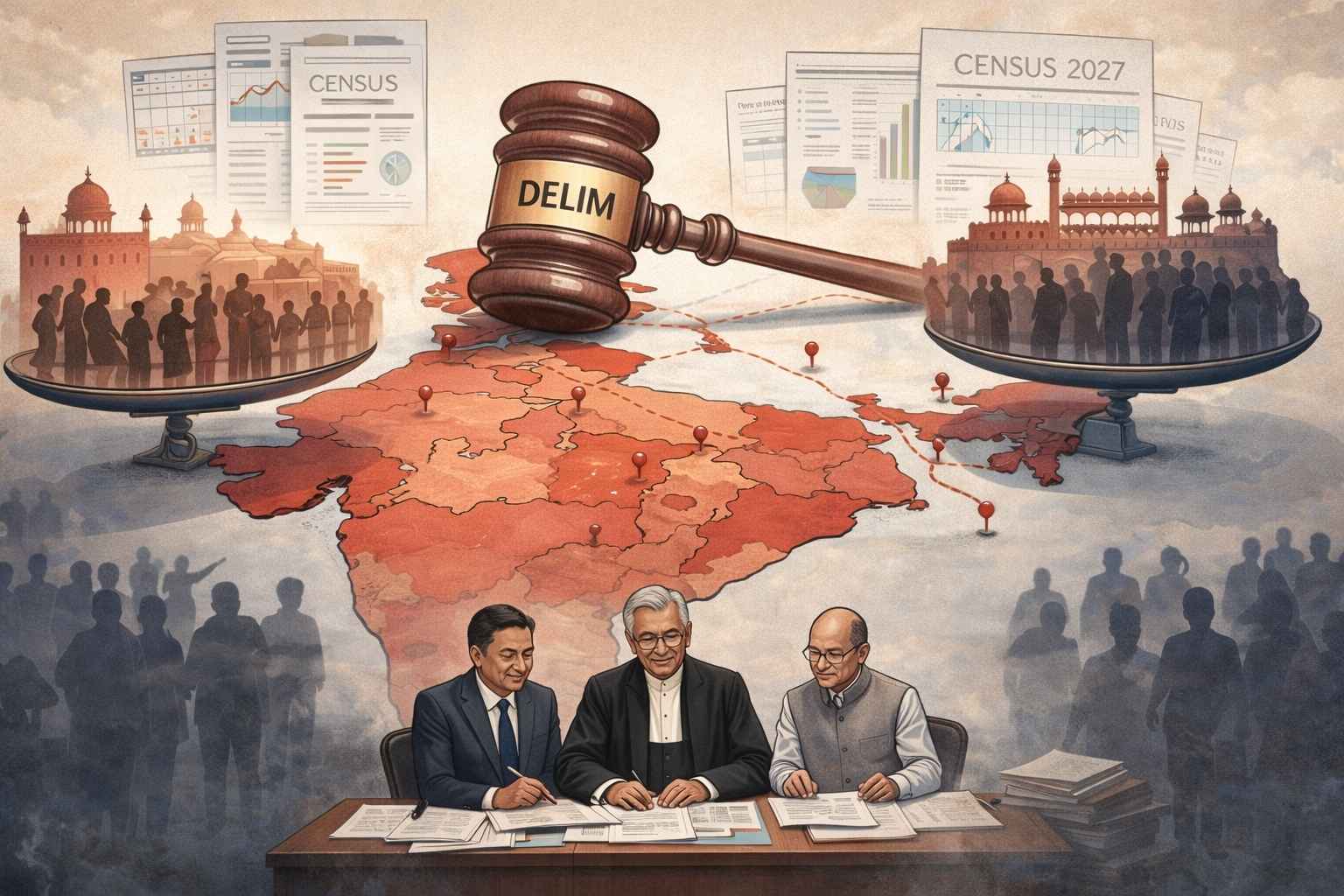
The next delimitation exercise, due after Census 2027, will be the most significant redistribution of Lok Sabha seats since Independence. It is expected to reshape representation, federal balance, and coalition politics in India—making it a high-value GS Paper II topic for aspirants preparing through UPSC coaching in Hyderabad.
Background
- Delimitation: Redrawing of electoral boundaries to reflect population changes.
- The Constitution mandates delimitation after every Census, but seat distribution among States has been frozen since 1976 (based on the 1971 Census).
- The 84th Constitutional Amendment (2001) extended the freeze until the first Census after 2026.
- Current representation is based on 548 million (1971), not today’s ~1.47 billion population.
Population Divergence
- Southern and western States achieved low fertility through investments in education and health.
- Northern States (e.g., Uttar Pradesh, Bihar) continue to record higher population growth.
- Projected Seat Distribution
- Uttar Pradesh may rise from 80 to ~151 seats, Bihar from 40 to ~82.
- Tamil Nadu (39→53) and Kerala (20→23) gain fewer seats, reducing their proportional influence.
- Moral Paradox
- States that successfully controlled population growth risk losing relative influence, while high-growth States gain—raising equity concerns often debated in polity classes at Hyderabad IAS coaching.
Challenges
- Women’s Reservation: Delimitation is required to create reserved constituencies; implementation could slip to the 2034 elections.
- Federal Balance: Larger northern States could dominate, reducing bargaining power of southern and smaller States.
- Political Stability vs Constitutional Fairness: Reconciling equal representation with regional equity.
Way Forward
- Ensure transparent and inclusive process with experts in demography, law, and federal studies.
- Conduct public consultations to build consensus.
- Balance population-based fairness with federal equity to avoid regional distrust.
- Treat delimitation as a national milestone to modernize representation while preserving unity.
Delimitation Commission:
Members of Delimitation Commission
- Chairperson: A retired judge of the Supreme Court of India.
- Ex-officio Members:
- Chief Election Commissioner (CEC).
- State Election Commissioners of the concerned States/UTs.
- Associate Members:
- Members of Parliament (Lok Sabha) from the concerned States.
- Members of Legislative Assemblies of the concerned States.
- These are non-voting members but provide inputs.
Powers of Delimitation Commission
- Constitutional Authority: Set up under the Delimitation Act, its orders have the force of law.
- Redraw Boundaries: Determines boundaries of Lok Sabha and State Assembly constituencies based on latest Census.
- Seat Allocation: Decides number of seats to be reserved for SCs and STs in each State.
- Finality of Decisions:
- Orders cannot be challenged in any court of law.
- Parliament and State Legislatures cannot modify its decisions.
- Ensures Fair Representation: Aims to balance population changes with equal representation across constituencies.
- Consultative Role: Takes inputs from MPs and MLAs of concerned States but final decision rests with the Commission.
Significance
- Maintains democratic fairness by adjusting constituencies to population shifts.
- Prevents over-representation or under-representation of regions.
- Strengthens federal balance and ensures reserved seats reflect demographic realities.
Conclusion
Delimitation after 2027 will redefine representation in Parliament. If guided by fairness and transparency, it can strengthen federalism; if driven by political arithmetic alone, it risks deepening divisions.
This topic is available in detail on our main website.