

Why in News?
A pair of rare Dusky Eagle Owls was recently sighted in the Phato tourism zone of Terai West Forest Division in Uttarakhand, near Corbett Tiger Reserve — a biodiversity development often discussed in UPSC coaching in Hyderabad while studying wildlife conservation and ecology.
Physical Characteristics
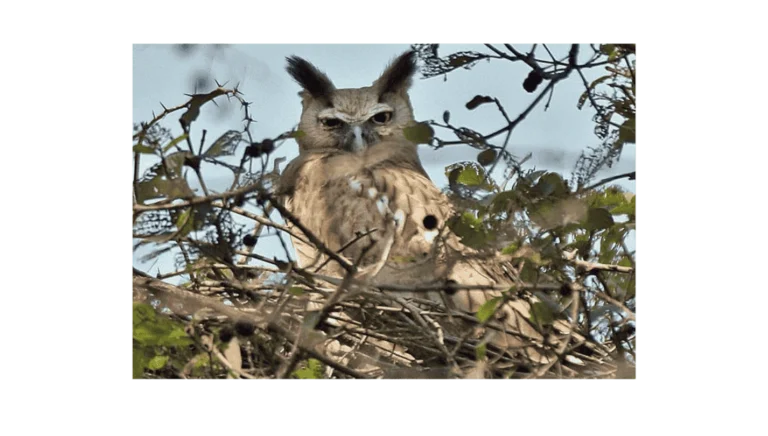
• The Dusky Eagle Owl is a large and powerful owl species with a strong body and broad wings.
• Size: Approximately 48–53 cm in length, with females generally larger than males.
Colouration
• The body appears greyish-brown.
• Underparts are greyish-white with dark brown streaks.
• Wings are dark brown with pale streaks.
Distinct Features
• Ear Tufts: Prominent ear-like feather tufts, giving it the typical eagle-owl appearance.
• Eyes: Large eyes adapted for excellent night vision.
Habitat and Behaviour
• Typically inhabits dense forests, riverine woodlands, and areas with large old trees.
• Prefers regions near water bodies, where prey availability is higher.
• During daytime, it rests quietly in shaded branches or dense foliage to avoid disturbance.
• Becomes active around dusk and at night, although it may occasionally hunt during cloudy daylight conditions — wildlife behaviour often analysed in IAS coaching in Hyderabad for environment preparation.
Feeding and Hunting Adaptations
• The species is a skilled predator with powerful talons and strong flight capability.
• It feeds mainly on:
• Small mammals such as rodents
• Birds
• Occasionally reptiles and insects
• Its sharp hearing and silent flight help it locate prey efficiently in low-light conditions.
Breeding and Nesting Behaviour
• Unlike many birds, the Dusky Eagle Owl does not build its own nest.
• Instead, it uses abandoned stick nests originally built by large birds of prey, including:
• Kites
• Vultures
• Eagles
• These nests are usually located on tall trees, providing protection from predators.
Conservation Status
• IUCN Red List: Least Concern (LC)
Although the global population remains stable, local threats include:
• Habitat loss due to deforestation
• Disturbance near nesting sites
• Decline of old-growth trees
Protecting mature forests and riverine ecosystems is essential for sustaining the species’ population — topics commonly covered in UPSC online coaching and civils coaching in Hyderabad for GS3 environment and biodiversity.
This topic is available in detail on our main website.