
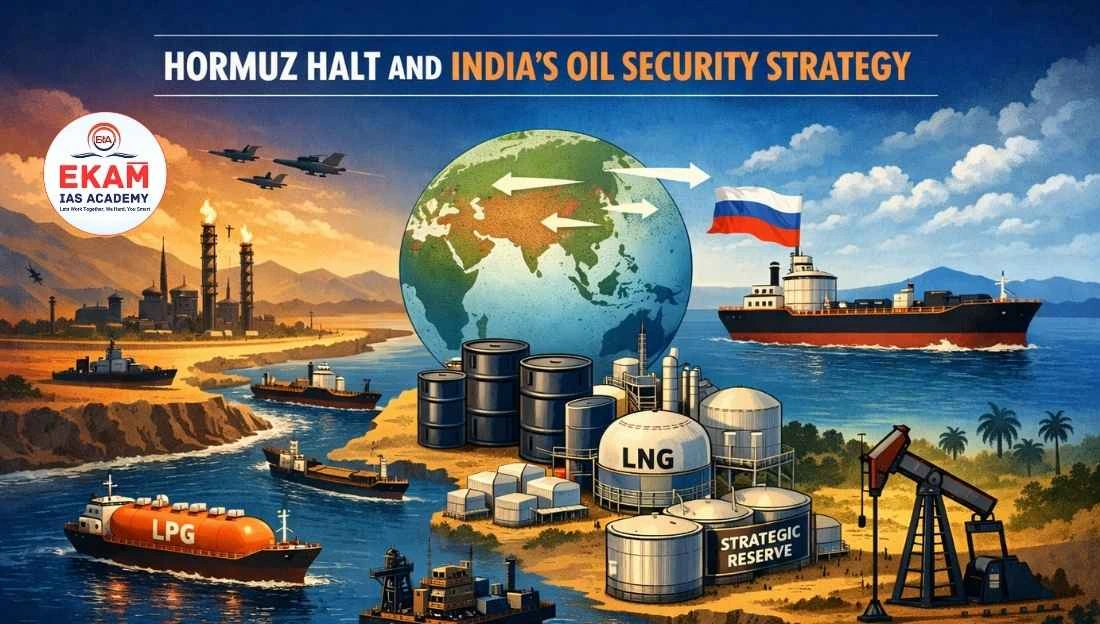
Disruptions in oil shipments through the Strait of Hormuz due to conflict in West Asia have prompted India to consider increasing imports of Russian crude to maintain supply stability — an issue frequently analysed in UPSC coaching in Hyderabad under energy security and international relations.
India’s Oil Dependence and Hormuz
• India is the third largest consumer of crude oil, importing over 88% of its needs.
• Around 2.5–2.7 million barrels per day of crude imports pass through the Strait of Hormuz, accounting for nearly half of India’s total imports.
• Major suppliers through Hormuz include Iraq, Saudi Arabia, UAE, and Kuwait.
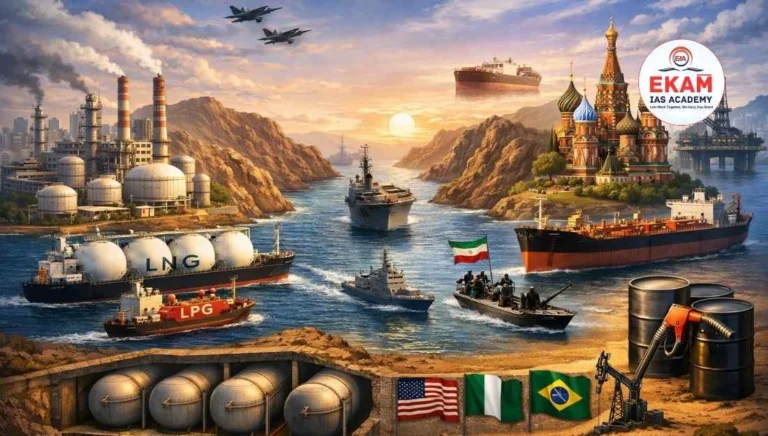
• India also relies heavily on Hormuz for LPG and LNG imports, making it a critical chokepoint for energy security.
Strategic Importance of the Strait
• The Strait of Hormuz is a narrow waterway between Iran and Oman, connecting the Persian Gulf to the Arabian Sea.
• It is the world’s most important oil transit chokepoint, handling nearly 20% of global petroleum and LNG trade.
• Recent claims by Iran’s Revolutionary Guards about closure led traders, insurers, and shipping firms to suspend shipments, raising global concerns.
Russian Crude as an Alternative
• India had reduced Russian oil imports during trade talks with the U.S., but disruptions in Hormuz have revived interest.
• Russian crude is available in large volumes in the Indian Ocean and Arabian Sea, including floating storage.
• Industry estimates suggest 10 million barrels of Russian crude are currently accessible in Asian waters.
• India imported 1.1 million barrels per day of Russian crude in February 2026, down from a peak of over 2 million barrels in 2025, leaving scope for increase.
India’s Energy Cushion
• Indian refiners hold 10 days of crude inventories and about a week’s worth of fuel stocks.
• Strategic petroleum reserves provide an additional week’s supply.
• These buffers offer short-term protection against sudden disruptions — a point often discussed in IAS coaching in Hyderabad programs.
Alternative Sourcing Options
• India can diversify imports from U.S., West Africa, Latin America, and Russia.
• Spot purchases and strategic reserves can help bridge temporary shortages.
• Russian crude in nearby waters offers immediate flexibility if Middle Eastern supplies remain blocked.
Key Vulnerabilities
• LPG imports (80–85%) are India’s biggest vulnerability, with no large strategic reserves.
• Around 60% of LNG imports also pass through Hormuz, with limited alternative buffers.
• Prolonged disruption could impact domestic fuel prices and household energy security more severely than crude oil.
Conclusion
While Russian crude offers a short-term cushion, the real challenge lies in securing LPG and LNG supplies and diversifying long-term energy sources — a critical theme in international relations and economic security covered extensively in UPSC online coaching and civils coaching in Hyderabad.
This topic is available in detail on our main website.