

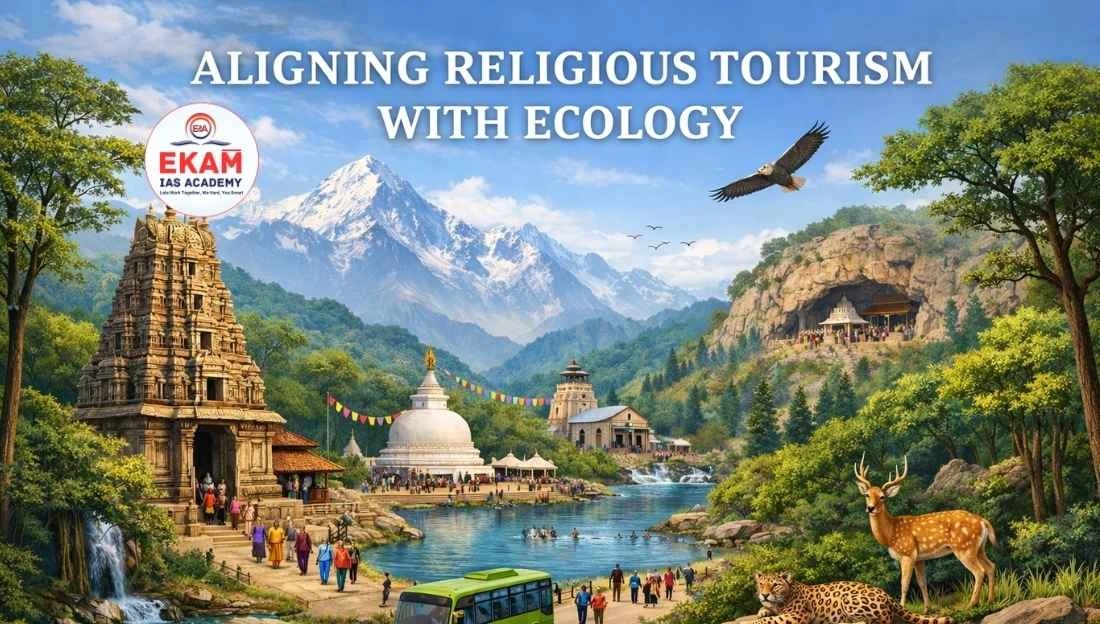
The Standing Committee of the National Board for Wildlife (SCNBWL) recently proposed to expand religious structures inside sanctuaries, raising concerns about balancing faith practices with ecological protection — a policy debate frequently analysed in UPSC coaching in Hyderabad.
Religion–Ecology Linkages in India
• Overlap with Sensitive Ecosystems: India’s sacred geography often coincides with forests, caves, shrines, and pilgrimage routes located inside or near protected areas.
• Traditional Regulation: For centuries, belief systems and community norms restricted extraction and ensured coexistence with nature.
• Rising Pressures: Mass tourism and commercialisation now strain fragile ecosystems, with pilgrim numbers rising sharply (e.g., Kumbh Mela 2019 drew ~25 crore visitors).
• Sacred Groves as Biodiversity Refuges: India has over 13,000 documented sacred groves, covering thousands of hectares, especially in Maharashtra, Karnataka, Kerala, and Himachal Pradesh. These groves conserve species diversity and water sources.
• Protected Area Stress: India has 104 national parks and 564 wildlife sanctuaries, many hosting religious sites. Unregulated expansion risks habitat fragmentation and human–wildlife conflict.
Sanctuary Expansion Concerns
• Proposal in Gujarat: A plan to expand a religious site inside a sanctuary was first approved but later withdrawn.
• Precedent Risk: Expansion could set a dangerous precedent for diverting protected areas to religious institutions.
• Legal Restrictions: Under the Forest (Conservation) Act, 1980, any construction on forest land after 1980 is treated as encroachment.
• Wildlife Protection Norms: The Wildlife (Protection) Act, 1972 and NTCA guidelines allow only limited, justified interventions to manage ecological pressures — a governance issue often discussed in IAS coaching in Hyderabad.
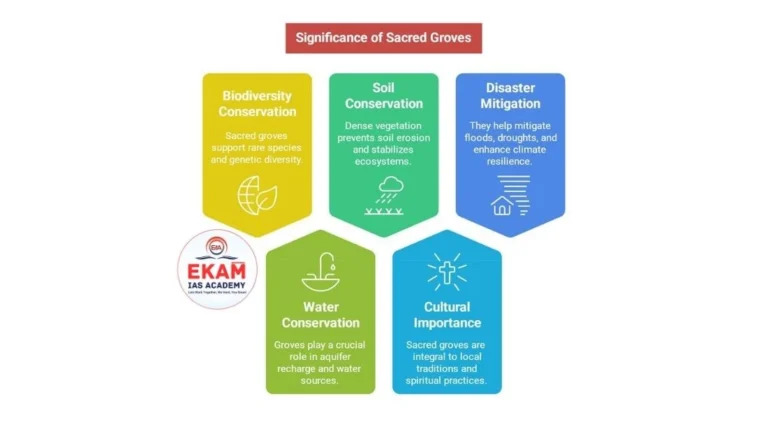
Sacred Groves
• Sacred groves are community-protected forest patches linked to local faith traditions.
• They act as biodiversity refuges, restricting extraction and disturbance.
• India has over 13,000 documented sacred groves, especially in states like Maharashtra, Karnataka, Kerala, and Himachal Pradesh.
Government Initiatives
• Forest Rights Act, 2006: Recognises rights of Scheduled Tribes and forest dwellers.
• National Tiger Conservation Authority (NTCA): Issues norms for managing religious tourism in tiger reserves.
• ATREE–WWF Guidelines (2023): Proposed a green pilgrimage model with caps on visitors, waste management, and transport restrictions.
Ecological Challenges of Religious Tourism
• Habitat Fragmentation: Unregulated construction inside forests breaks natural habitats and increases human–wildlife conflict (e.g., rising leopard encounters near pilgrimage routes in Uttarakhand).
• Ignoring Forest Rights: Failure to recognise rights under the Forest Rights Act, 2006 marginalises local communities who traditionally protect sacred groves and forest shrines.
• Commercialisation Pressure: Large pilgrimages overwhelm fragile ecosystems — for instance, the Amarnath Yatra and Kumbh Mela have reported issues of waste, pollution, and strain on local resources.
Way Forward
• No Expansion Principle: Ban new constructions in core forest areas.
• Case-by-Case Evaluation: Assess long-standing sites with strict ecological safeguards.
• Mandatory Settlement of Forest Rights: Ensure rights recognition before regulating access.
• Green Pilgrimage Models: Visitor caps, waste management, bans on night traffic.
• Multi-Stakeholder Governance: Forest departments, temple trusts, local bodies, and conservation NGOs.
• Awareness Campaigns: Engage religious leaders to promote eco-friendly practices — approaches often discussed in UPSC online coaching.
Examples & Importance
• Kalakad Mundanthurai, Ranthambhore, Corbett: Pilot projects showed reduced roadkill, plastic waste, and water contamination.
• Sivakasi (Tamil Nadu): Improved safety record in the fireworks industry through training — similar awareness can help religious tourism.
• India hosts millions of pilgrims annually (e.g., 2.5 crore at Kumbh Mela 2019), making ecological safeguards critical.
Conclusion
India must integrate faith and ecology by protecting sacred landscapes while respecting cultural traditions. A principled approach — zero tolerance for new encroachments, recognition of forest rights, and adoption of green pilgrimage models — is essential for sustainable development and conservation, an issue widely examined in civils coaching in Hyderabad.