
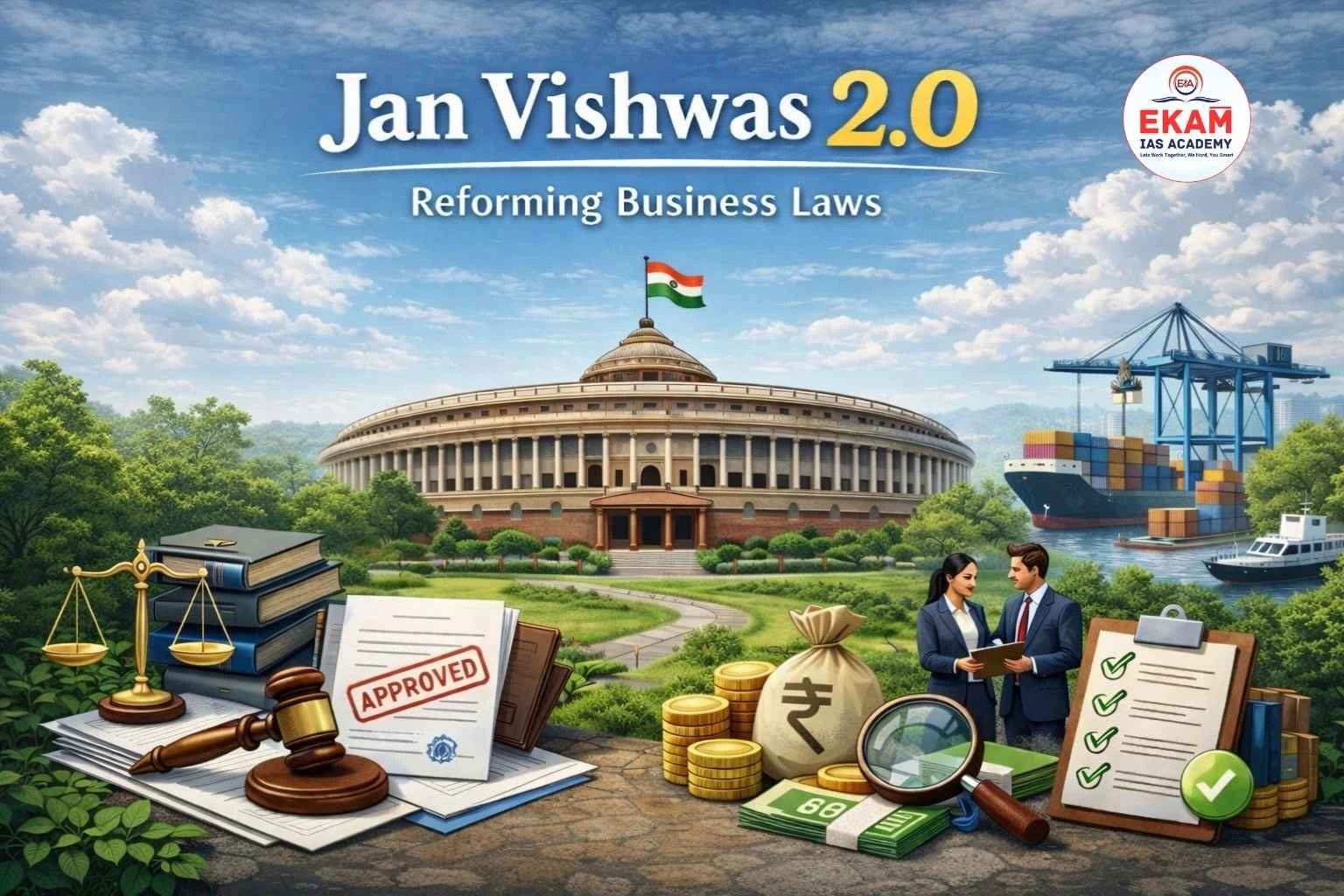
Parliament has passed the Jan Vishwas (Amendment of Provisions) Bill, 2026, which expands decriminalisation of minor business offences and promotes trust-based regulation. This reform is important for aspirants preparing through IAS coaching in Hyderabad, UPSC online coaching, and other civil services preparation platforms.
Background of Reform
• Jan Vishwas Act, 2023: Decriminalised 183 provisions across 42 Central Acts.
• Jan Vishwas 2.0 (2026): Enlarges scope → 784 provisions amended across 79 Acts, with 717 offences decriminalised.
• Aim: Shift from criminal punishment for minor lapses to civil penalties and administrative measures.
Such governance and economic reforms are widely discussed in UPSC coaching in Hyderabad and Hyderabad IAS coaching institutes.
Key Features of Jan Vishwas 2.0
• Decriminalisation: Removes criminal liability for minor procedural lapses (delays in filing, clerical errors).
• Rationalisation of Laws: Eliminates outdated and redundant offences. Strengthens coherence of regulatory framework.
• Trust-Based Regulation: Focus on voluntary compliance rather than fear-driven adherence. First-time or minor violations may attract warnings or lower penalties.
These features are often analysed in IAS coaching and civils coaching in Hyderabad for GS3 preparation.
Significance
• Ease of Doing Business: Reduces compliance burden, especially for MSMEs.
• Judicial Relief: With ~50 million cases pending, shifting minor offences out of criminal courts reduces congestion.
• Investor Confidence: Creates predictable and transparent regulatory environment.
• Economic Efficiency: Aligns regulation with evolving business realities.
Such topics are important for aspirants undergoing UPSC online coaching and structured GS answer writing programs.
Role of Industry & Stakeholders
• Confederation of Indian Industry (CII) played a major role in advocating reforms.
• Suggested shift from court fines to executive penalties with clear rules.
• Recommended retrospective application to cover pending cases.
• Continuous consultation ensured balance between facilitation and enforcement.
These dimensions are regularly discussed in UPSC coaching in Hyderabad and IAS coaching in Hyderabad classrooms.
Way Forward
• Effective Implementation: Build institutional capacity for administrative adjudication.
• Uniform Enforcement: Ensure consistency across ministries and departments.
• Clear Guidance: Provide transparent rules to businesses for compliance.
• Retrospective Relief: Review pending minor cases for closure under new framework.
Conclusion
Jan Vishwas 2.0 shifts India’s regulatory approach from criminalisation to trust-based compliance. It promotes entrepreneurship and builds investor confidence, with success relying on transparent implementation and stakeholder engagement. For aspirants preparing through IAS coaching, UPSC coaching in Hyderabad, and civils coaching in Hyderabad, this topic is highly relevant for GS3 and interview preparation.
This topic is available in detail on our main website.