
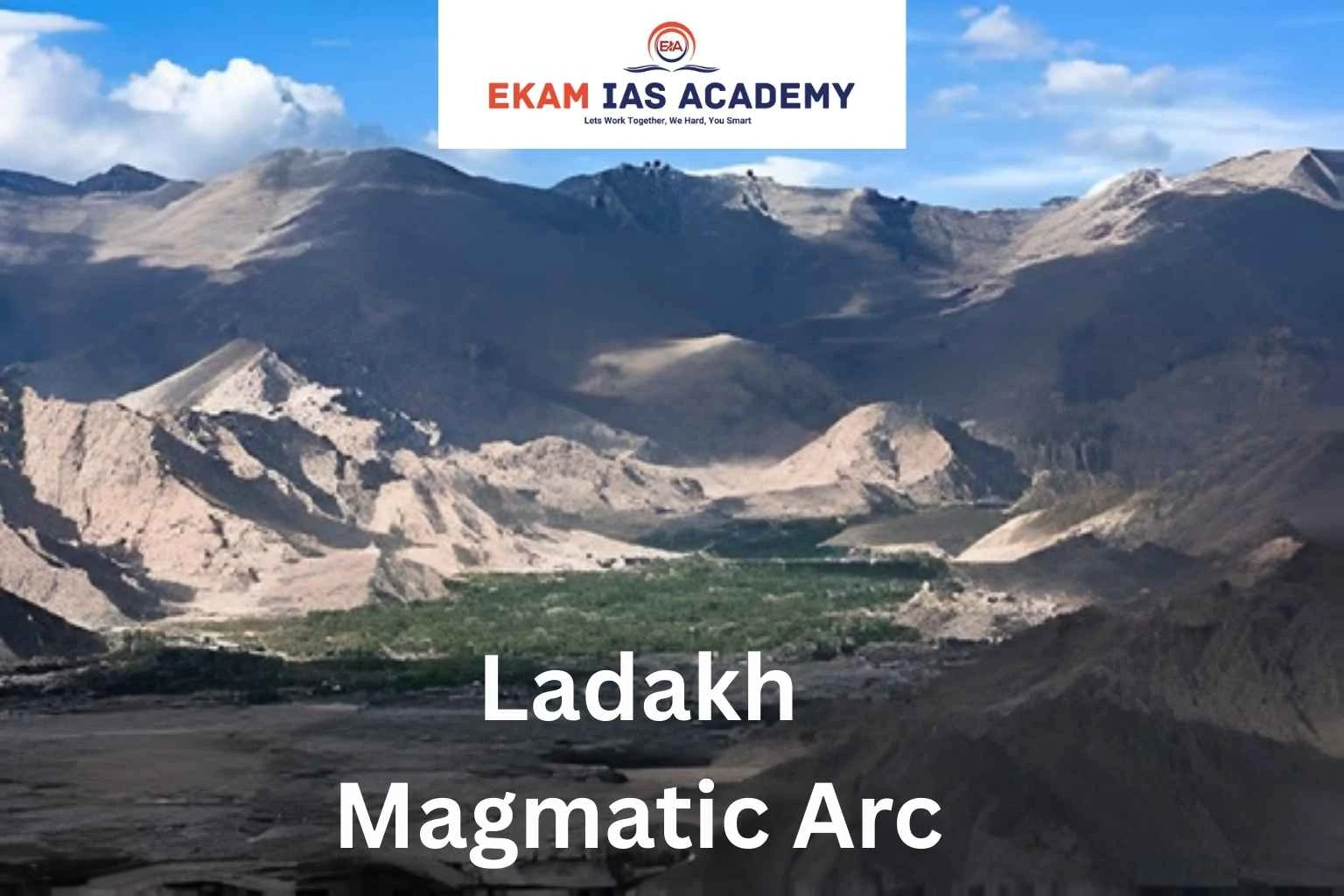
Scientists have recently studied the evolution of the Ladakh Magmatic Arc (LMA) in the northwestern Himalaya, shedding light on its geological history and tectonic significance. Such geography and tectonics topics are important for aspirants preparing through IAS coaching in Hyderabad, UPSC online coaching, and other civil services preparation programs.
Ladakh Magmatic Arc
• A belt of igneous rocks in the Trans-Himalaya.
• Formed between Jurassic (201.3 million years ago) and Eocene (33.9 million years ago).
• Represents a long-extinct volcanic system shaped by three major phases of magmatism.
Understanding such geological structures is essential for students preparing through UPSC coaching in Hyderabad and Hyderabad IAS coaching institutes, where physical geography forms a key part of the UPSC syllabus.
Phases of Evolution
Island Arc Formation (160–110 million years ago)
• Early stage: chain of volcanic islands in the Neo-Tethys Ocean.
• Represented by the Dras–Nidar Island Arc Complex (DNIAC).
• Magma mainly from mantle; little input from sediments.
Crustal Enrichment & Batholith Formation (103–45 million years ago)
• Convergence of tectonic plates intensified magmatism.
• Formation of large granite bodies called Ladakh Batholith (LB).
• Magma mixing and crustal processes enriched composition.
• Linked to the approaching India–Eurasia collision.
Post-Collision Magmatism (after 45 million years ago)
• Continued tectonic activity after closure of Neo-Tethys Ocean.
• Formation of mafic dykes (vertical sheets of volcanic rock).
• Magma derived from enriched mantle sources.
These evolutionary phases are often analysed in IAS coaching and civils coaching in Hyderabad, helping aspirants understand plate tectonics and geological processes for UPSC.
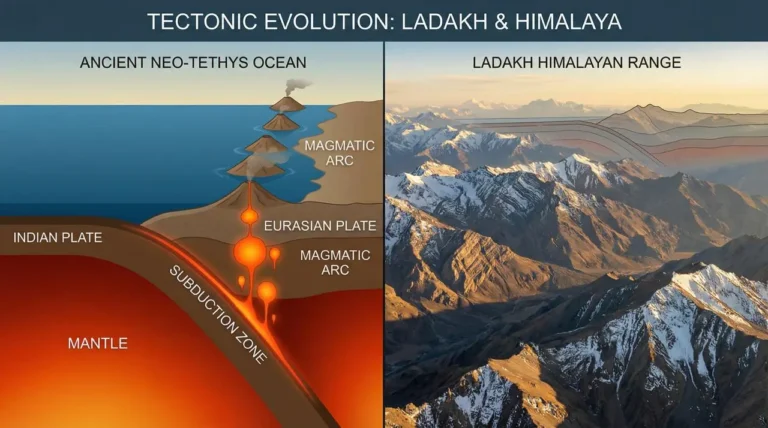
Process of Formation
• Originated due to subduction of oceanic crust beneath the Neo-Tethys Ocean.
• Subduction triggered volcanic activity, leading to arc formation.
• Over millions of years, evolved into batholiths and dykes after continental collision.
Such core concepts are frequently covered in UPSC online coaching and structured UPSC coaching in Hyderabad programs.
Significance
• Provides insights into plate tectonics and Himalayan evolution.
• Helps understand magma generation, crustal processes, and mountain building.
• Important for geological research and mapping India’s tectonic past.
These topics are crucial for aspirants studying through Hyderabad IAS coaching programs, especially for GS Paper 1.
Conclusion
The Ladakh Magmatic Arc is a geological archive of the Himalaya’s tectonic journey from oceanic subduction to continental collision. Its study highlights the dynamic processes that shaped the Indian subcontinent. For aspirants preparing through IAS coaching in Hyderabad, UPSC coaching in Hyderabad, and civils coaching in Hyderabad, such geography topics are essential for mastering UPSC preparation.
This topic is available in detail on our main website.