
The Indian Institute of Science (IISc) has launched a Moonshot Project to develop advanced brain co-processors — a cutting-edge development in neuroscience and artificial intelligence often discussed in UPSC coaching in Hyderabad while analysing emerging technologies in GS3 Science and Technology.
Moonshot Project
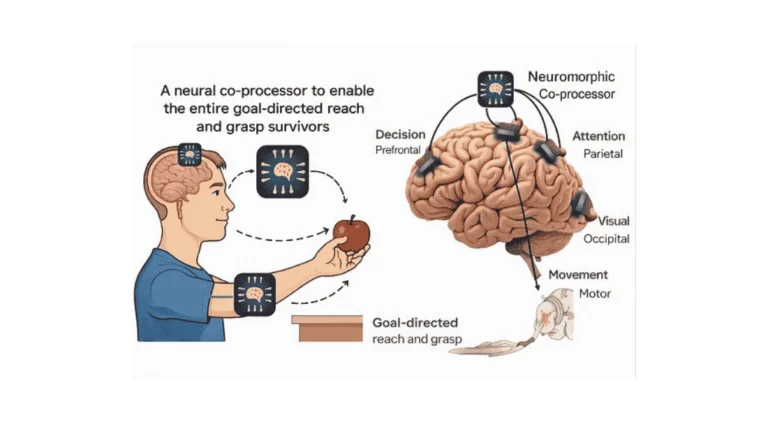
• Objective: To design implantable and non-invasive brain co-processors that can decode brain signals, process them using AI, and re-encode them back into the brain through stimulation or feedback.
• Technology:
• AI-powered closed-loop devices connecting different brain regions.
• Neuromorphic hardware mimicking natural brain processes.
• Origin: Evolved from a pilot project under IISc’s Brain, Computation and Data Science initiative.
• Funding: Supported by the Pratiksha Trust.
Key Features
• Brain Co-processors: Emerging technology designed to enhance natural brain abilities in real-life situations.
• Multidisciplinary Approach: Combines neuroscience, artificial intelligence, engineering, and medical sciences.
• Application: Focused on restoring sensorimotor functions, especially after stroke.
Significance
Medical Impact
• Helps in rehabilitation of stroke survivors.
• Supports restoration of critical functions like goal-directed reach and grasp.
Innovation
• Represents the first brain co-processor initiative of its kind in India.
Future Potential
• Could enable advanced cognitive rehabilitation and treatment of neurological disorders — topics often discussed in IAS coaching in Hyderabad while studying emerging biomedical technologies.
Conclusion
The Moonshot Project marks a significant advancement in India’s neuroscience and AI research ecosystem, aiming to integrate technology with medicine to improve human health. Such innovations highlight India’s growing capability in frontier technologies — a theme frequently covered in UPSC online coaching and civils coaching in Hyderabad for GS3 science and technology preparation.
This topic is available in detail on our main website.