

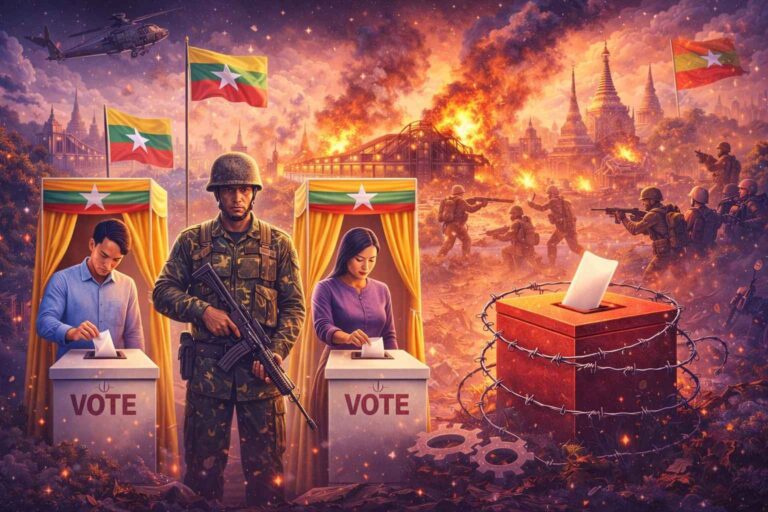
Myanmar’s military regime (the Tatmadaw) is conducting three-phase elections amid continuing civil conflict and political instability. These polls have attracted widespread international criticism for being neither free nor fair, with key democratic forces excluded. The developments are closely tracked in GS Paper II discussions by aspirants preparing through UPSC coaching in Hyderabad.
Context of Elections
- After the February 2021 coup, civilian leaders including Aung San Suu Kyi and members of the National League for Democracy (NLD) were detained.
- The Union Election Commission (UEC) was reconstituted with promilitary personnel.
- Armed resistance by People’s Defence Forces and Ethnic Armed Organisations (EAOs) has eroded Tatmadaw’s control over large rural areas.
- Elections are not being held in several constituencies due to security concerns, and turnout remains very low.
Why the Tatmadaw is Pushing Ahead
- The military seeks domestic and international legitimacy through elections.
- By holding polls, it aims to project a façade of civilian governance while retaining dominance.
- Arrests under the Election Protection Law (2025) and use of electronic voting machines raise concerns of coercion and manipulation.
Major Parties Absent
- NLD dissolved after refusing to register under new stringent laws.
- Regional parties like Arakan National Party (ANP) and Shan Nationalities League for Democracy (SNLD) were denied registration.
- With opposition sidelined, militarybacked parties such as the Union Solidarity and Development Party (USDP) face little competition.
- USDP is already winning uncontested seats, strengthening Tatmadaw’s grip.
Electoral System and Military Advantage
- Lower House: FirstPastthePost (FPTP) system.
- Upper House & State legislatures: Proportional Representation (PR) + FPTP.
- PR system prevents any single party from securing a majority, unlike NLD’s victories in 2015 and 2020.
- Constitution reserves 25% of seats for the military, ensuring Tatmadaw’s dominance regardless of results.
International Response
- ASEAN has excluded Myanmar’s military leaders from high-level summits.
- The UN, Japan, the EU, and Australia have criticised the elections as polarising and non-inclusive.
- China and Russia sent observers, signalling tacit support for the regime.
- The United States’ recent easing of certain sanctions has raised concerns about prioritising economic interests over democratic principles—an issue often debated in IR classes at Hyderabad IAS coaching.
What Lies Ahead
- Genuine peace requires a federal democratic framework and resolution of ethnic conflicts.
- Current elections are unlikely to deliver reform; instead, they reinforce military dominance.
- Myanmar’s path to stability depends on balancing internal reconciliation with external geopolitical pressures.
Conclusion
- Sustainable peace requires a federal democratic framework and credible resolution of long-standing ethnic conflicts.
- The current electoral exercise is unlikely to produce meaningful reform and instead entrenches military authority.
- Myanmar’s stability will depend on internal reconciliation combined with calibrated international engagement, a recurring theme in civils coaching in Hyderabad.
This topic is available in detail on our main website.