
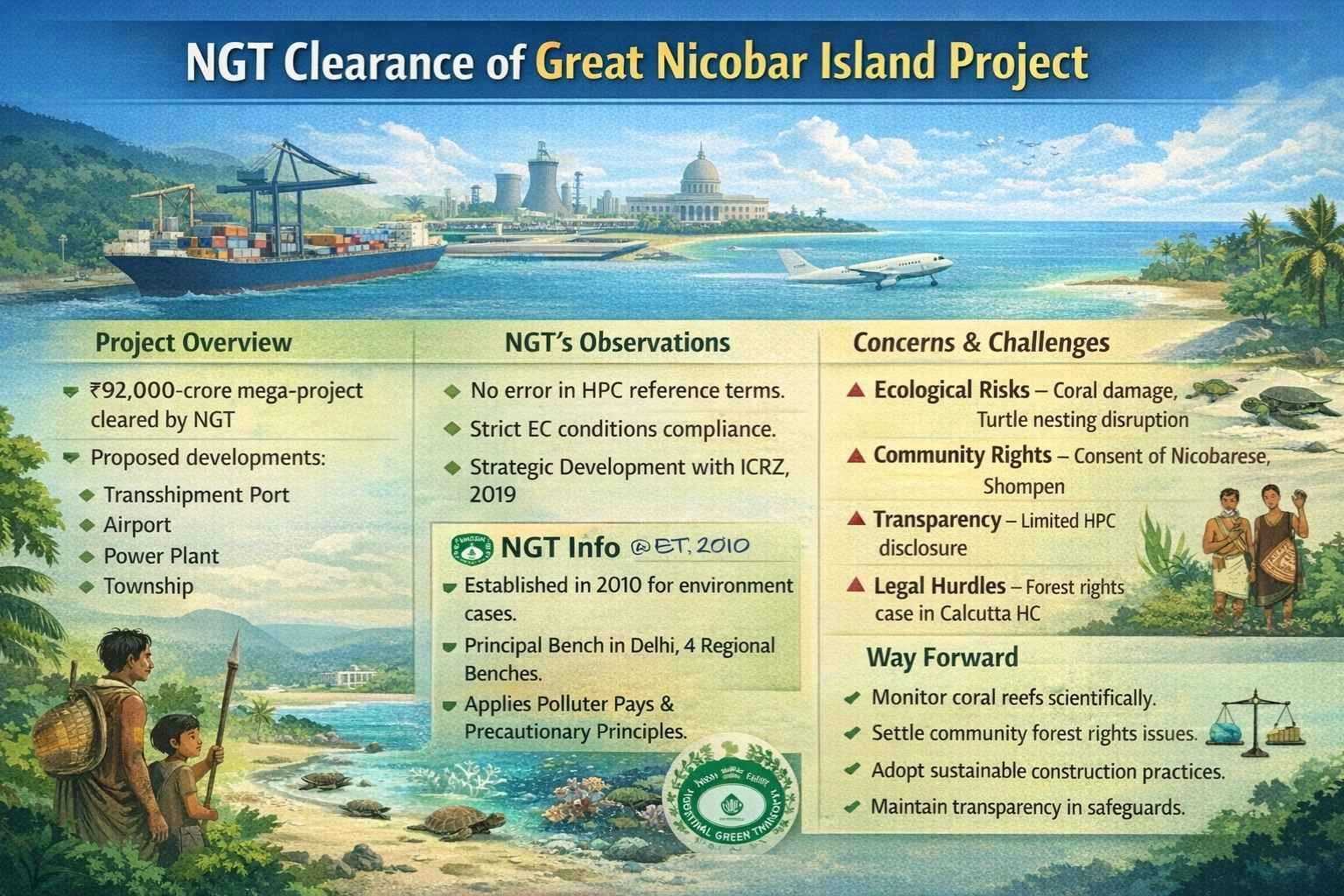
The National Green Tribunal (NGT) has cleared the ₹92,000-crore Great Nicobar Island mega-infrastructure project, stating that adequate environmental safeguards are in place and no grounds exist to interfere with its clearance — a development of high relevance for aspirants preparing through UPSC coaching in Hyderabad.
• Proposed development includes: Transshipment port, Airport, Power plant, Township
• Environmental clearance (EC) was granted in 2022. Project considered of strategic and national importance.
NGT’s Observations
• Found no error in the High-Powered Committee (HPC) terms of reference.
• Directed strict compliance with EC conditions.
• Stressed a balanced approach: strategic development must align with ICRZ Notification, 2019.
• Environment Ministry tasked with: Protecting coral reefs. Ensuring shoreline stability. Preparing an implementation plan for coral regeneration.
Concerns Raised by Applicants
• Alleged inadequate examination of ecological issues (coral reefs, turtle nesting sites).
• Claimed EIA was limited to one season, not three as required.
• Objected to project location in ecologically sensitive zones.
• Local communities (Nicobarese, Shompen) argued: Their consent was not lawfully taken. Forest rights not settled before project approval.
Challenges
• Ecological risks – coral reef damage, turtle nesting disruption, shoreline erosion.
• Community rights – concerns of indigenous groups over displacement and forest land use.
• Transparency – limited public disclosure of HPC findings.
• Legal hurdles – forest clearance aspects under challenge in Calcutta High Court.
Way Forward
• Ensure scientific monitoring of coral reefs and shoreline changes.
• Strengthen community consultation and settle forest rights before implementation.
• Adopt sustainable construction practices to minimise ecological damage.
• Maintain transparency and accountability in environmental safeguards.
• Balance strategic needs with ecological protection to avoid long-term damage — a governance theme frequently analysed in IAS coaching in Hyderabad.
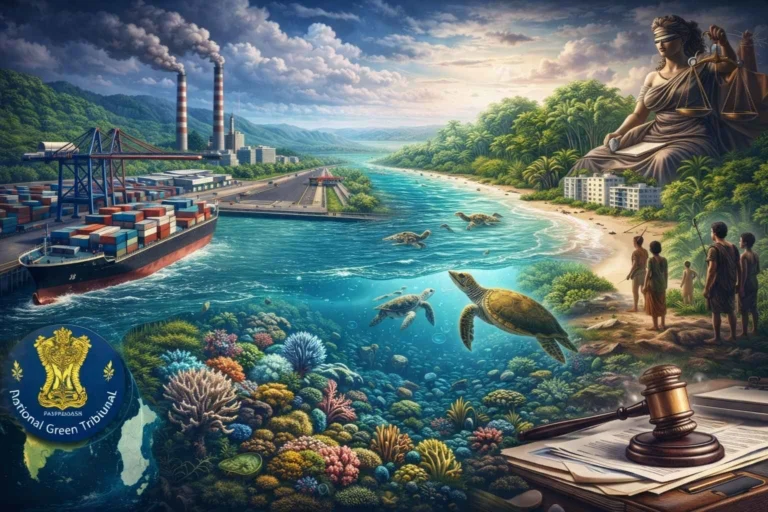
National Green Tribunal (NGT)
Constituted in 2010 under the National Green Tribunal Act, 2010. Provides a specialised forum for effective and speedy disposal of cases relating to environmental protection, conservation of forests, and natural resources — an important topic covered in UPSC online coaching modules.
Jurisdiction
• Deals with cases under laws like the Environment Protection Act (1986), Forest Conservation Act (1980), Air Act (1981), Water Act (1974), and Biological Diversity Act (2002).
• Can hear appeals against orders of authorities under these laws.
Composition
• Headed by a Chairperson (retired Supreme Court Judge or Chief Justice of High Court).
• Includes Judicial Members and Expert Members with knowledge in environmental science, forestry, ecology, etc.
Powers
• Has powers of a civil court.
• Can provide relief, compensation, and restitution of damaged environment.
• Decisions are binding and appealable only in the Supreme Court.
Principles Applied:
• Polluter Pays Principle – those who pollute must bear the cost of managing pollution.
• Precautionary Principle – preventive measures must be taken even if scientific certainty is lacking.
• Sustainable Development – balance between development and environmental protection.
Benches
• Principal Bench: New Delhi.
• Regional Benches: Bhopal, Pune, Kolkata, Chennai.
Conclusion
Effective safeguards, transparent monitoring, and respect for indigenous rights will be crucial to ensure that development does not compromise environmental sustainability and social justice.
This topic is available in detail on our main website.