
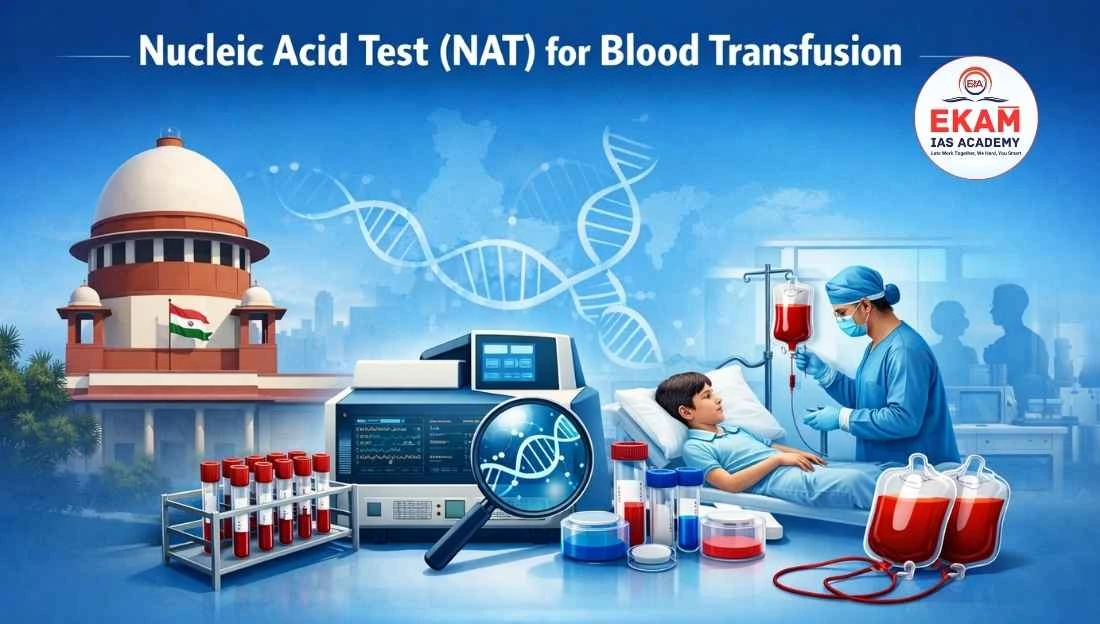
The Supreme Court of India is examining whether the Nucleic Acid Test (NAT) should be made compulsory in blood banks to ensure safer blood transfusions, following petitions citing risks of transfusion-related infections — a public health issue frequently analysed in UPSC coaching in Hyderabad.
Background of the Case
• A petition filed by an NGO argued that safe blood transfusion is part of the fundamental right to life under Article 21.
• The plea highlighted that NAT is more sensitive than current screening methods and can prevent infections like HIV, Hepatitis B, and Hepatitis C.
• The Court has sought data on cost-effectiveness, feasibility, and State-level implementation before deciding.
What is NAT?
• NAT is a molecular diagnostic technique that detects the genetic material (DNA/RNA) of viruses in donated blood.
• It reduces the window period between infection and detectability, making transfusions safer.
• Current practice in India relies mainly on ELISA tests, which are cheaper but less sensitive in early infection stages.
Constitutional Dimension
• The petitioner argued that access to safe blood is part of the right to health and dignity under Article 21.
• The Supreme Court has previously interpreted Article 21 broadly to include healthcare and public safety.
• Making NAT mandatory would align with the State’s duty to protect public health — a governance theme often discussed in IAS coaching in Hyderabad.
Cost and Feasibility Concerns
• The Court raised concerns about whether economically weaker States can afford NAT implementation.
• Infrastructure, trained personnel, and financial resources are required for nationwide adoption.
• The Court has asked for details on where NAT is currently used and its operational status across States.
Public Health Context
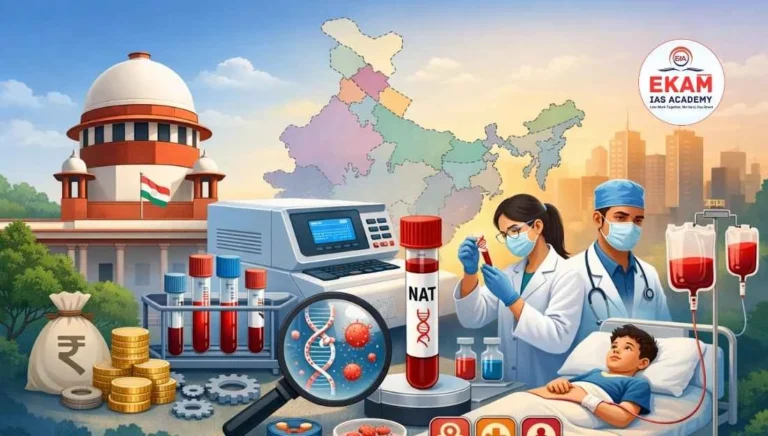
• Reported cases of children contracting HIV from contaminated transfusions have intensified debate.
• Thalassemia patients, who need frequent transfusions, are especially vulnerable.
• Incidents in Madhya Pradesh and Jharkhand highlight gaps in current screening systems.
Policy and Regulatory Framework
• Blood safety is regulated under the Drugs and Cosmetics Act, 1940, supervised by the National Blood Transfusion Council (NBTC).
• Mandatory screening currently includes HIV, Hepatitis B & C, malaria, and syphilis, but NAT is not compulsory.
• Introducing NAT nationwide would require upgraded labs, skilled staff, and higher financial allocations — an issue relevant for aspirants preparing through UPSC online coaching and civils coaching in Hyderabad.
Conclusion
The Supreme Court’s decision will have significant implications for India’s health governance and the constitutional right to safe medical care, making it an important GS2–GS3 intersection topic for those enrolled in UPSC coaching in Hyderabad.
This topic is available in detail on our main website.