
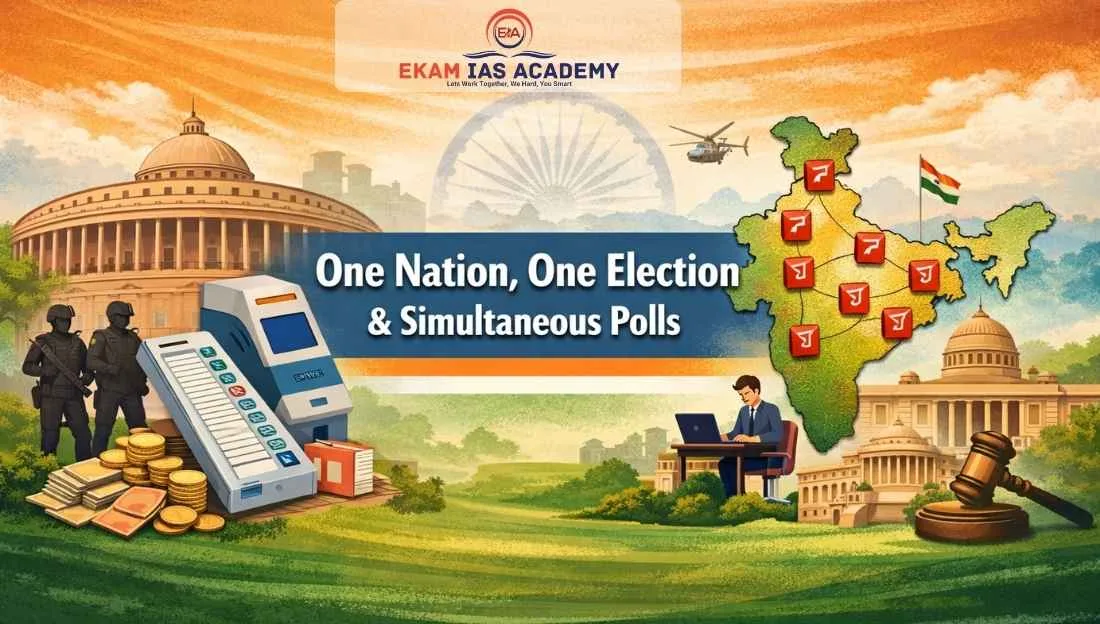
The One Hundred and Twenty-ninth Constitutional Amendment Bill, 2024 proposes synchronising Lok Sabha and State Assembly elections across India — a major electoral reform frequently discussed in UPSC coaching in Hyderabad while analysing governance and constitutional debates.
Why ONOE is Considered Important
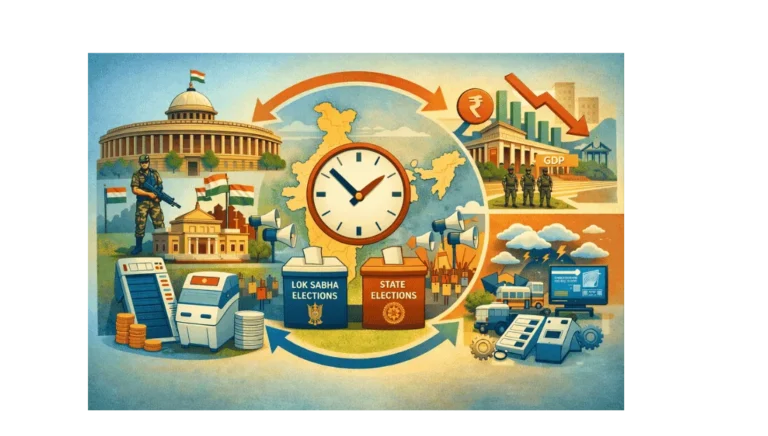
• Cost Reduction: Current election costs are about ₹4,500 crore (2015–16), nearly 0.25% of the Union Budget and 0.03% of GDP.
• Administrative Efficiency: Limits prolonged deployment of security forces and reduces disruption caused by the Model Code of Conduct (MCC).
• Governance Focus: Avoids governments being in constant campaign mode, allowing greater focus on policy implementation.
• Political Stability: Synchronisation could provide longer policy continuity and reduce political uncertainty.
Economic Impact of Frequent Elections
• Multiple State Elections: India holds elections almost every year in different states, leading to repeated costs for EVMs, VVPATs, and security forces.
• GDP Share: Lok Sabha election costs historically range between 0.02%–0.05% of GDP (1957–2014) — small but recurring.
• Election Commission View: Simultaneous polls would require massive resources upfront (more EVMs, VVPATs, security personnel), but reduce repeated cycles of expenditure — issues often analysed in IAS coaching in Hyderabad for polity and governance.
Concerns
• Federalism Issues: Curtailing State Assembly terms could undermine federal principles and legislative accountability.
• Mid-term Elections: “Unexpired-term elections” may weaken voter trust and democratic continuity.
• Risk of President’s Rule: If elections are deferred for synchronisation, it could lead to prolonged President’s Rule in certain states.
Way Forward
Strengthen Electoral Infrastructure
• Increase EVM/VVPAT stock, improve logistics, and enhance digital monitoring.
Phased Synchronisation
• Begin with aligning local body elections with State polls before implementing nationwide synchronisation.
Consensus Building
• Consult States, Election Commission, and political parties to ensure reforms respect federal principles and the basic structure doctrine — a debate widely covered in UPSC online coaching.
Conclusion
The One Nation, One Election (ONOE) proposal promises cost savings and administrative efficiency, but it also raises concerns about federalism, democratic accountability, and constitutional safeguards. India must carefully balance administrative convenience with democratic principles, ensuring reforms do not compromise the basic structure of the Constitution — a key discussion point in civils coaching in Hyderabad for GS2 polity preparation.
This topic is available in detail on our main website.