

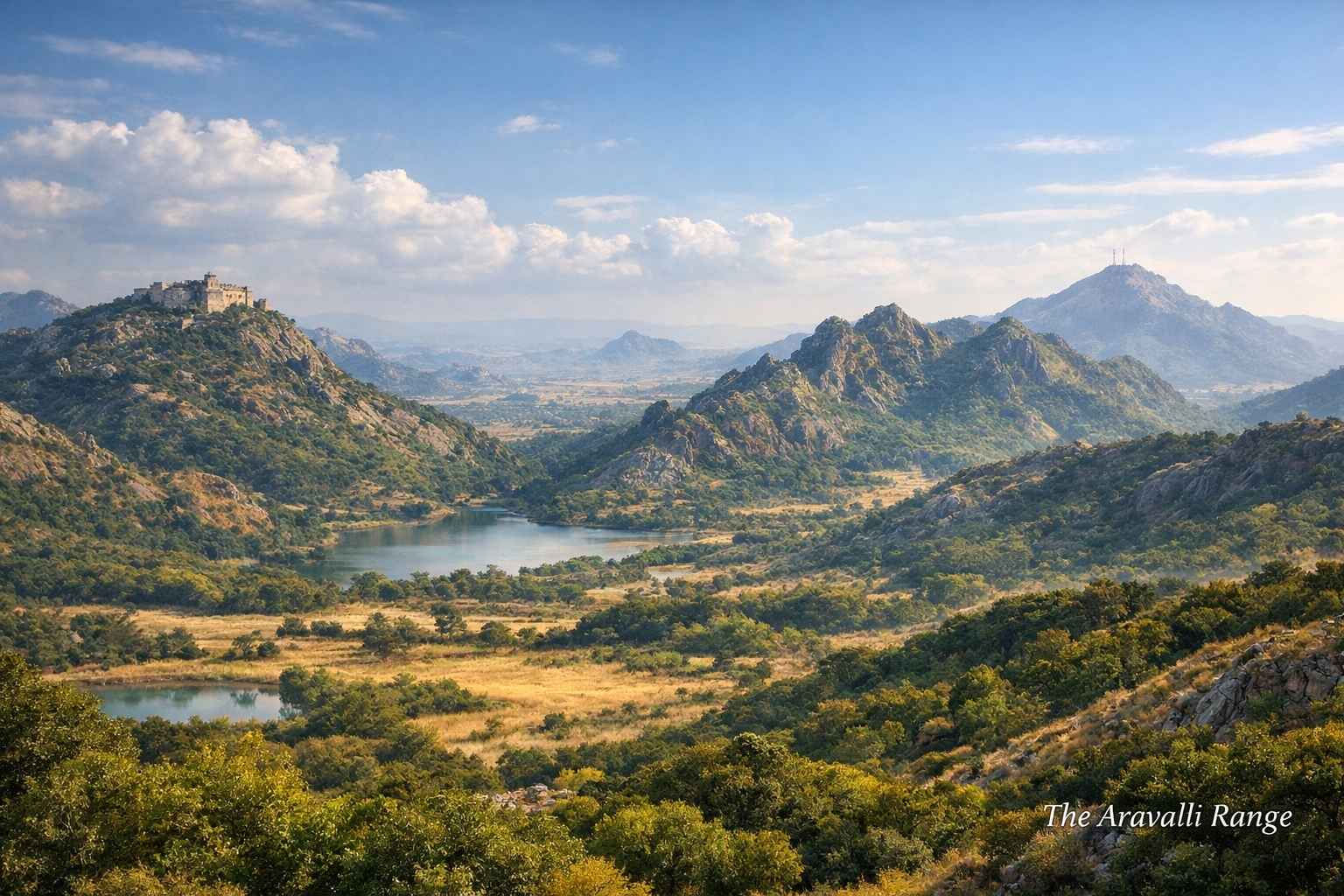
The Supreme Court approved a new definition of the Aravalli Hills (November 2025) based on local elevation, triggering criticism from environmental experts. The issue has significant implications for environmental governance, geography, and sustainable development—core areas of focus for aspirants preparing through UPSC coaching in Hyderabad.
Importance of the Aravalli Range
- One of the oldest mountain ranges in the world, stretching across Gujarat, Rajasthan, Haryana, and Delhi.
- Acts as a natural barrier against desertification and supports groundwater recharge, biodiversity, and climate moderation in north-west India.
- Ecologically crucial for Delhi–NCR air quality and long-term water security, making it a frequently discussed case study in the geography optional syllabus.
New Definition of Aravalli Hills
- Approved definition includes Landforms rising at least 100 metres above the local surrounding terrain. Their slopes and adjoining areas.
- Elevation will be measured from the local profile, not from a uniform baseline.
Why This Matters
- Using a local profile may exclude genuine hills if nearby land is already elevated.
- Critics argue this could reduce the officially recognised Aravalli footprint.
What Remains Protected
- Areas already notified under other laws continue to enjoy protection:
- Tiger reserves, national parks, wildlife sanctuaries
- Eco-sensitive zones and wetlands
- Compensatory afforestation areas
- Mining or development here remains restricted unless permitted by law.
Limits of Protection
- Such protections are not permanent and can be altered.
- Example: Attempt to dilute Sariska Tiger Reserve boundaries was stopped only after Supreme Court intervention.
- Areas Likely to be Excluded: The new rule departs from the Forest Survey of India (FSI) method, which used Minimum elevation (115 m in Rajasthan) + Slope of at least 3 degrees
- Rajasthan, which hosts nearly two-thirds of the Aravallis, faces the largest exclusions.
- Districts Dropped: Several districts earlier recognised as Aravalli regions are now excluded, such as: Sawai Madhopur (near Ranthambhore) Chittorgarh (Aravalli outcrop with UNESCO fort)
Scale of Exclusion
- Under the FSI method, Aravallis covered about 40,000 sq km in Rajasthan.
- Applying the new 100-metre benchmark could exclude over 99% of these identified hill areas, drastically shrinking the recognised range.
Mining and Government’s Stand
- The government maintains that mining is permitted in only 0.19% of the Aravalli area.
- Critics argue that this figure is misleading, as it is calculated based on entire districts rather than the actual hill ecosystem.
- Concerns persist regarding illegal mining, future expansion, and cumulative ecological damage—issues often debated in environmental governance discussions within civils coaching in Hyderabad.
ARAVALLI RANGE
Oldest Fold Mountain Range in India and among the oldest in the world (Pre-Cambrian age).
- Extends in a south-west to north-east direction across north-western India.
- Length: about 690 km.
- States covered: Gujarat, Rajasthan, Haryana, Delhi.
Origin & Geological Structure
- Formed due to tectonic activity during the Proterozoic era.
- Highly eroded and discontinuous due to long geological history.
- Composed mainly of igneous and metamorphic rocks (gneiss, schist, quartzite).
- Rich in minerals: copper, zinc, lead, marble, limestone.
Highest Peaks
- Guru Shikhar (Mount Abu, Rajasthan) – 1,722 m (highest peak).
Regional Importance
- Acts as a climatic divide:
- East: comparatively more rainfall
- West: arid and semi-arid conditions (Thar Desert side)
- Prevents eastward spread of the Thar Desert.
- Influences the path of the south-west monsoon winds.
Conclusion
The Supreme Court’s redefinition of the Aravalli Hills risks drastically shrinking their protected footprint and weakening long-standing ecological safeguards. Given the range’s critical role in biodiversity conservation, climate resilience, and sustainable development in north-west India, preserving the integrity of the Aravallis remains a pressing environmental priority—one that demands careful legal, scientific, and policy scrutiny by future administrators trained through UPSC online coaching platforms.
This topic is available in detail on our main website.