
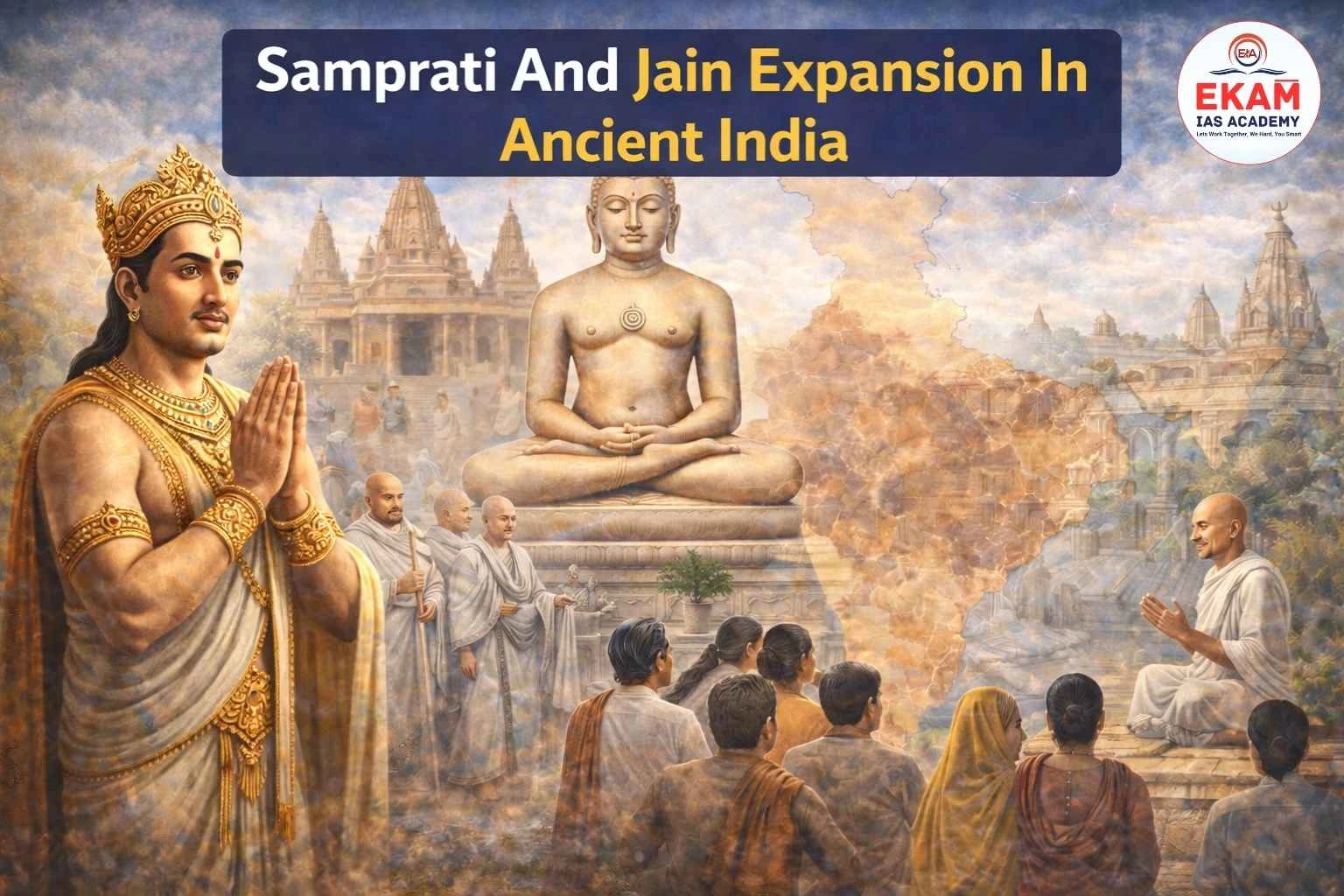
On Mahavir Jayanti, the Prime Minister inaugurated the Samrat Samprati Museum in Gandhinagar, highlighting Samprati’s role in promoting Jainism after the Mauryan era. Such art and culture topics are important for aspirants preparing through IAS coaching in Hyderabad, UPSC online coaching, and other civil services preparation platforms.
Background
• Mauryan context: The Mauryan Empire (3rd century BCE) is best known for Ashoka’s promotion of Buddhism, but Jainism also remained influential during and after this period.
• Family links: Jain traditions record that Chandragupta Maurya embraced Jainism; Samprati is remembered in Shvetambara texts as Ashoka’s grandson who championed Jain faith.
Understanding such historical themes is essential for students preparing through UPSC coaching in Hyderabad and Hyderabad IAS coaching institutes, especially for GS Paper 1.
Samprati’s Conversion and Reign
• Conversion: Jain sources describe Samprati as a devoted follower who adopted Jain practices after guidance from monk Suhastin at Ujjain.
• Rule: He is traditionally dated to the early 3rd century BCE and is portrayed as a ruler who used his authority to support religious work rather than for political expansion.
These aspects are often discussed in IAS coaching and civils coaching in Hyderabad for better understanding of ancient Indian history.
How Samprati Spread Jainism (Key Methods)
• Missionary outreach: Sent monks and teachers to distant regions to preach Jain doctrines and establish local sanghas.
• Temple and icon patronage: Commissioned construction and renovation of temples and installed images of the Jinas to encourage public worship.
• Institutional support: Founded charitable centres and religious institutions to sustain monastic communities and lay followers.
• Cultural integration: Promoted daily devotional practices and rituals that helped embed Jainism in local societies.
Such cultural developments are frequently analysed in UPSC online coaching and structured UPSC coaching in Hyderabad programs.
Regional Reach and Impact
• Peninsular and western India: Traditions credit Samprati with strengthening Jain presence in Andhra, Tamil Nadu, Karnataka, Maharashtra and Gujarat.
• North and central India: Activities in Malwa and Rajputana helped consolidate Jain communities there.
• Broader claims: Later texts extend his influence to neighbouring regions and parts of Central and West Asia, reflecting the long memory of his patronage.
These topics are important for aspirants studying through IAS coaching in Hyderabad and Hyderabad IAS coaching programs.
Legacy and Historical Sources
• Textual record: Accounts of Samprati appear in medieval works such as Samprati Nripa Charitra, Sampratikatha, Parishistaparva and Prabhavakcharita.
• Tradition vs. history: Many numerical claims (temple counts, icon installations) are hagiographic; they signal wide reverence rather than precise historical fact.
• Comparative role: In Jain memory, Samprati occupies a role similar to Ashoka’s in Buddhism — a royal patron who institutionalised and spread a religion.
These discussions are commonly covered in IAS coaching and civils coaching in Hyderabad for GS1 preparation.
Conclusion
Samprati’s active patronage, missionary activity and temple-building helped Jainism gain durable roots across regions. His legacy remains central to Jain historical identity. For aspirants preparing through IAS coaching in Hyderabad, UPSC coaching in Hyderabad, and UPSC online coaching, such topics are crucial for understanding Indian culture and religious movements in UPSC.
This topic is available in detail on our main website.