
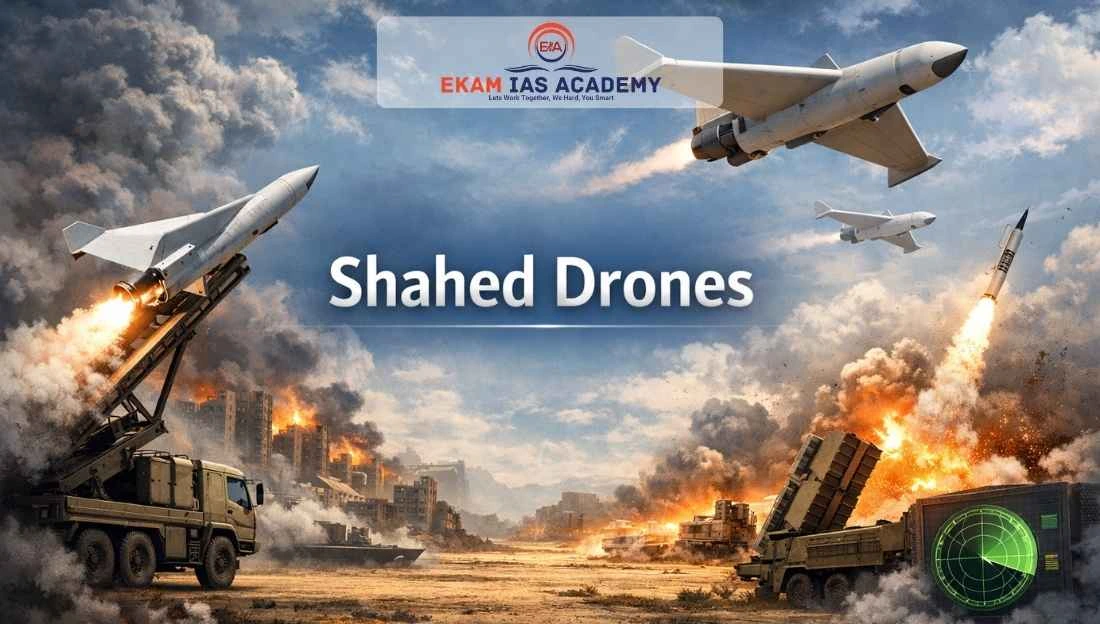
The United States recently expressed concern over the growing use and capabilities of Iran’s Shahed drones in global conflict zones — a development relevant to modern warfare technologies often discussed in UPSC coaching in Hyderabad under GS3 security and defence technology.
Shahed Drones
• Origin: Developed by Iran; “Shahed” means witness in Farsi.
• Type: Low-cost one-way attack drones (OWA UAVs), also called “kamikaze” or “suicide drones”.
• Function: Fly toward a target and explode on impact, acting like guided missiles.
Variants
• Shahed-131: Range of 700–900 km.
• Shahed-136: Longer range of 2,000–2,500 km.
• Russia refers to them as Geran-1 and Geran-2.
Key Features
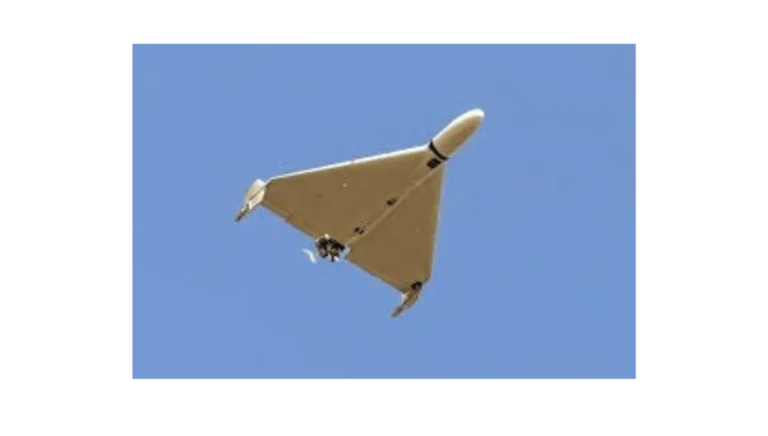
• Size & Weight: Around 2.5–3 metres long; launch weight about 200 kg.
• Launch System: Uses a disposable rocket booster, followed by a piston engine.
• Navigation: Combines civilian GPS/GLONASS with inertial navigation systems (INS).
• Warheads: Can carry high-explosive, thermobaric, or shrapnel-filled munitions.
• Deployment: Can be launched from static mounts or mobile vehicles.
Strategic Significance
• Cost Advantage: Estimated cost between $20,000–$50,000, far cheaper than cruise or ballistic missiles.
• Tactical Use: Often deployed in swarms to overwhelm air defence systems from multiple directions.
• Nickname: Often called the “poor man’s cruise missile” due to affordability and operational effectiveness — a concept frequently analysed in IAS coaching in Hyderabad while studying modern military technologies.
Conclusion
Shahed drones represent a new era of low-cost aerial warfare, significantly influencing modern conflict strategies. Their increasing use in global conflicts raises concerns about defence preparedness, drone warfare regulation, and international security, issues commonly covered in UPSC online coaching and civils coaching in Hyderabad for GS3 security and technology preparation.
This topic is available in detail on our main website.