

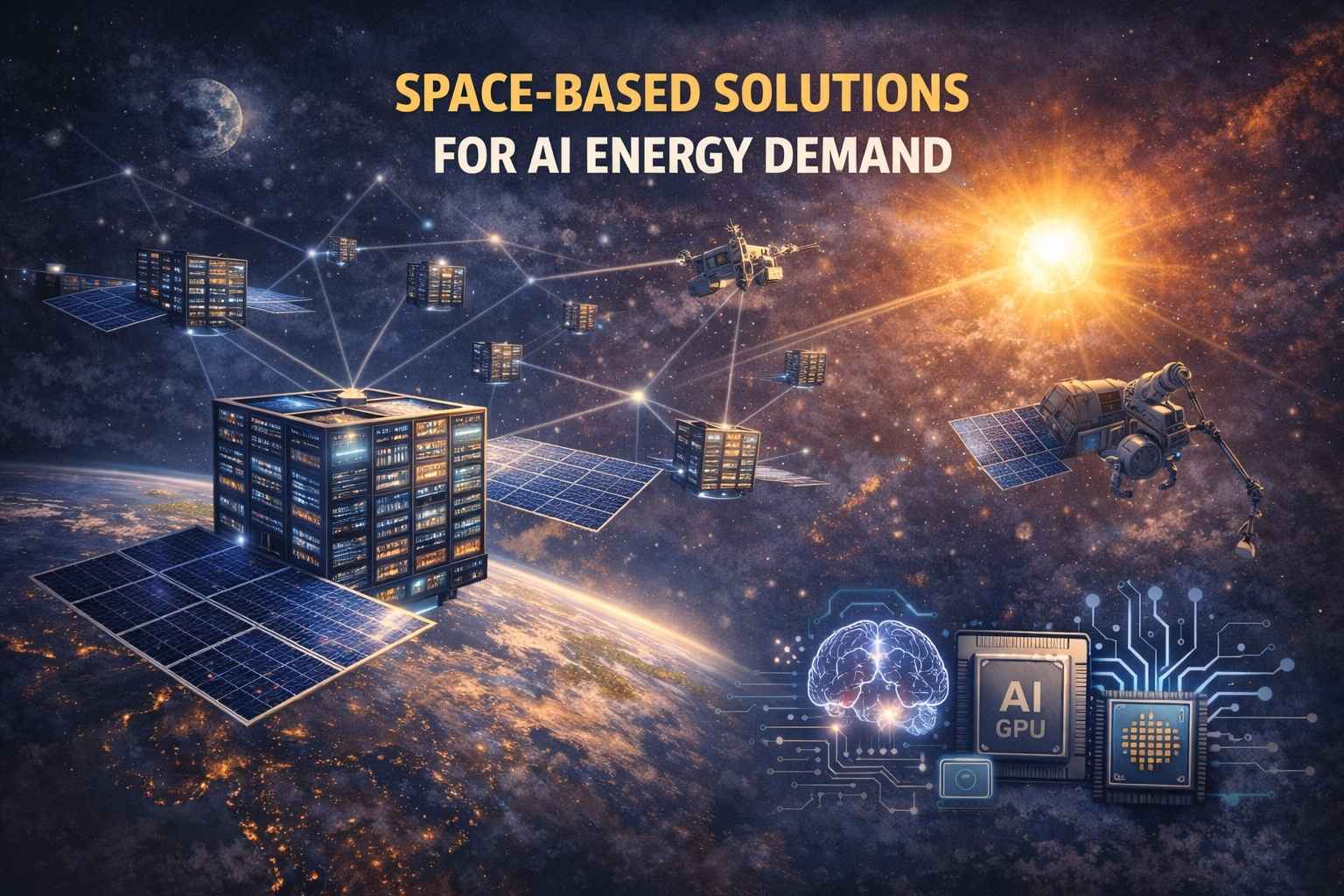
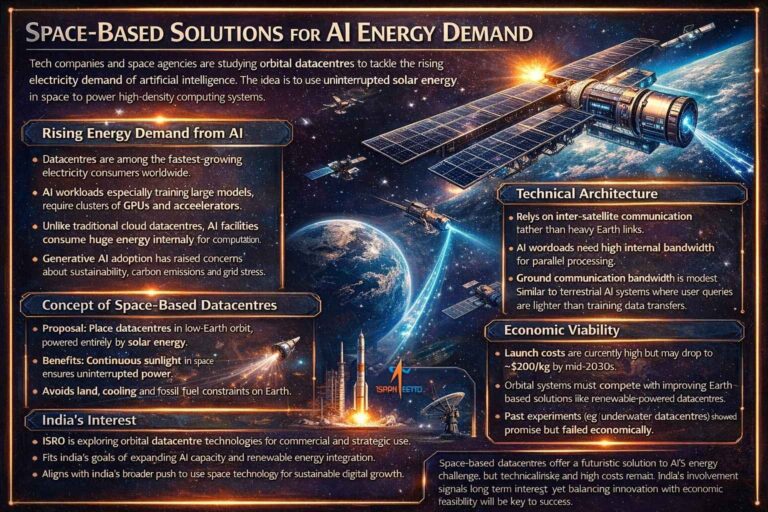
Tech companies and space agencies are studying orbital datacentres to tackle the rising electricity demand of artificial intelligence. The idea is to use uninterrupted solar energy in space to power high-density computing systems—an emerging GS-III science & technology theme often discussed in IAS coaching in Hyderabad.
Rising Energy Demand from AI
- Datacentres are among the fastest-growing electricity consumers worldwide.
- AI workloads, especially training large models, require clusters of GPUs and accelerators.
- Unlike traditional cloud datacentres, AI facilities consume huge energy internally for computation.
- Generative AI adoption has raised concerns about sustainability, carbon emissions, and grid stress—topics regularly analysed in UPSC online coaching programs.
Concept of Space-Based Datacentres
- Proposal: Place datacentres in low-Earth orbit, powered entirely by solar energy.
- Benefits: Continuous sunlight in space ensures uninterrupted power. Avoids land, cooling, and fossil fuel constraints on Earth.
- Example: Google’s Project Suncatcher envisions satellite clusters with computing hardware operating in choreographed orbits.
Such frontier technologies are increasingly relevant for answer enrichment in GS-III and essays prepared through Hyderabad IAS coaching.
Technical Architecture
- Relies on inter-satellite communication rather than heavy Earth links.
- AI workloads need high internal bandwidth for parallel processing.
- Ground communication bandwidth is modest, similar to terrestrial AI systems where user queries are lighter than training data transfers.
Engineering Challenges
- Radiation exposure: Cosmic rays can degrade chips; long missions remain risky.
- Thermal management: No atmosphere in space makes cooling difficult; advanced heat dissipation needed.
- Maintenance: Repairs in orbit are costly and complex, raising reliability concerns.
Economic Viability
- Launch costs are currently high but may drop to ~$200/kg by mid-2030s.
- Orbital systems must compete with improving Earth-based solutions like renewable-powered datacentres.
- Past experiments (e.g., underwater datacentres) showed promise but failed economically.
India’s Interest
- ISRO is exploring orbital datacentre technologies for commercial and strategic use.
- Fits India’s goals of expanding AI capacity and renewable energy integration.
- Aligns with India’s broader push to use space technology for sustainable digital growth.
Conclusion
Space-based datacentres offer a futuristic solution to AI’s energy challenge, but technical risks and high costs remain. India’s involvement signals long-term interest, yet balancing innovation with economic feasibility will be key to success.
This topic is available in detail on our main website.