
The Supreme Court ruled that telecom service providers (TSPs) do not own spectrum, clarifying that it is a scarce natural resource vested in the Union of India and cannot be treated as an asset under insolvency or liquidation proceedings — a crucial constitutional and regulatory issue often analysed in UPSC coaching in Hyderabad.
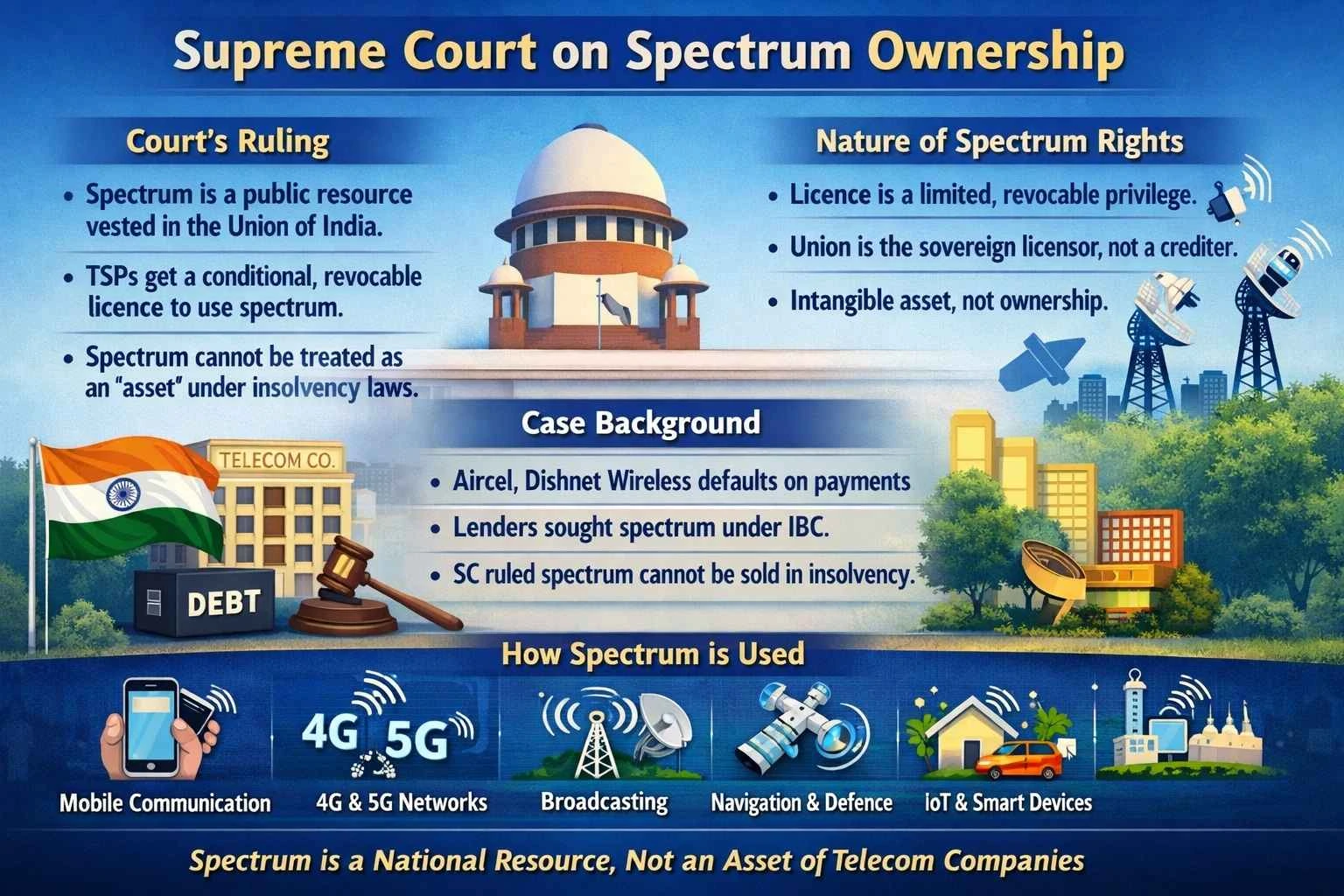
Court’s Ruling
- Spectrum is a finite public resource, owned by the people of India, with legal title vested in the Union government.
- TSPs only receive a conditional, revocable licence to use spectrum, not ownership rights.
- Spectrum cannot be listed as an “asset” for insolvency resolution under the Insolvency and Bankruptcy Code (IBC).
Nature of Spectrum Rights
- Recognition of spectrum in financial statements as an intangible asset does not mean ownership.
- Licence grants only a limited privilege, subject to statutory rules, licence conditions, and public interest.
- Relationship between Union and TSPs is sovereign licensor–licensee, not creditor–debtor — a distinction frequently discussed in IAS coaching in Hyderabad under governance and constitutional law.
Case Background
- Involved corporate debtors like Aircel Limited, Aircel Cellular, and Dishnet Wireless, which defaulted on licence fee payments.
- Lenders, including State Bank of India, sought insolvency resolution under IBC.
- The Department of Telecommunications (DoT) demanded dues before spectrum transfer.
- Supreme Court upheld DoT’s position, rejecting the idea that spectrum could be sold under IBC.
Key Clarifications
- DoT dues are not “operational debts” under IBC; they arise from sovereign privilege, not commercial transactions.
- IBC cannot override telecom laws or restructure spectrum rights.
- TRAI and DoT retain exclusive authority over spectrum administration — an important regulatory principle highlighted in UPSC online coaching.
Telecom Spectrum
What is Telecom Spectrum?
- Spectrum refers to the range of electromagnetic radio frequencies used for transmitting voice, data, and video signals.
- It is a natural, finite resource owned by the Union of India and held in trust for the public.
- Telecom companies do not own spectrum; they receive licensed rights to use specific frequency bands for a limited period.
How Spectrum is Used
- Mobile Communication – Enables phone calls, SMS, and internet services.
- Data Transmission – Supports 4G, 5G, and upcoming 6G networks.
- Broadcasting – Used in radio, television, and satellite communication.
- Navigation & Defence – Critical for GPS, radar, and secure military communication.
- IoT & Smart Devices – Connects smart appliances, autonomous vehicles, and industrial automation.
Allocation and Regulation
- Managed by the Department of Telecommunications (DoT) and regulated by TRAI (Telecom Regulatory Authority of India).
- Spectrum is allocated through auctions to telecom service providers.
- Usage is subject to licence conditions, fees, and public interest requirements.
Importance
- Spectrum is the backbone of the digital economy, enabling connectivity for billions of users.
- Efficient use ensures better network quality, coverage, and affordability.
- Mismanagement or scarcity can lead to call drops, slow internet, and higher costs — issues regularly examined in civils coaching in Hyderabad.
Conclusion
- The Supreme Court’s verdict reinforces that spectrum is a national resource held in trust by the Union government, not a tradable asset of telecom companies. This ensures public interest, regulatory control, and financial discipline in the telecom sector, while preventing misuse of insolvency laws to bypass statutory dues.
This topic is available in detail on our main website.