

The Supreme Court banned a Class 8 NCERT social science textbook and ordered seizure of all copies (digital and print) — a significant constitutional development often discussed in UPSC coaching in Hyderabad.
Background
• The textbook was published by NCERT in February under the Ministry of Education.
• A three-judge Bench led by CJI Surya Kant took suo motu action, calling the content “reckless, motivated, and contemptuous.”
• The Court initiated contempt proceedings against NCERT officials and the Education Ministry.
Court’s Observations
• The content was seen as a deliberate move to instil bias against the judiciary in young minds.
• The book ignored the judiciary’s role in upholding constitutional morality, basic structure, and access to justice.
• The Court said the publication “washed away the illustrious history of the Supreme Court and High Courts.”
• Solicitor-General offered an unconditional apology, but the Court insisted on deeper accountability — a development closely analysed in IAS coaching in Hyderabad.
Impact on Children’s Perspective
• Trust Deficit – Such content can create negative perceptions about the judiciary among impressionable students.
• Bias Formation – Early exposure to one-sided narratives may lead to long-term mistrust of institutions.
• Loss of Respect – Undermines the judiciary’s image as a guardian of rights and democracy.
Way Forward
• Balanced Curriculum: Textbooks must present objective and holistic views of institutions.
• Accountability: Stronger review mechanisms before publishing educational material.
• Awareness: Promote civic education highlighting the role of judiciary in democracy.
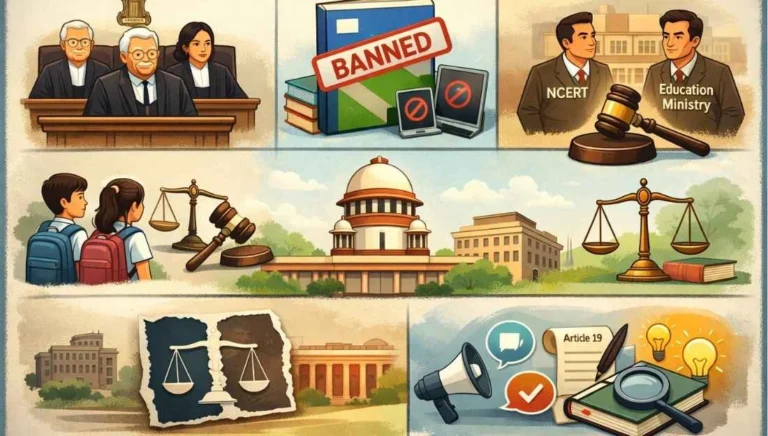
Citizens’ Right to Criticise Organs of Government
• Freedom of Speech (Article 19) – Citizens can criticise government institutions within reasonable limits.
• Constructive Criticism – Criticism should aim at reform and accountability, not defamation.
• Judicial Protection – Courts protect free speech but balance it against contempt jurisdiction to safeguard institutional dignity — a crucial GS2 theme covered in UPSC online coaching and civils coaching in Hyderabad.
Conclusion
The SC’s intervention underscores the sensitivity of shaping young minds through textbooks. While citizens have the right to critique institutions, educational content must remain balanced, factual, and respectful of constitutional values to preserve trust in democracy.
This topic is available in detail on our main website.