
The Union Fisheries Ministry has advised States to diversify fish species and explore new markets to reduce disease risks and strengthen seafood exports, especially amid tariff uncertainties and climate change challenges. This development is relevant for GS Paper III (Agriculture, Economy, Environment) and is closely tracked by aspirants preparing through UPSC coaching in Hyderabad.
Background
- India’s seafood exports face global tariff issues and climate-related disruptions.
- Heavy dependence on a few species increases vulnerability to disease outbreaks.
- Example: In 2006–07, the white spot virus wiped out black tiger shrimp farming.
Government Advisory
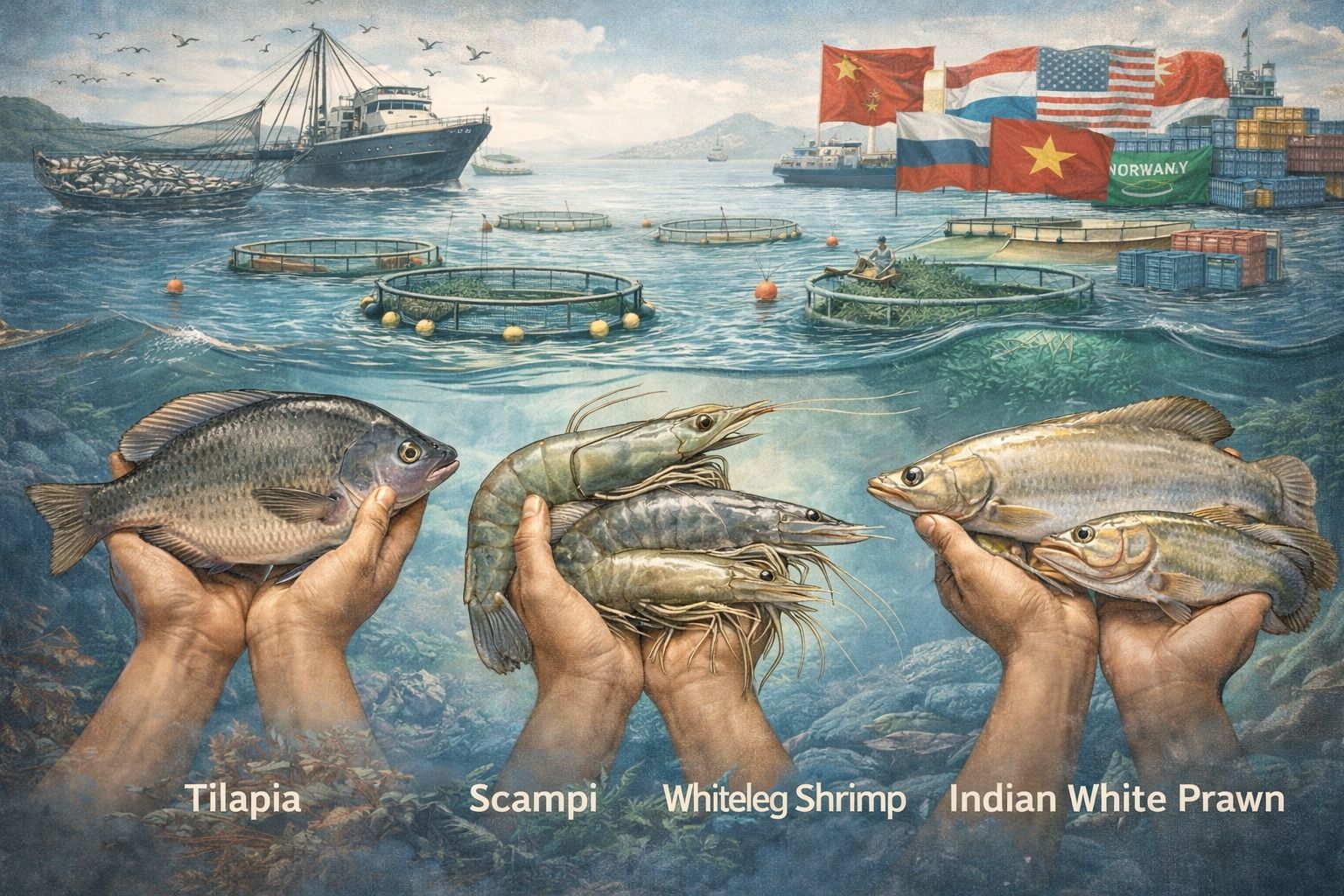
- Diversification of Species: Promote scampi, tilapia, pangasius instead of only rohu and catla (limited global demand).
- Reduce dependence on Litopenaeus vannamei (whiteleg shrimp).
- Indigenous Varieties: Improve Penaeus indicus (Indian white prawn) and Penaeus monodon (giant tiger prawn) for disease-free farming. Both species already have strong export markets in over 100 countries.
- Advanced Practices: Encourage integrated multi-trophic aquaculture (cultivating multiple species together).
Global Demand & Opportunities
- Rising international demand for seabass and Kerala’s karimeen (pearl spot) due to superior meat quality.
- Expansion of brackish water farming in inland States (Punjab, Haryana, Uttar Pradesh, Rajasthan) using saline groundwater.
- Promotion of seaweed and marine cage culture, already successful in countries like China and Norway.
- A recent meeting attended by envoys from 40+ countries explored new export markets and diversification avenues—an issue often discussed in trade and agriculture modules at Hyderabad IAS coaching.
Significance
- Enhances export competitiveness and reduces vulnerability to disease outbreaks.
- Supports farmers’ income, rural employment, and sustainable aquaculture.
- Aligns with India’s goal of becoming a global leader in seafood exports.
India Fisheries Sector
Overall Production
- India ranks 2nd globally in fish production.
- Contributes 8% of global fish output.
- Fisheries sector is considered a “sunrise sector” due to rapid growth.
Marine Fisheries
- India has a coastline of 7,500 km and 2.02 million sq. km Exclusive Economic Zone (EEZ).
- Marine fish production is a major contributor to exports.
- Popular marine species: seabass, pearl spot (karimeen), Indian white prawn, giant tiger prawn.
- Marine exports face challenges like tariff barriers and climate change impacts.
Inland Fisheries & Aquaculture
- Inland fisheries contribute over 65% of total fish production.
- Major inland species: rohu, catla, tilapia, pangasius, scampi.
- Integrated aquaculture practices are being promoted to increase productivity.
- States with saline groundwater (Punjab, Haryana, UP, Rajasthan) are being encouraged to cultivate brackish water species.
Shrimp Market
- Shrimp is India’s largest seafood export item.
- Key species:
- Litopenaeus vannamei (whiteleg shrimp) – dominant in exports.
- Indigenous species being promoted: Penaeus indicus (Indian white prawn) and Penaeus monodon (giant tiger prawn).
- India exports shrimp to 100+ countries, with major markets in the US, EU, Japan, and Southeast Asia.
Employment & Economy
- Fisheries sector sustains ~9 million livelihoods.
- Provides food and nutritional security.
- Union Budget 2025–26 allocated ₹2,703.67 crore – highest ever support for fisheries.
Conclusion
Diversifying fish species and adopting modern aquaculture practices will make India’s fisheries sector more resilient, profitable, and globally competitive, while safeguarding farmers against risks of monoculture farming.
This topic is available in detail on our main website.