
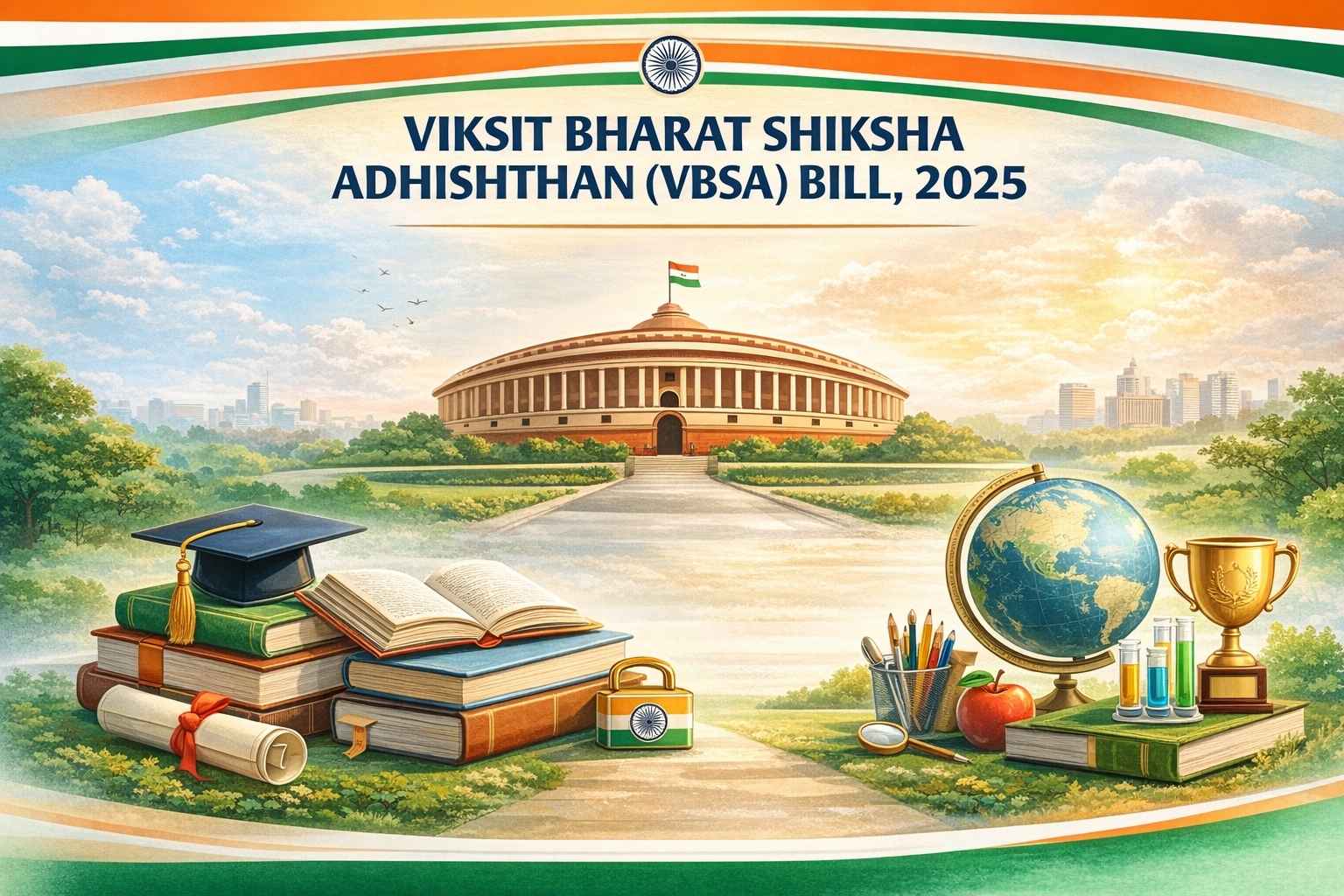
The Union Government has introduced the Viksit Bharat Shiksha Adhishthan (VBSA) Bill, 2025 in Parliament during the Winter Session. The Bill proposes a comprehensive restructuring of India’s higher education regulatory architecture in line with the National Education Policy (NEP) 2020—a key area of focus for aspirants preparing governance reforms through a UPSC Academy in Hyderabad.
Background
- India’s higher education system is regulated by multiple bodies, leading to:
- Overlapping roles
- Multiple approvals
- Inconsistent standards
- To address these issues and implement the vision of NEP 2020, the government has proposed the VBSA Bill.
- The aim is to simplify regulation, improve quality, and modernise governance.
Objectives of the VBSA Bill
The Bill aims to:
- Promote excellence in teaching, learning, research, and innovation
- Ensure better coordination among regulators
- Establish clear academic and institutional standards
It follows the NEP principle of “light but tight” regulation—minimum interference combined with strong accountability, a concept frequently discussed in GS-II classes at the Best IAS Academy in Hyderabad.
Objectives of the VBSA Bill
- Promote excellence in teaching, learning, research and innovation
- Ensure Better coordination among regulators, Clear academic and institutional standards
- Follows the NEP principle of “light but tight” regulation—less bureaucracy with strong accountability.
Structure of the VBSA Framework
- Viksit Bharat Shiksha Adhishthan (VBSA): Apex umbrella commission with 12 members, It supervises three specialised councils:
- Regulatory Council (Viniyaman Parishad): Maintains regulatory norms and Oversees governance standards in HEIs
- Accreditation Council (Gunvatta Parishad): Manages accreditation of institutions and programmes and Promotes an independent accreditation ecosystem
- Standards Council (Manak Parishad): Each council can have up to 14 members, including State representatives and experts.
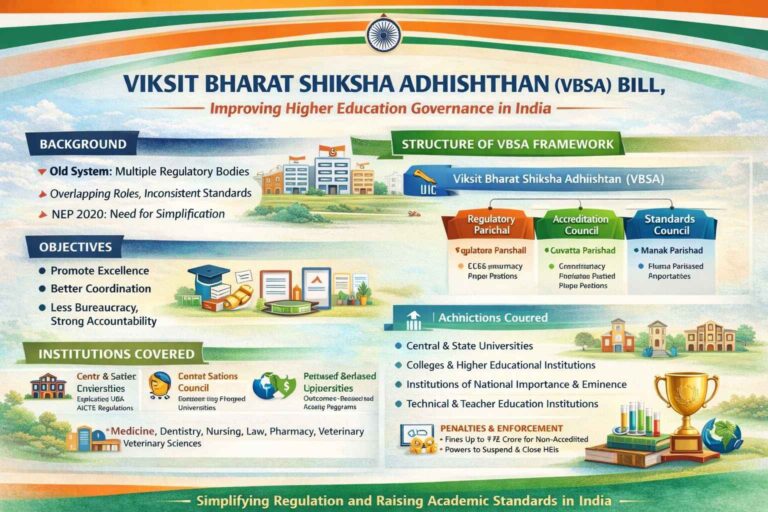
Institutions Covered
- Central and State universities
- Colleges and higher educational institutions
- Institutions of national importance and eminence
- Technical and teacher education institutions
Excluded programmes:
- Medicine, Dentistry, Nursing, Law, Pharmacy, Veterinary Sciences
- These will continue under existing professional regulators.
Key Reforms Proposed
- Replacement of UGC, AICTE, and NCTE with a unified regulatory framework
- Separation of funding from regulation:
- Grant allocation removed from UGC
- Funding to be routed through Ministry-approved mechanisms
- Clear norms for foreign universities entering India
- Support for Indian universities to establish offshore campuses
- Shift from input-based compliance to outcome-based accreditation
These reforms align India’s education governance with global best practices—an important GS-II dimension for aspirants in IAS Coaching in Hyderabad.
Penalties and Enforcement Mechanism
- Monetary penalties ranging from ₹10 lakh to ₹75 lakh
- Fines up to ₹2 crore for operating without accreditation
- Powers to:
- Suspend degree-granting authority
- Close institutions for repeated violations
This marks a move towards rule-based regulation with deterrence, rather than discretionary control.
Concerns and Criticism
- Possible over-centralisation of powers
- Reduced financial autonomy of universities
- Risk of excessive central influence in appointments
- However, inclusion of State representation addresses some federal concerns.
Conclusion
The VBSA Bill, 2025 represents a landmark reform aimed at simplifying regulation, improving academic quality, and aligning India’s higher education system with global standards, while operationalising the vision of NEP 2020. Its success will ultimately depend on balanced implementation that safeguards institutional autonomy, cooperative federalism, and academic freedom—a crucial analytical takeaway for UPSC aspirants preparing through platforms like the Best IAS Academy in Hyderabad.
This topic is available in detail on our main website.