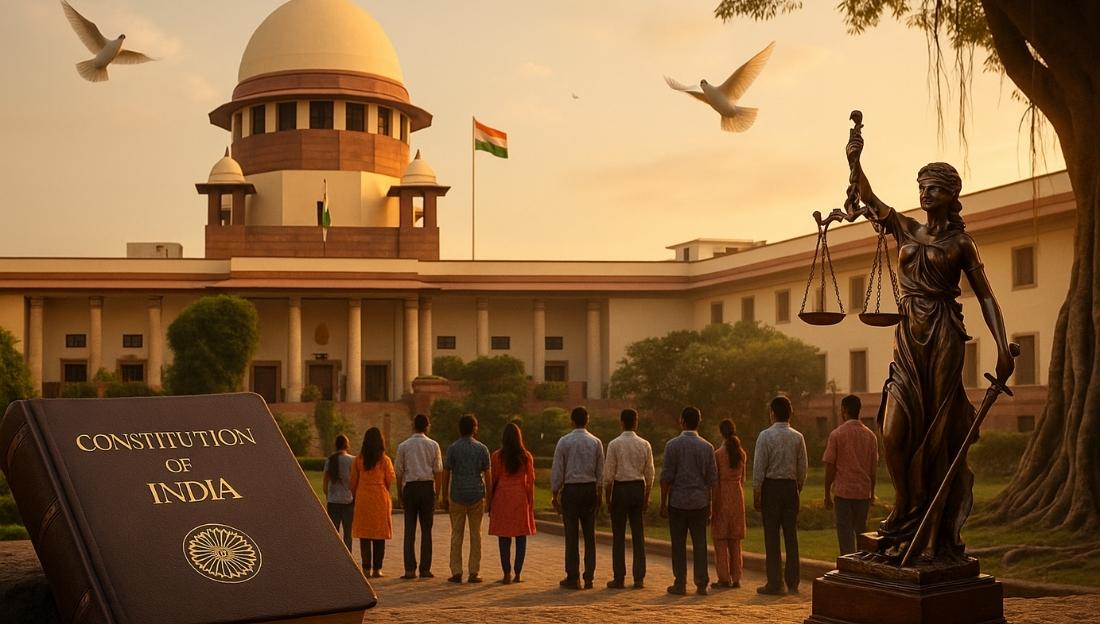

The Supreme Court raised concerns over an NCERT Class 8 textbook’s portrayal of the judiciary, suspended its use, and set up a new expert committee to review and decide appropriate content for students. Such constitutional and governance-related topics are important for aspirants preparing through IAS coaching in Hyderabad, UPSC online coaching, and other civil services preparation platforms.
Contempt of Court
• Civil Contempt: Disobedience of a court order.
• Criminal Contempt: Acts that obstruct justice, prejudice proceedings, or scandalize the court by lowering its authority.
• Purpose: Protects public confidence in the judiciary, not individual judges’ pride.
• Foundation of Judicial Power: Courts rely on public trust and goodwill, not force or money.
Understanding such constitutional provisions is essential for students preparing through UPSC coaching in Hyderabad and Hyderabad IAS coaching institutes, especially for GS Paper 2.
NCERT Class 8 Textbook
• Portrayal of Judicial Corruption: The chapter suggested that corruption was widespread in the judiciary, creating a perception that courts were deeply compromised. This depiction was seen as biased and irresponsible.
• Undermining Judicial Credibility: The content implied that judicial decisions were influenced by external pressures rather than law and justice, eroding public trust in the judiciary as an institution.
• Motivated Narrative: The Supreme Court observed that the material appeared to be motivated and reckless; NCERT later issued an unconditional apology and withdrew the textbook.
These issues are often analysed in IAS coaching and civils coaching in Hyderabad for better understanding of judiciary-related debates.
Criticism and Judicial Dignity
• Judges Accept Criticism: Many Chief Justices have acknowledged shortcomings and welcomed constructive critique.
• Caution in Using Contempt: CJI Gajendragadkar stressed restraint, fairness, and dignity in exercising contempt powers.
• Broad Shoulder Approach: CJI Bharucha noted courts should be strong enough to ignore harsh comments.
• Global Perspective: Lord Denning emphasized freedom of speech and fair comment; dignity rests on judicial conduct, not suppression of criticism.
Such perspectives are frequently discussed in UPSC online coaching and structured UPSC coaching in Hyderabad programs.
Limits of Criticism and Contempt of Court
• Fact-Based Criticism: Any criticism of the judiciary must be grounded in accurate facts and presented responsibly.
• Protection Against Malicious Attacks: Hostile or ill-motivated remarks aimed at eroding public trust in the judiciary can invite criminal contempt.
• Judicial Review and Public Faith: The judiciary’s strength lies in public confidence, which sustains its power of judicial review.
• Balancing Free Speech and Integrity: Courts must carefully balance freedom of expression and academic independence with the need to protect institutional dignity.
These concepts are important for aspirants studying through IAS coaching in Hyderabad and Hyderabad IAS coaching programs.
Way Forward
• Due Process: Authors could be given notice and chance to clarify before punitive action.
• Educational Role: Textbooks should highlight judiciary’s role in safeguarding fundamental rights and constitutional values.
• Judicial Challenges: Address corruption, infrastructure gaps, and delays to strengthen credibility.
• Reform Needed: Stronger mechanisms beyond impeachment or transfers to deal with judicial misconduct.
Such reforms are widely covered in IAS coaching and civils coaching in Hyderabad, helping aspirants write better UPSC answers.
Conclusion
The NCERT textbook controversy underscores the delicate balance between criticism and contempt. Courts must protect their authority while upholding free speech and academic freedom. For aspirants preparing through IAS coaching in Hyderabad, UPSC coaching in Hyderabad, and UPSC online coaching, such topics are crucial for understanding judiciary, governance, and constitutional values in UPSC.