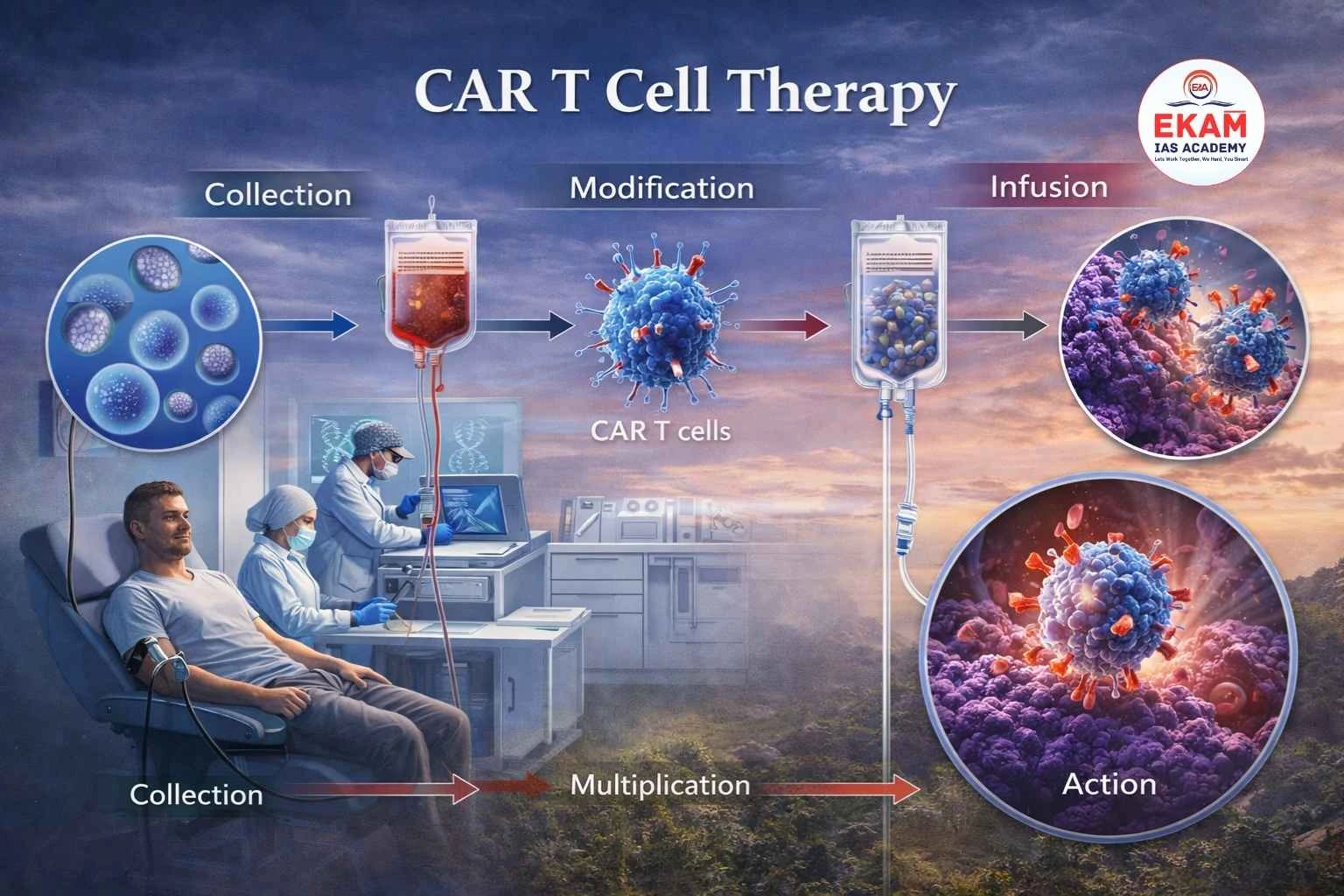

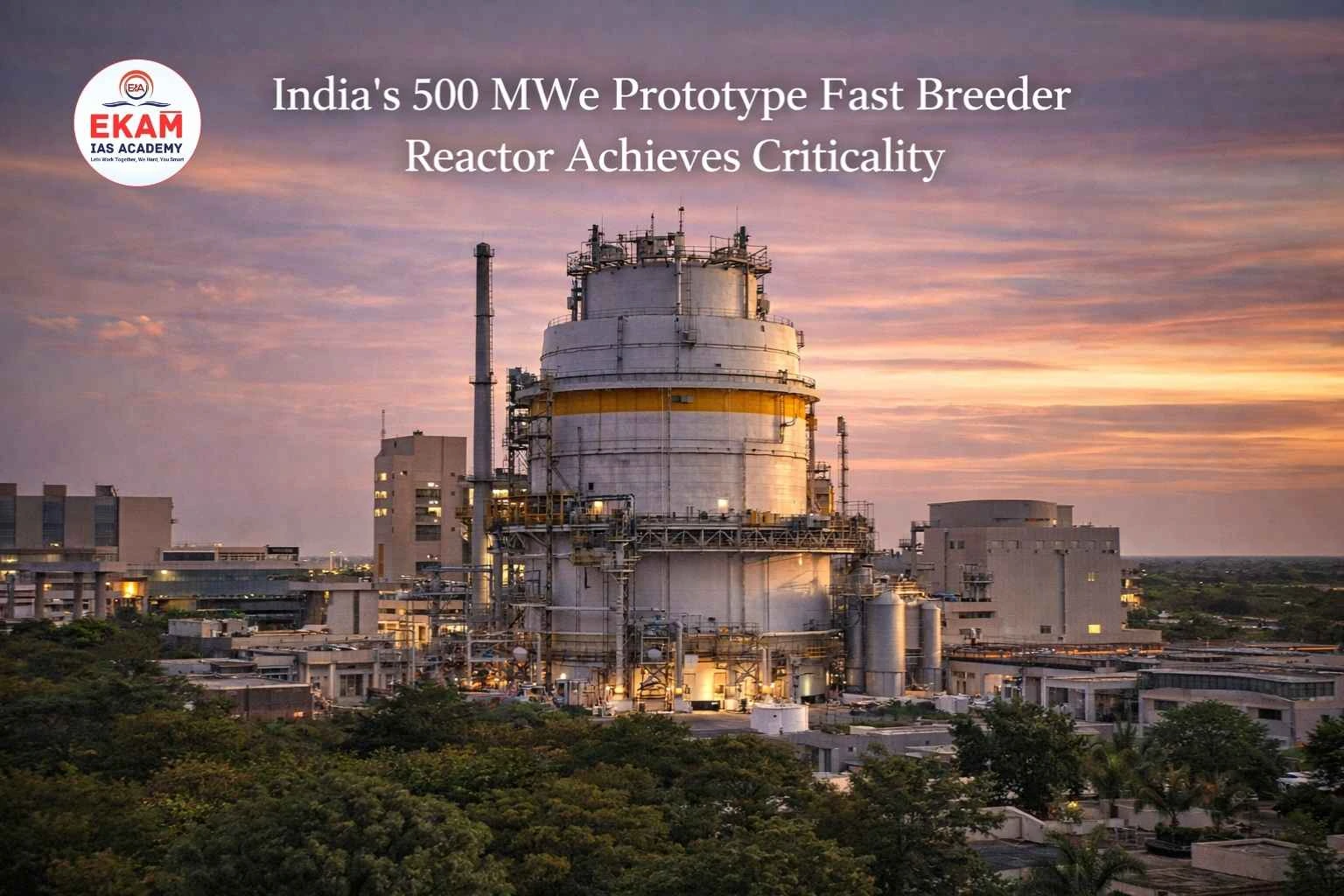
India’s 500 MWe Prototype Fast Breeder Reactor (PFBR) at Kalpakkam, Tamil Nadu, has achieved criticality, marking a major step in India’s nuclear energy programme. This development is highly relevant for aspirants preparing through IAS coaching in Hyderabad, UPSC online coaching, and other civil services platforms.
Fast Breeder Reactor (FBR)
• FBRs generate more fissile material than they consume.
• They use fast neutrons instead of slow (thermal) neutrons.
• Fuel: Mixed Oxide (MOX) – plutonium with uranium-238.
• “Breeding” process: Converts non-fissile uranium-238 into fissile plutonium-239.
• Crucial for India due to limited uranium reserves but abundant thorium resources.
• Forms the second stage of India’s three-stage nuclear programme.
These concepts are frequently covered in UPSC coaching in Hyderabad and Hyderabad IAS coaching for GS Paper 3 preparation.
Significance of FBRs
• Enhance fuel efficiency by maximising energy from uranium.
• Reduce nuclear waste by utilising otherwise unused materials.
• Enable conversion of thorium into uranium-233 for the third stage.
• Strengthen long-term energy security and reduce dependence on imported uranium.
Such topics are important for aspirants undergoing IAS coaching and civils coaching in Hyderabad.
Criticality in Nuclear Reactors
• Criticality = reactor achieves a self-sustaining chain reaction.
• States of criticality:
• Subcritical: Reaction dies out.
• Critical: Stable, self-sustaining reaction.
• Supercritical: Reaction grows rapidly.
• Achieving controlled criticality is a key commissioning milestone before power generation.
Understanding these scientific concepts is essential in UPSC online coaching and structured GS preparation.
India’s PFBR at Kalpakkam
• Located at Indira Gandhi Centre for Atomic Research (IGCAR).
• Operated by BHAVINI, under Department of Atomic Energy.
• Sodium-cooled, pool-type reactor using MOX fuel.
• Designed to produce more fissile material than consumed.
• Safety feature: Negative void coefficient – reduces reaction rate if overheating occurs.
• Positions India among select nations with advanced FBR technology (Russia being the other).
These developments are regularly discussed in IAS coaching in Hyderabad and UPSC coaching in Hyderabad classrooms.
India’s Three-Stage Nuclear Programme
• Stage 1: Pressurised Heavy Water Reactors (PHWRs) – produce plutonium.
• Stage 2: Fast Breeder Reactors (PFBR) – use plutonium to generate more fissile material.
• Stage 3: Thorium-based reactors – convert thorium into uranium-233 for sustainable energy.
This framework is a key topic in Hyderabad IAS coaching and UPSC online coaching modules.
Conclusion
The PFBR’s criticality achievement at Kalpakkam is a historic milestone in India’s nuclear journey. It strengthens India’s path toward a closed nuclear fuel cycle, enhances energy independence, and lays the foundation for a thorium-based future. For aspirants preparing through IAS coaching, UPSC coaching in Hyderabad, and civils coaching in Hyderabad, this topic holds high relevance for GS3 and interview preparation.
This topic is available in detail on our main website.