
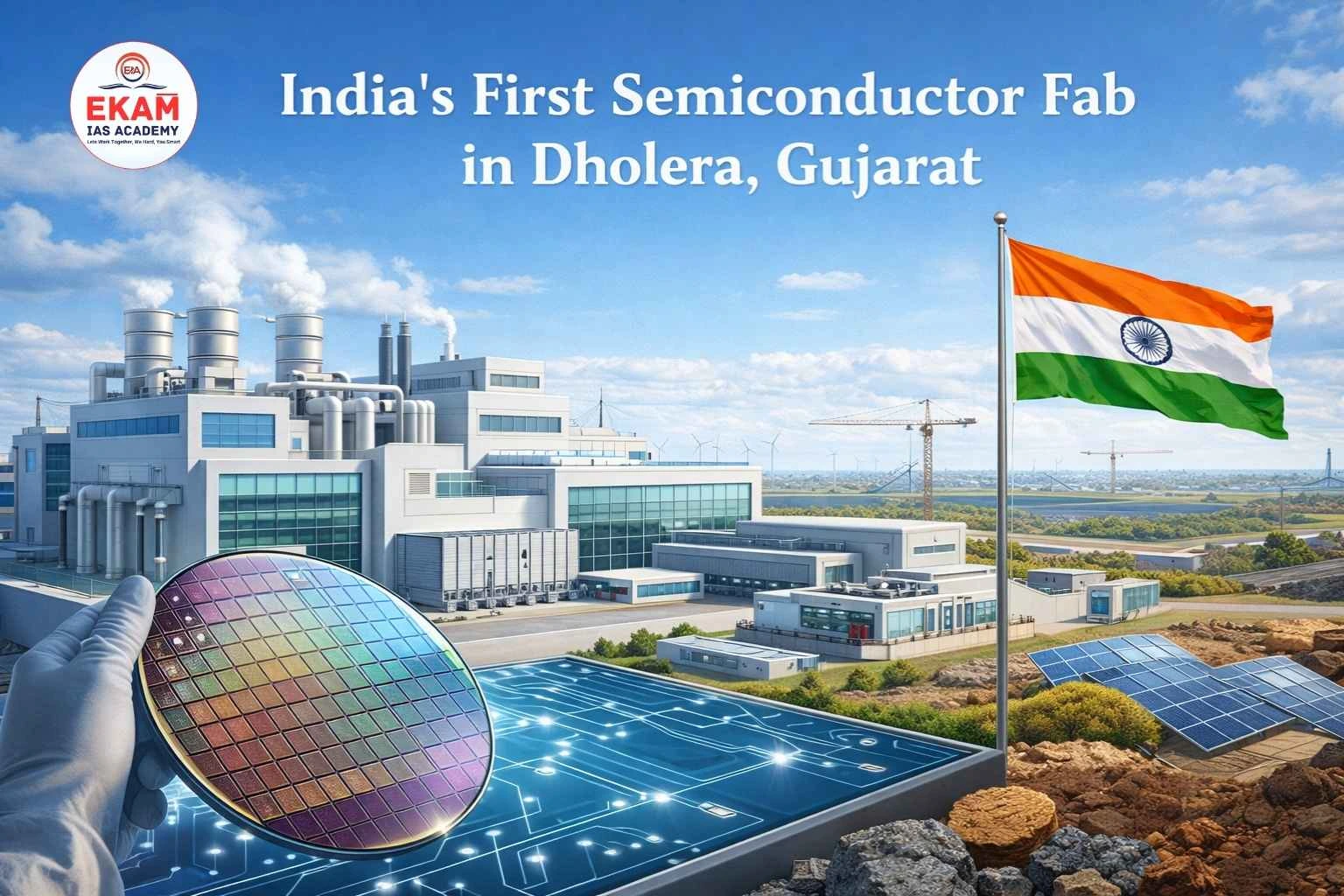
India has officially announced the establishment of its first semiconductor fabrication plant (fab) in a Special Economic Zone (SEZ) at Dholera, Gujarat, marking a milestone in the country’s electronics and IT manufacturing ecosystem. This development is highly relevant for aspirants preparing through IAS coaching in Hyderabad, UPSC coaching in Hyderabad, and UPSC online coaching.
About Semiconductor Fab
• A semiconductor fabrication plant (fab) is a highly advanced facility where microchips are produced on ultra pure silicon wafers.
• Processes like photolithography, doping, and metallization create billions of transistors that power devices from smartphones to AI systems.
• The Dholera SEZ is dedicated to Electronic Hardware, Software, IT/ITES, and is expected to generate 21,000 jobs.
Such emerging technology topics are extensively covered in Hyderabad IAS coaching and civils coaching in Hyderabad for GS3 Science & Technology.
Policy Reforms Enabling the Fab
• In June 2025, SEZ Rules (2006) were amended to attract capital intensive investments:
• Minimum land requirement reduced from 50 hectares to 10 hectares.
• Flexibility introduced in encumbrance norms.
• Free of cost supplies allowed in Net Foreign Exchange (NFE) calculations.
• Domestic sales permitted in the Domestic Tariff Area (DTA) with applicable duties.
These reforms are crucial topics in IAS coaching and UPSC online coaching for economic policy analysis.
Strategic Significance
• Part of India Semiconductor Mission 2.0, which aims to build a complete domestic ecosystem from chemicals and gases to chip making machinery.
• Reduces dependence on imports and strengthens supply chain resilience.
• Positions India as a globally competitive hub for semiconductor and electronics production.
• Expected to catalyze domestic value chains and generate high skilled employment.
Such strategic developments are frequently discussed in UPSC coaching in Hyderabad.
Challenges
• High Capital and Technology Requirements: Semiconductor fabs demand multi billion dollar investments, advanced machinery, and skilled manpower, which India is still developing.
• Supply Chain Dependence: Critical inputs like ultra pure chemicals, gases, and lithography equipment are largely imported, making India vulnerable to global disruptions.
• Global Competition and Geopolitics: Countries like Taiwan, South Korea, and the US dominate chip manufacturing, and India must compete while navigating geopolitical tensions in supply chains.
These analytical dimensions are important for aspirants in IAS coaching in Hyderabad.
Way Forward
• Strengthen Domestic Ecosystem: Build the entire value chain — from raw materials to advanced machinery — under the India Semiconductor Mission 2.0.
• Skill Development and R&D: Invest in training engineers, technicians, and researchers, while promoting innovation through partnerships with global leaders and academia.
• Policy Support and Incentives: Ensure long term financial incentives, infrastructure support, and ease of doing business to attract global chipmakers and sustain domestic fabs.
Conclusion
By building a domestic chip making ecosystem, India is moving closer to self reliance in critical technologies, reducing import dependence, and strengthening its role in the global electronics supply chain. For aspirants preparing through IAS coaching in Hyderabad, UPSC coaching in Hyderabad, and UPSC online coaching, this topic is crucial for GS3 economy and technology.
This topic is available in detail on our main website.