
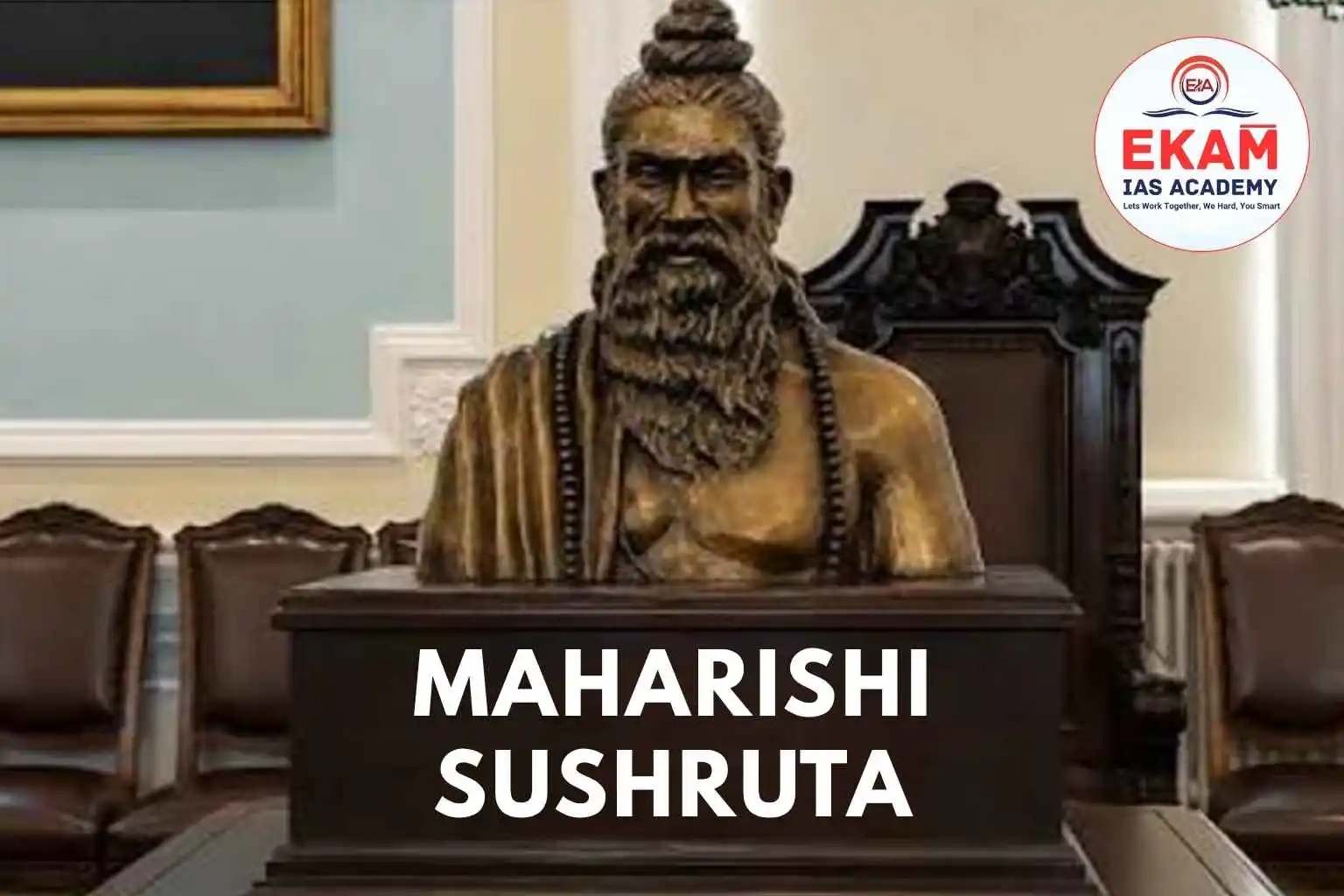
A bronze statue of Maharishi Sushruta, revered as the Father of Surgery, was recently unveiled at the Royal College of Surgeons of Edinburgh, UK, honouring his global legacy in medicine. This topic is important for aspirants preparing for GS1 Indian Art & Culture and medical heritage through UPSC Coaching in Hyderabad.
Life and Background
• Lived between 600–1000 BCE.
• Disciple of Lord Dhanvanthri, the deity of Ayurveda.
• Practised and taught medicine in Varanasi.
Contributions
• Authored the Sushruta Samhita — 184 chapters covering surgery, medicine, toxicology, pediatrics, and pharmacology.
• Listed 300+ surgical procedures and 120+ instruments.
• Detailed descriptions of wounds, fractures, dislocations, and treatments.
• Documented 100+ medicinal plants with properties and uses.
Surgical Innovations
• Rhinoplasty (nose reconstruction): Earliest record of cosmetic surgery.
• Lithotomy: Removal of bladder stones.
• Obstetric procedures — including removal of dead fetus.
• Introduced cadaver dissection for anatomy study.
• Advocated herbal anaesthetics and post-operative care.
Global Influence
• His methods shaped reconstructive surgery, orthopaedics, ophthalmology worldwide.
• Standards of documentation, training, and practical experience continue to guide modern surgical education.
• UNESCO and WHO recognise Ayurveda’s contributions, with Sushruta as a central figure.
Conclusion
Maharishi Sushruta’s pioneering work laid the foundation of surgical science, making him a timeless icon of India’s medical heritage.