
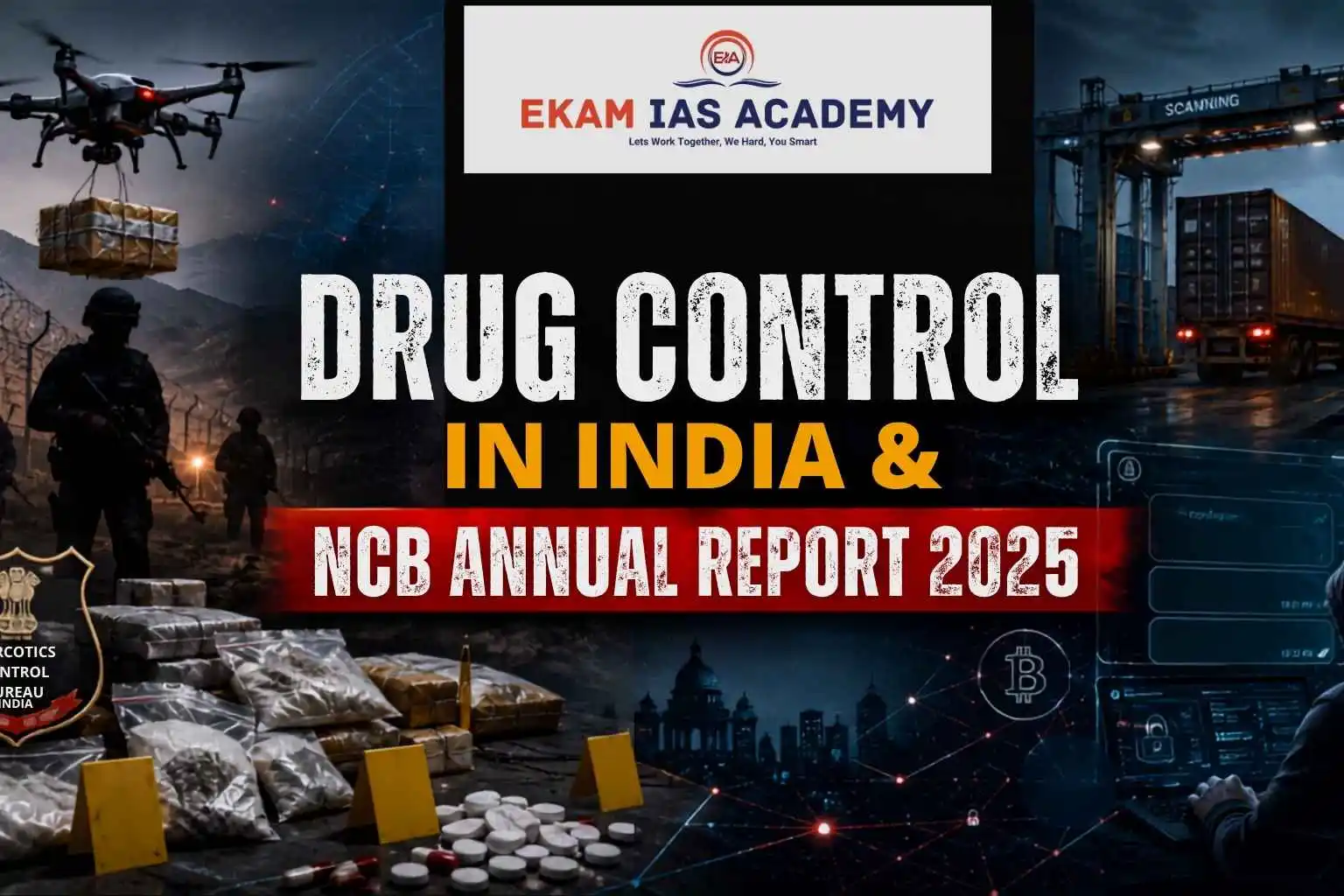
Union Home Minister Amit Shah released the Vision Document on Drug Control (2026–2029) and the NCB Annual Report 2025 at the 10th Apex Level NCORD meeting, outlining India’s new anti-drug strategy and highlighting the scale of the narcotics threat. This topic is important for aspirants preparing for GS2 Polity and national security-related issues through UPSC Coaching in Hyderabad.
Vision Document 2026–2029
• Foundation: Built on detect, disrupt, destroy.
• Network Focus: Shift from chasing carriers to dismantling cartels, financiers, handlers, and facilitators.
• Mission Mode: Targeting 100 major interstate and transnational cartels through intelligence-driven operations.
• Whole of Government: Over 40 ministries, states, districts, civil society, and citizens under one framework.
Commitments
• Legal Reform: Amend NDPS Act & Rules to close loopholes; adopt reformative approach for addicts.
• Speedy Justice: Exclusive NDPS courts for faster convictions.
• Financial Probe: Mandatory financial investigations; use PITNDPS Act to attach assets.
• Global Reach: Pursue traffickers abroad via Red Corner Notices.
• Technology: AI profiling, anti-drone systems, container scanning.
• Synthetic Drugs: Focus on methamphetamine, mephedrone; tighter precursor controls.
NCB Annual Report 2025 Highlights
• Scale: 1.48 lakh cases; 1,200+ tonnes seized (plant-based, synthetic, diverted pharma, precursors).
• Supply Shift: Myanmar overtakes Afghanistan as India’s main opium source.
Eastern Front
- Manipur corridor (NH 102) → heroin & meth tablets.
- Champhai corridor (Mizoram) → routes via Aizawl to Assam’s Barak Valley.
- Linked to arms smuggling & insurgent financing.
Western Front
- Drone smuggling in Punjab rose 100-fold (2021–2025).
- Afghan stockpiles still feed routes via Punjab, Rajasthan, Gujarat coasts.
Digital Trafficking: Telegram, WhatsApp, Signal used for advertising & crypto payments.
Emerging Threats
- Nitazenes (synthetic opioids, 500× stronger than heroin).
- Nexus of trafficking with organised violence.
Comparative & Policy Dimensions
• Global Context: Golden Triangle (Myanmar) now a poly-drug hub; mirrors UNODC findings.
• Domestic Policy: Aligns with National Policy on Narcotic Drugs (MoRTH, MHA) and Digital India surveillance initiatives.
• Security Angle: Drug trade linked to terror financing and insurgency in border states.
• Societal Impact: NDPS reforms aim at rehabilitation over punishment for addicts, echoing WHO and UNODC recommendations.
Conclusion
India’s new drug control vision marks a shift from piecemeal enforcement to systemic dismantling of cartels, combining law, technology, and global cooperation to secure both society and national security.