


The Indian rupee has fallen to record lows against the US dollar, raising concerns about trade balance, inflation, and import costs. The Reserve Bank of India (RBI) data highlights the impact of currency depreciation on imports, especially crude oil purchases, and overall foreign exchange trends. This topic is important for aspirants preparing for GS3 Economy and current affairs through upsc online coaching.
Background
- Currency depreciation occurs when the value of the rupee declines compared to foreign currencies, mainly the US dollar.
- India’s dependence on imports, particularly oil and gold, makes the economy sensitive to exchange rate fluctuations.
- Past episodes like the 1991 Balance of Payments crisis and 2013 taper tantrum showed similar vulnerabilities.
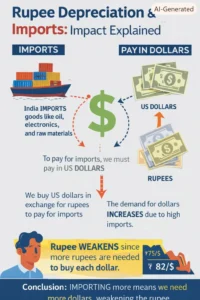
Economic Impact
- Import Costs Rise: Oil, machinery, and electronics become more expensive, widening the current account deficit.
- Inflationary Pressure: Higher import bills push up domestic prices, affecting households.
- Trade Balance: Exporters may benefit from cheaper rupee, but gains are offset by rising import costs.
- Corporate Debt: Firms with foreign borrowings face higher repayment burdens.
- Data: India imports nearly 85% of crude oil needs, making rupee weakness a direct inflation driver (Ministry of Petroleum, 2025).
Policy Response
- RBI Intervention: Uses foreign exchange reserves to stabilize the rupee.
- Monetary Measures: Adjusts interest rates to control inflation and capital flows.
- Government Strategy: Encourages local manufacturing under Make in India and PLI schemes to reduce import dependence.
- Example: RBI’s forex reserves of $650 billion (2026) act as a buffer against volatility.
Global Dimensions
- US Dollar Strength: Global investors shift to dollar assets during uncertainty, weakening emerging market currencies.
- Russia Factor: India’s discounted oil imports from Russia face payment challenges due to exchange rate volatility.
- China & Trade: Competition with China in exports adds pressure on India’s trade competitiveness.
- WTO Note: Global trade tensions and tariff wars have increased currency volatility worldwide.
Way Forward
- Diversify energy sources and invest in renewables to reduce oil dependency.
- Strengthen domestic manufacturing to cut reliance on imports.
- Enhance export competitiveness through technology and skill development.
- Build stronger regional currency cooperation in South Asia to reduce dollar reliance.
Conclusion
The rupee’s depreciation highlights India’s need for resilient economic policies, reduced import dependence, and stronger global trade positioning to safeguard stability.



One thought on “Depreciation Of Indian Rupee”