

World Food Day 2026, observed on October 16, highlights the theme “Innovate Today, Nourish Tomorrow”, emphasising innovation for sustainable Food Security in India and Climate-Resilient Agriculture.
Understanding Food Security
- Meaning: According to FAO, food security exists when everyone has reliable access to sufficient, safe and nutritious food.
- Four pillars: Availability, accessibility, utilisation and stability.
- Global challenges: Climate change, conflicts, inflation and supply-chain disruptions threaten Food Security and Climate Change.
- SDG 2: Aims to achieve Zero Hunger by 2030.
India's Journey Towards Food Security
- Green Revolution: High-yielding seeds, irrigation and price support increased foodgrain production and strengthened Food Grain Production in India.
- Agricultural diversification: India became a major producer of milk, pulses, fruits and vegetables.
- National Food Security Act, 2013: Provides foodgrain entitlements to up to 75% of rural and 50% of urban populations.
- PMGKAY: Provides free foodgrains to approximately 81 crore beneficiaries, with the current extension covering five years from January 2024.
- One Nation One Ration Card: Enables migrant beneficiaries to access ration entitlements across States.
Role of Innovation in Food Security
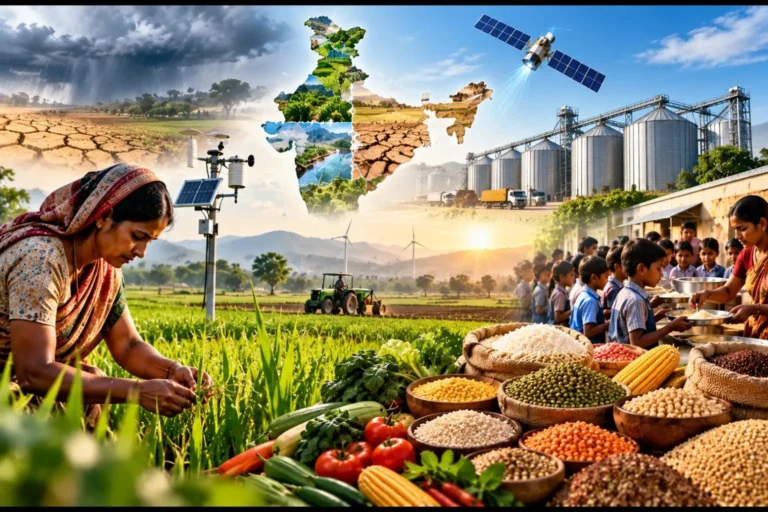
- Digital agriculture: Weather information, satellite monitoring and mobile advisories improve farm decisions.
- Climate-resilient crops: Drought-tolerant varieties reduce production risks and support Agricultural Resilience to Climate Change.
- Biofortification: Nutrient-enriched crops help address micronutrient deficiencies.
- Precision farming: Efficient irrigation and fertiliser application conserve resources.
- Food-loss reduction: Better storage, cold chains and processing minimise post-harvest losses.
- Digital PDS: Electronic records and supply-chain monitoring improve transparency.
Role of International Organisations
- FAO: Supports digital farming, livestock management and food-loss reduction through technical assistance.
- IFAD: Promotes smallholder financing, market access and agricultural infrastructure.
- WFP: Supports efficient food distribution through innovations such as Grain ATMs and logistics improvements.
- Global relevance: India’s experience offers adaptable solutions for developing countries facing resource constraints and Food Security Challenges India.
Challenges
- Malnutrition: Foodgrain availability does not automatically ensure balanced diets.
- Climate vulnerability: Irregular rainfall and extreme temperatures threaten agricultural productivity, highlighting Climate Change and Crop Production concerns.
- Small landholdings: Limit mechanisation, investment and economies of scale.
- Food inflation: Reduces poor households’ purchasing power.
- Gender inequality: Women farmers often face unequal access to land, credit and technology.
Government Initiatives
- POSHAN Abhiyaan: Addresses malnutrition among children, women and adolescents.
- PM POSHAN: Supports schoolchildren’s nutritional needs.
- Digital Agriculture Mission: Promotes technology-enabled agricultural services.
- PM-KUSUM: Encourages solar energy use in agriculture.
- International Year of Millets 2023: Promoted nutritious and climate-resilient crops.
Way Forward
- Diversify food baskets towards pulses, millets and nutrient-rich foods.
- Expand Climate-Smart Agriculture India and affordable technologies.
- Strengthen farmer-producer organisations and women’s access to finance.
- Reduce food waste through modern storage and processing.
- Integrate nutrition outcomes into agricultural and welfare policies while promoting Sustainable Agriculture in India, Agricultural Adaptation to Climate Change and Climate-Resilient Farming Practices.
Conclusion
India’s next food-security revolution must move beyond producing enough food towards ensuring nutritious, affordable and climate-resilient diets for every citizen. Strengthening National Mission for Sustainable Agriculture, Agricultural Sustainability UPSC, Food Security UPSC and Agriculture and Environment UPSC approaches can help build a more resilient food system.