
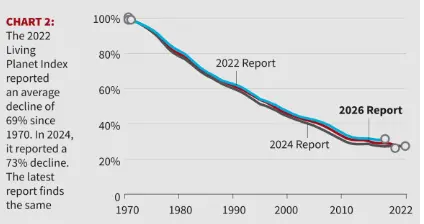
The WWF Living Planet Report 2026 and Living Planet Index 2026 highlight an average 73% decline in monitored wildlife populations between 1970 and 2022. The report highlights the growing challenge of Global Wildlife Population Decline and Global Biodiversity Loss.
What is the Living Planet Index (LPI)?
- Published by: WWF, using scientific data compiled by the Zoological Society of London (ZSL) and its partners. The findings form an important part of the WWF Biodiversity Report 2026.
- Objective: Measures changes in the relative abundance of monitored vertebrate wildlife populations over time.
- Coverage: Includes mammals, birds, reptiles, amphibians and freshwater and marine fish.
- Methodology: Uses population trends and a weighted geometric mean to calculate the overall index.
- Significance: Helps assess biodiversity trends and guide conservation priorities, making the Living Planet Index 2026 an important indicator for understanding Global Wildlife Conservation.
Key Findings of the 2026 Report
- Average decline: Monitored wildlife populations recorded an average 73% reduction in the index compared with the 1970 baseline, highlighting Wildlife Population Decline 2026.
- Population trends: Among the studied populations:
- 50% showed declining trends.
- 43% recorded increasing trends.
- 7% remained relatively stable.
- Regional differences: Latin America and the Caribbean experienced the steepest decline (95%), followed by Africa (80%), Asia (49%) and Europe (23%).
- Important clarification: A 73% index decline does not mean 73% of animals have disappeared or 73% of species have become extinct. The Living Planet Report measures changes in monitored population abundance rather than total numbers of animals or species extinctions.
Major Causes of Wildlife Decline
- Habitat destruction: Deforestation, agricultural expansion, mining and urbanisation reduce natural habitats and contribute to Habitat Loss and Degradation.
- Overexploitation: Illegal hunting, overfishing and wildlife trafficking threaten species survival.
- Climate change: Rising temperatures and extreme weather disrupt ecosystems and breeding patterns, demonstrating the link between Climate Change and Biodiversity Loss.
- Pollution: Pesticides, plastics and industrial waste damage terrestrial and aquatic biodiversity.
- Invasive species: Non-native organisms compete with indigenous species for food and habitat.
Limitations of the Living Planet Index
- Limited coverage: Excludes plants and invertebrates from the global index.
- Data gaps: Remote regions and poorly studied species may be underrepresented.
- Changing datasets: New populations and species are added, making direct comparisons between different report editions misleading.
- Statistical variation: Severe losses in some populations can strongly influence the global average.
India's Biodiversity Conservation Efforts
- Wildlife (Protection) Act, 1972: Provides legal protection to wild animals and regulates hunting and wildlife trade.
- Project Tiger and Project Elephant: Support habitat conservation and protection of flagship species, contributing to Wildlife Conservation in India.
Way Forward
- Habitat restoration: Restore degraded forests, wetlands, grasslands and wildlife corridors.
- Scientific monitoring: Expand biodiversity surveys using camera traps, satellite technology and environmental DNA.
- Community participation: Strengthen local conservation initiatives and provide sustainable livelihood opportunities.
- Sustainable development: Integrate biodiversity safeguards into agriculture, infrastructure and urban planning.
- Targeted conservation: Prioritise species and ecosystems facing the most severe population declines, including areas affected by Freshwater Biodiversity Decline.
Conclusion
Biodiversity conservation must move beyond alarming global statistics towards science-based, community-driven action that protects threatened wildlife and restores ecological balance. The WWF Living Planet Report 2026, Living Planet Report 2026 UPSC, Biodiversity Conservation UPSC and Environment and Ecology UPSC perspectives highlight the need for stronger Global Wildlife Conservation and effective responses to Global Biodiversity Loss.