
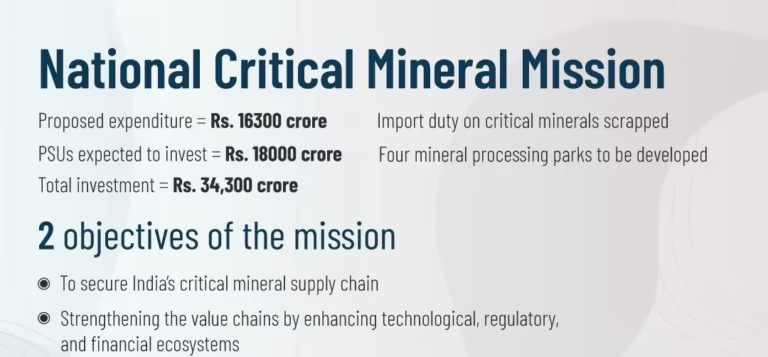
The Union Cabinet recently approved a ₹7,280 crore rare-earth magnet programme to strengthen India’s supply chain.
Critical Minerals
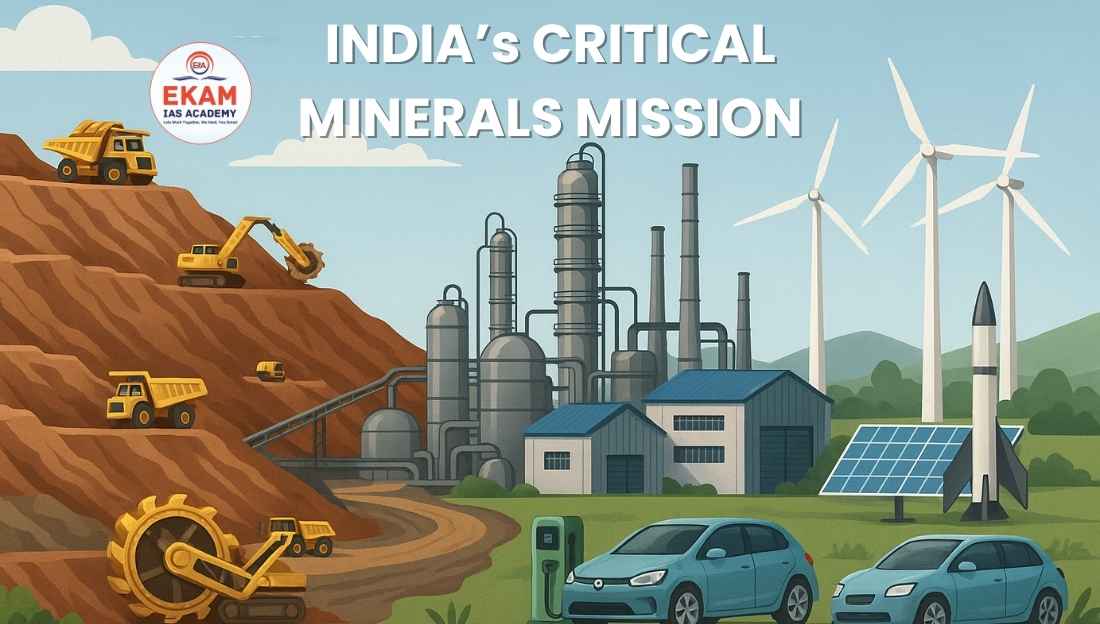
- Critical minerals are raw materials necessary for defence, clean energy, electronics and communication systems.
- They are used in electric vehicles, solar panels, wind turbines, semiconductors and missiles.
- Countries that control these minerals also influence technology leadership and national security.
Present Status of India
- India has introduced reforms to increase domestic mining activities. However, the country lacks sufficient refining and purification facilities.
- India imports almost all of its lithium, cobalt and nickel. Advanced industries still depend on foreign suppliers for high-grade minerals.
Global Scenario and Risks
- Global refining is controlled by very few countries.
- Recent export restrictions show how fragile mineral supply chains are.
- Processing is the weakest and most sensitive stage in mineral security.
Why Mining Alone Is Not Enough
- Mining gives raw ore but not usable materials. Processing creates high-value industrial inputs.
- Without refining capacity, India exports minerals cheaply and imports finished products at high cost.
Roadmap for Strengthening Processing Capacity
- Research and Innovation: Centres of Excellence must focus on industry-ready technology. Universities and research labs should work on low-cost refining techniques.
- Resource Recovery: Coal ash, steel slag and industrial waste contain valuable minerals. Recycling should be integrated into mineral processing parks.
- Skill Development: India needs trained metallurgists and technicians. New courses and training programmes must be started.
- Financial Support: Government should guarantee mineral purchases by public sector industries. Stockpiling can reduce price shocks and investor risk.
- Strategic Diplomacy: International partnerships should focus on joint refining projects. Industrial parks can attract foreign technology and capital.
Strategic Partnerships and Agreements
- Quad Critical Minerals Initiative: Supply chain cooperation with USA, Japan, and Australia.
- Mineral Security Partnership (MSP): India collaborates with advanced economies for stable mineral access.
- Indian Public Sector Abroad: KABIL invests in lithium and cobalt mines abroad. National Mineral Development Corporation (NMDC) active overseas.
SOURCES OF CRITICAL MINERALS
Domestic Sources (Within India)
Lithium
- Found in Reasi (Jammu & Kashmir) – India’s first major lithium reserve identified.
- Smaller deposits in Karnataka and Rajasthan.
Cobalt
- Located in Odisha (Sukinda belt).
- Also found in Jharkhand and Rajasthan.
Nickel
- Available in Odisha and parts of Nagaland.
- Mostly extracted as a by-product of other mining.
Rare Earth Elements (REEs)
- Found in Beach sands of Kerala, Tamil Nadu, Andhra Pradesh, and Odisha.
- Contain monazite and ilmenite minerals.
Conclusion
The true strength of India’s mineral mission lies in processing, not just extraction. Refining will secure clean energy goals and reduce import dependence. India must move up the mineral value chain to secure its economic future.
This topic is available in detail on our main website.