

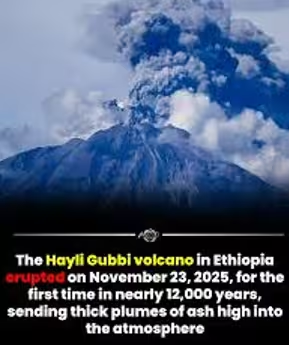
The Hayli Gubbi volcano erupted in Ethiopia on November 23, 2025, after millennia of dormancy. The Director General of Civil Aviation (DGCA) in India directed airlines to avoid ash-affected airspace and conduct safety checks.
The Eruption and Ash Movement
- “After lying dormant for nearly 12,000 years, the Hayli Gubbi volcano erupted, hurling massive ash plumes soaring 14–15 km into the atmosphere.”
- Winds carried ash across the Red Sea, Middle East, Iran, and into India’s western airspace on November 24.
- The plume moved at 100–120 km/h at altitudes of 15,000–25,000 ft, crossing Rajasthan, Gujarat, Delhi-NCR, Punjab, and Uttar Pradesh before drifting into China.
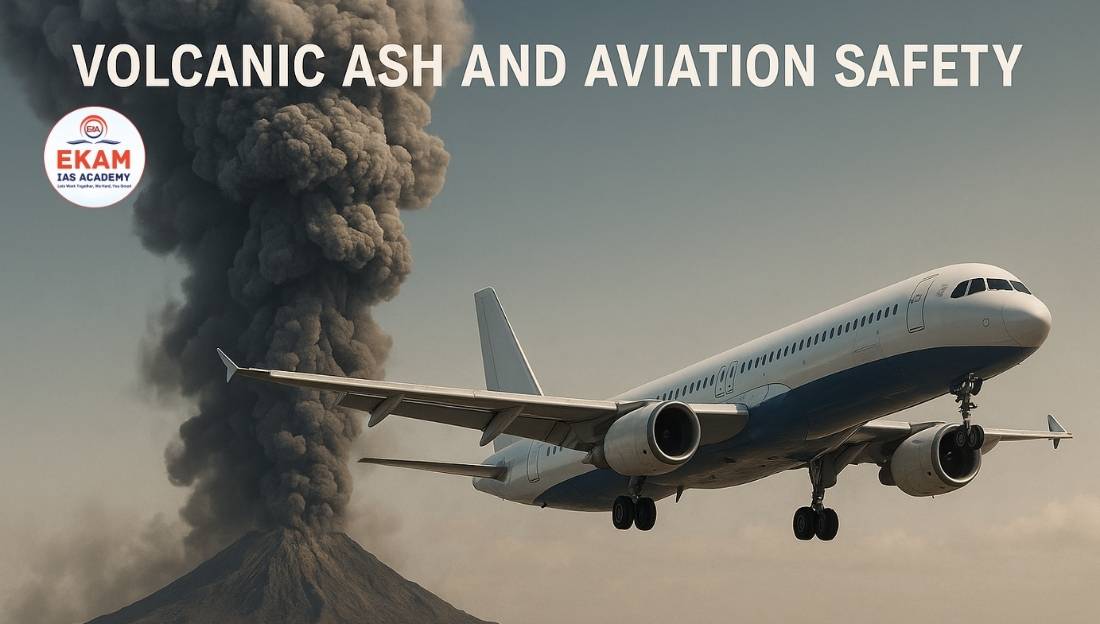
Why Volcanic Ash is Dangerous for Aircraft
- What Ash Is Made Of Volcanic ash is not soft dust. It contains tiny particles of rock, minerals, and volcanic glass (silica).
- Effect on Jet Engines: Engines run at very high heat (~1,600°C). Ash melts inside, turns into glassy deposits, blocks cooling holes, and can cause engine failure or shutdown.
- Damage to Aircraft Surfaces: Sharp ash particles can scratch windscreens, reducing pilot visibility. They also erode the aircraft’s body and wings over time.
- Impact on Systems and Cabin: Ash can block sensors and navigation instruments, affecting flight safety. Inside the cabin, passengers may notice a sulphur-like smell due to gases mixed with ash.
DGCA Orders and Institutional Response
- Airlines instructed to avoid affected zones and altitudes.
- Mandatory engine and surface inspections for ash contamination.
- Pilots told to report smoke, odour, or unusual engine behaviour.
- Airports ordered to check runways for ash deposits and suspend operations if unsafe.
- Airlines like Air India and Akasa cancelled multiple flights from Dubai, Doha, Dammam, Jeddah, Kuwait, and Abu Dhabi.
- International coordination: Volcanic Ash Advisory Centres (VAACs) and ICAO advisories supported DGCA’s actions.
Past Incidents Showing Real Danger
- 1982: British Airways Boeing 747 lost all four engines after flying through ash near Jakarta; engines restarted after descent.
- 1989: KLM Boeing 747-400 hit ash from Mount Redoubt, Alaska; all engines shut down at 24,000 ft, later restarted, but engines were destroyed.
- These cases highlight how ash clouds can cause near-catastrophic failures.
Institutional Framework
- ICAO (International Civil Aviation Organization): Issues global rules for volcanic ash zones.
- VAACs (Volcanic Ash Advisory Centres): Track ash movement worldwide using satellites and meteorological data.
- DGCA (India): Implements advisories, flight rerouting, and operational checks.
- Airports Authority of India (AAI): Released ASHTAM (Aeronautical Special Notice to Airmen) for ash alerts.
Conclusion
Volcanic eruptions are global aviation safety hazards, not just local events. The Hayli Gubbi eruption shows how ash clouds can travel thousands of kilometres, affecting India’s skies. Timely DGCA advisories, ICAO coordination, and airline precautions ensured passenger safety.
This topic is available in detail on our main website.