
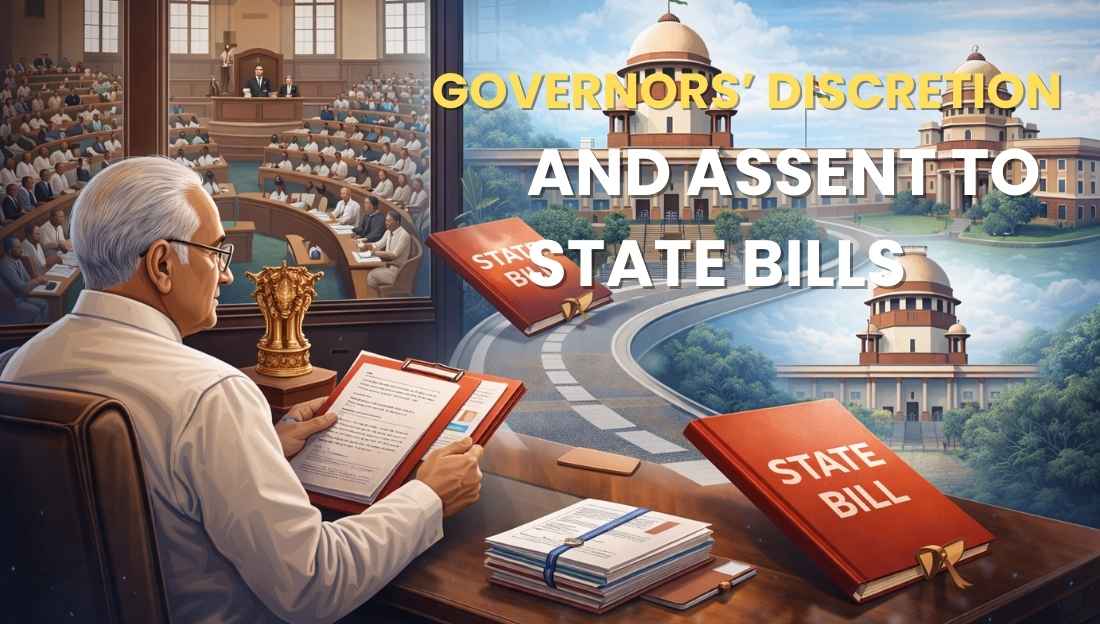
In 2025, the Supreme Court delivered an advisory opinion on a Presidential Reference (Special Reference No. 1 of 2025) that significantly altered the evolving jurisprudence on Governors’ powers under Article 200 of the Constitution. The opinion diluted the timelines earlier fixed for Governors to act on State Bills, reopening debates on federalism, democratic accountability, and constitutional morality—issues frequently analysed in advanced polity classes at institutions offering UPSC Coaching in Hyderabad
Governor’s Assent to State Bills
Under Article 200, when a Bill is presented after being passed by the State Legislature, the Governor may:
- Give assent
- Withhold assent
- Return the Bill for reconsideration (except Money Bills)
- Reserve the Bill for the consideration of the President
In recent years, several Opposition-ruled States alleged that Governors were indefinitely delaying assent, leading to policy paralysis and legislative stagnation. This controversy has become a recurring case study for aspirants preparing through a IAS Coaching in Hyderabad
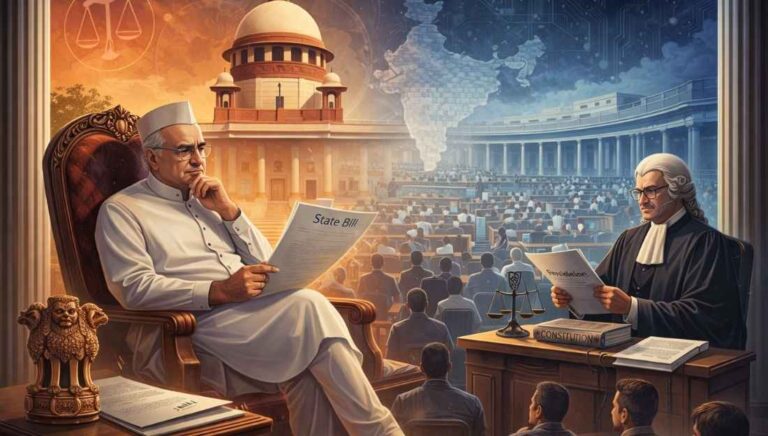
April 2025 Judgment: State of Tamil Nadu vs Governor
In April 2025, the Supreme Court attempted to curb this problem by laying down judicially enforceable principles:
- Fixed clear timelines for Governors to act on Bills
- Held that unexplained delay could invite judicial scrutiny
- Introduced the concept of “deemed assent” if constitutional timelines were violated
Significance of the Judgment
- Reinforced legislative supremacy of elected Assemblies
- Prevented obstructionist use of Raj Bhavan powers
- Strengthened cooperative federalism
This ruling was widely welcomed in academic discussions within Top UPSC Coaching in Hyderabad as a step towards constitutional accountability.
Special Reference No. 1 of 2025: A Course Correction
On a Presidential Reference under Article 143, a Constitution Bench revisited the issue and rolled back key aspects of the April judgment:
- Held that there is no constitutional basis for courts to impose timelines on Governors
- Rejected the doctrine of deemed assent, stating it is not envisaged by the Constitution
- Affirmed that Governors and the President enjoy wide discretionary space under Articles 200 and 201
Although advisory in nature, such opinions carry high persuasive value and shape future constitutional practice—an important nuance stressed in Civil Services Coaching in Hyderabad.
Issue of “Constitutional Dialogue”
The Court characterised Article 200 as enabling a “constitutional dialogue” between the Legislature and the Governor.
Criticism:
A dialogue requires timely response, not prolonged silence. Critics argue that Governors have transformed silence into a political instrument, and the advisory opinion legitimises motivated inaction, leaving courts with the limited power to merely direct that a decision be taken.
This tension between constitutional theory and political practice is a recurring analytical theme in Best IAS Coaching Institute Hyderabad.
Reconsidered Bills and President’s Reference
Earlier understanding:
If a Bill returned by the Governor is re-passed by the State Legislature, the Governor is constitutionally bound to grant assent.
New interpretation:
The advisory opinion allows the Governor to still reserve the Bill for the President, even after reconsideration.
Concern:
This creates a constitutional vacuum where Bills may be stalled indefinitely, undermining the authority of elected legislatures—an issue critically examined in UPSC Foundation Course Coaching in Hyderabad.
Checks and Balances: A False Equivalence
The Court justified expansive discretion as a constitutional safeguard.
Counter-argument:
- Courts already exercise judicial review over unconstitutional laws
- Governor’s assent is a procedural requirement, not a substitute for pre-legislative judicial scrutiny
- Excessive discretion transforms the Governor into a dominant veto authority, upsetting the balance
This argument aligns with the Sarkaria Commission’s caution against unilateral use of gubernatorial powers, a topic often discussed in UPSC Prelims cum Mains Course Hyderabad.
Federalism and Democratic Concerns
Governors are:
- Unelected constitutional authorities
- Appointed by the Union Government
- Function as a constitutional bridge—but increasingly perceived as Union representatives
Expanded discretion risks:
- Central overreach
- Weakening of State autonomy
- Erosion of cooperative federalism
The Court missed an opportunity to subject reservation of Bills for the President to limited judicial scrutiny, despite earlier expert recommendations—an omission frequently debated in UPSC Online Coaching Hyderabad.
Conclusion
The 2025 advisory opinion marks a retreat from judicial restraint on gubernatorial power. By weakening clarity and rejecting enforceable timelines, it revives constitutional uncertainty and risks deepening Centre–State tensions. For UPSC aspirants analysing constitutional morality, federal balance, and democratic accountability through platforms like the Best IAS Academy in Hyderabad, this development represents a critical contemporary case study with long-term implications.
This topic is available in detail on our main website.