

The Viksit Bharat – Guarantee for Rozgar and Ajeevika Mission (Gramin) Act, 2025 has received Presidential assent, formally replacing the Mahatma Gandhi National Rural Employment Guarantee Act (MGNREGA), 2005. This development marks a significant shift in India’s rural employment policy framework and has become a key topic of analysis in governance and social justice discussions, particularly for aspirants preparing through UPSC coaching in Hyderabad.
Background
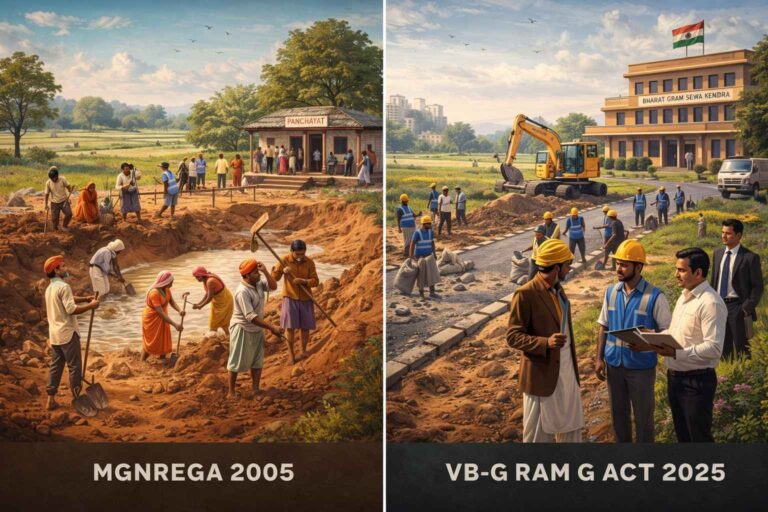
- MGNREGA (2005): Guaranteed 100 days of wage employment per rural household, demand-driven, rights-based, and implemented through Panchayati Raj institutions.
- VB-G RAM G Act (2025): Introduced to align rural employment with the national vision of Viksit Bharat @2047, promising modernization and convergence with other development schemes.
Features of VB-G RAM G Act
- Guaranteed Work: 125 days of wage employment per household annually (up from 100 days under MGNREGA).
- Funding Model: Centre-State cost sharing at 60:40, unlike MGNREGA where the Centre bore 90% of costs.
- Normative Allocation: Funds distributed based on “objective parameters” decided by the Union government, making it command-driven rather than demand-driven.
- Seasonal Restriction: No employment for 60 days during peak agricultural season, potentially worsening inequalities.
- Planning: Introduction of Viksit Gram Panchayat Plans for decentralized planning, but with strong central oversight.
- Employment Days Reality: While 125 days are promised, past funding constraints meant households averaged only ~50 days of work annually, raising doubts about feasibility.
Achievements of MGNREGA
- Increased rural incomes and reduced poverty.
- Women’s participation consistently above 55%, promoting gender parity.
- Reduced reliance on moneylenders by 21%.
- Created durable assets like water conservation structures.
- Strengthened Panchayati Raj institutions and local governance.
- Recognized globally as a “stellar example” of rural development by the World Bank in 2014.
Concerns with VB-G RAM G Act
- Dilution of Rights: MGNREGA guaranteed work as a legal right; VB-G RAM G shifts to a centrally sponsored scheme.
- Reduced Local Autonomy: Panchayats lose control over planning and implementation.
- Financial Burden on States: States must bear 40% of costs, limiting their ability to meet demand.
- Risk of Political Bias: Normative allocation may lead to favoritism in fund distribution.
- Exclusionary Clauses: Seasonal restrictions deny work when rural households most need income.
- Corruption Risks: No new safeguards against leakages or misuse of funds.
Conclusion
The VB-G RAM G Act, 2025 promises modernization and increased workdays but undermines the rights-based, demand-driven nature of MGNREGA. By shifting financial responsibility to states and centralizing control, it risks weakening rural livelihood security and eroding local governance.
This topic is available in detail on our main website.